
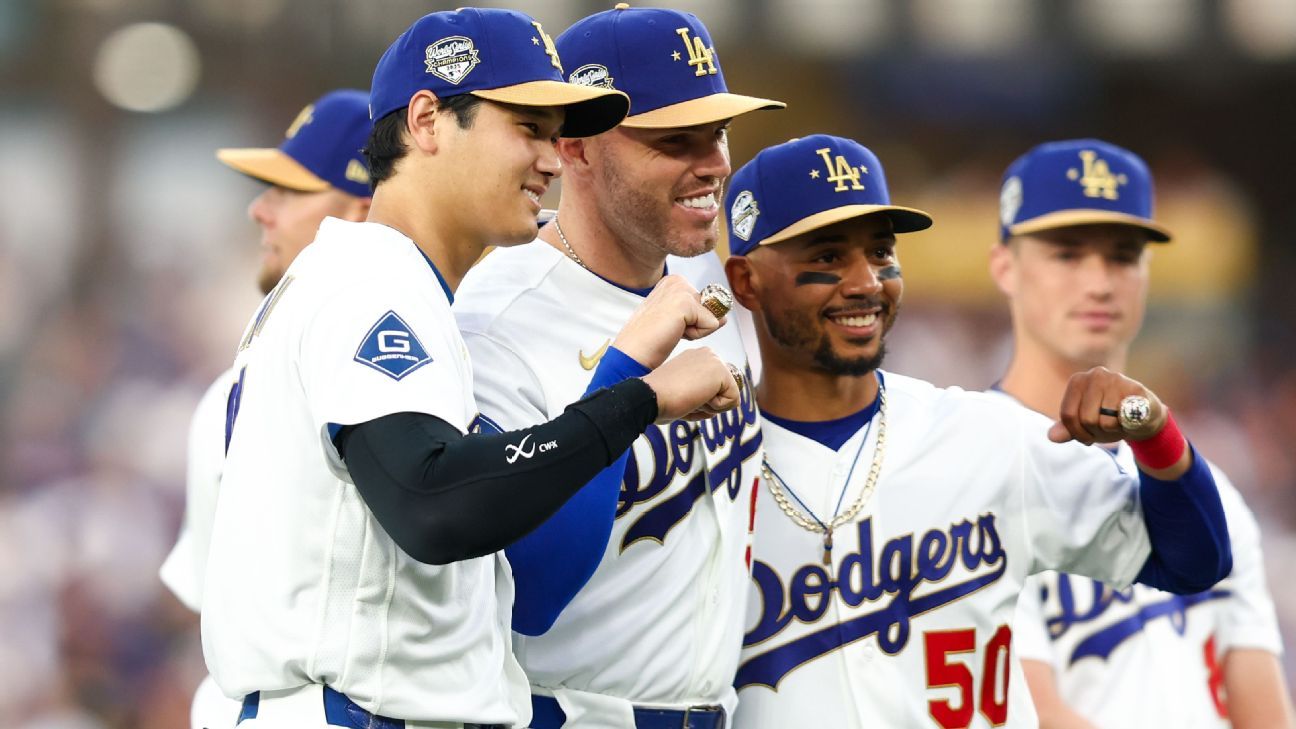
LOS ANGELES — A 100-second promotional clip, broadcast prior to every home match, unveils the essence of the 2026 Los Angeles Dodgers. It commences with a query posed by actor Jason Bateman, set to the rhythm of Billie Eilish’s “Bad Guy”:Is there an issue with being the antagonist?Towards its conclusion, Bateman invokes Tony Montana, the notorious fictional drug kingpin from the film “Scarface”:You require squads such as ours so you can indicate and declare, “That’s the villain.”
Thus, it is evident that the Dodgers’ advertising division is embracing the “villain” portrayal, even if the athletes are merely participating.
“I personally am indifferent,” stated Dodgers shortstop Mookie Betts. “You may label us however you choose. Ultimately, one must perform the sport. Antagonists, non-antagonists, whatever—the contest will determine victors and vanquished. The ‘villains’ designation is merely external discourse.”
If outside opinions were pronounced last year, they will be deafening this season, following a second consecutive title and a third successive significant offseason acquisition.
With an acrimonious labor dispute over the sport’s financial matters impending, it appears the entire league has fixed its attention on the Dodgers. It’s their squad against all others. While some, like Betts, deem it best to disregard that circumstance, others, such as Max Muncy, seem to gain fortitude from it.
“We always have that aim,” the Dodgers’ veteran third baseman commented. “It will merely be amplified now. It presents a formidable task, yet it’s something we anticipate. We get to accept it fully. That’s what renders it enjoyable. This explains why you’ve heard individuals assert, ‘Being a Dodger isn’t for everyone.’ You must desire to be present and confront everyone’s peak performance each and every evening. It simply generates a challenge one must discover how to welcome.”
The Dodgers — holding a 4-2 record in their initial homestand despite receiving nearly negligible output from their formidable lineup’s upper tier — will face constant opposition from rival clubs eager to overcome them. At times it will propel them forward, at other times it will exhaust them. Throughout this period, however, the Dodgers’ focus will remain fixed on October. These six months serve solely as preparation.
With that consideration, we pinpointed four principal themes that will define their regular season.
Shatter the regular-season victory record? The Dodgers are unconcerned.
Last year’s championship roster clinched 93 regular-season contests, the lowest for the Dodgers in a complete season since 2018. In 2022 and 2023, they amassed a collective 211 victories — only to be eliminated in the National League Division Series each instance. Consequently, while numerous external observers have pondered over these past two years whether the Dodgers could achieve 117 wins, surpassing the 1906 Chicago Cubs and the 2001 Seattle Mariners for the single-season benchmark, no one within the Dodgers’ changing room expresses concern.
“Anything is conceivable, certainly with this collective, but that is not our guiding principle,” declared Dodgers manager Dave Roberts. “It genuinely is not.”
Their ultimate objective, naturally, is a third consecutive title, an feat no NL team has achieved. Nevertheless, they still believe their optimal route involves securing home-field advantage and gaining a first-round exemption. The Dodgers endured a demanding postseason last October, surmounting the unpredictability of a wild-card series, then engaging in the initial two contests of a best-of-five NLDS in Philadelphia, and subsequently having to triumph in Games 6 and 7 of the World Series in Toronto.
They will dedicate these forthcoming six months intensely to preventing such a scenario, regardless of the number of wins it necessitates.
“That three-game series presents numerous difficulties,” stated Dodgers general manager Brandon Gomes. “We lose series throughout the calendar year to teams that are less proficient than us, yet that is the essence of the sport. Therefore, being able to circumvent that three-game series and genuinely arrange circumstances, utilizing those five days for preparation, holds considerable importance.”
It almost seems like a distant recollection at this juncture, but the Dodgers of this era were long characterized by dominant summer performances that consistently culminated in disappointing autumns. From 2013 to 2023, they secured 10 division crowns in 11 years, accumulated a major league-leading 1,031 regular-season triumphs — 91 more than the second-place New York Yankees — and emerged with only one championship, during the COVID-shortened 2020 campaign.
The setbacks prompted an internal inquiry to ascertain the points of failure. Some could be attributed to the chance nature of October, but there was an underlying issue with their preparation methods, their roster construction, and their approach to the preceding six months.
The Dodgers are not disclosing that report, yet one aspect is certain: maximizing regular-season victories is not featured within it.
“We achieved 111 wins four years ago and were eliminated in the initial round,” stated Dodgers first baseman Freddie Freeman. “I merely wish to be at home during the playoffs.”
Will they genuinely employ 40 pitchers again? ‘It’s far from an exact science.’
The Dodgers established a team record by utilizing 40 players to pitch in 2024. Astonishingly, they repeated this in 2025. Through this, they honed what has become a core organizational philosophy: given pitchers’ high susceptibility to injuries, and the difficulty in foreseeing when or how these occur, the Dodgers have adopted a meticulous approach to the recovery process, frequently granting them significantly more time than might seem necessary.
In essence, their aim is to ensure that when pitchers return, they avoid reinjury.
“Experiencing situations where players returned either diminished or suffering injury resonated profoundly,” remarked Dodgers president of baseball operations Andrew Friedman. “For us, it involves striving to construct the fundamental phases in the rehabilitation process to enable them to come back and remain healthy. It is impossible to replicate the adrenaline and strain of a major league game within that process, so we endeavor to build as much resilience as possible to position them optimally for a lasting return. However, it is far from a precise methodology.”
The Dodgers implemented this strategy with Yoshinobu Yamamoto in 2024, then with Blake Snell, Tyler Glasnow, and, to some degree, Shohei Ohtani in 2025. This year, they are doing so with Snell once more. He is a two-time Cy Young Award recipient on a $182 million contract, but shoulder fatigue hindered him in spring training, and his progress is slow; he is not anticipated to return before late May at the earliest.
Snell’s unavailability permits Roki Sasaki and Justin Wrobleski to receive extensive opportunities. Subsequently, should any among Yamamoto, Glasnow, Ohtani, or Emmet Sheehan require time off, the Dodgers can summon another promising pitching prospect, River Ryan, who would bolster the rotation of most
other prominent baseball teams’ pitching staffs.
Gradually introducing starting pitchers is an advantage that perhaps only the Dodgers can afford.
However, should one seek an explanation for why their total victories in the regular season might not align with their skill level, this particular aspect could be the most significant.
Workload regulation for a veteran batting order? Updates to follow
Should you contemplate whether Freeman, currently in his 36th year, intends to observe extra rest this season, he has already determined his plan.
“I anticipate being absent for about two contests upon the arrival of the baby,” stated Freeman, whose spouse, Chelsea, is anticipating their fourth offspring. “Subsequently, I consistently observe a day of rest once we secure the division title, totaling three days. One hundred fifty-nine games – that should suffice, wouldn’t you agree?”
The Dodgers are a seasoned team, comparatively speaking, particularly regarding their position players (with an average age of 31.3, leading the major leagues). One of their prominent players, Freeman, is resolute about participating daily. Another, Betts, aged 33, now occupies the second most physically strenuous role on the diamond. Moreover, with Ohtani’s involvement, the role of designated hitter is unavailable for periodically alleviating their physical demands.
Ensuring the vitality of these two athletes is not merely crucial for the Dodgers’ prospects of securing a third consecutive championship, but also for prolonging their period of competitiveness to the fullest extent.
“A significant portion of this will manifest in how players move, and if they can maintain their lower body strength while batting,” Friedman remarked concerning the scheduling of extra rest days for Freeman and Betts. “Numerous indicators emerge that will provide a clearer understanding of how assertive we ought to be in that regard.”
While he was acquiring the skills for shortstop in 2024 and the initial segment of 2025, Betts fielded countless ground balls daily. Hours prior to the game’s commencement, he would already be thoroughly perspiring. The constant strain on his physique grew worrisome, yet it proved transient. Betts had not assumed the shortstop role since his high school years. He required increasing repetitions and developing motor patterns. His preparatory work before games has since been substantially reduced.
“It was essential,” affirmed Dodgers infield coach Chris Woodward. “One cannot physically sustain such an intense regimen.”
Prior to each match, Betts, Freeman, Muncy (aged 35), and Miguel Rojas (aged 37) engage in preliminary defensive drills on the field. Frequently, Woodward requires assistance from other coaches to manage these activities. This stands as a source of organizational pride, emblematic of the commitment and precision that have enabled the Dodgers to excel in this period. The efforts, Woodward emphasized, are calculated and streamlined. Instead of imposing a burden on their bodies, he contends it’s a primary factor in their sustained productivity.
This is partially why Freeman is disinclined to take rest days.
“I do not consider myself elderly,” he stated. “That is to say, I do not perceive myself as old, making it difficult to utter. And I understand, in our profession, being in one’s mid-thirties is considered advanced for our role. Nevertheless, as athletes, our duty is to be prepared for the day’s contest.”
Is Ohtani capable of securing a Cy Young Award? Solely if he fully utilizes his chances
Should any persistent uncertainty have existed regarding Ohtani’s preparedness to serve as a conventional starting pitcher at the commencement of this season, his performance of six innings allowing merely one hit on Tuesday ought to have dispelled such concerns. Despite not participating in his inaugural spring training game until March 18, eight days prior to Opening Day, Ohtani has already become an established component of this pitching staff, with the anticipation that, provided he maintains good health, he will maintain his position throughout the entire season.
“The aspiration is strong, and I believe it is achievable,” Roberts stated concerning Ohtani’s full season as a starting pitcher, which aligns with his broader aims to claim a Cy Young Award. “Subsequently, the more significant inquiry becomes: How shall we oversee and traverse that path?”
It will primarily involve supplementary periods of recuperation. The Dodgers are commencing this season with seven Thursday breaks within a nine-week span, which they will utilize to afford Ohtani more intervals between his pitching appearances. Ohtani’s subsequent pitching appearance is anticipated for Wednesday, whereupon he will pitch after seven days of recovery. Anticipate this schedule to be customary. During his three-season tenure as a dual-threat athlete with the Los Angeles Angels from 2021 to 2023, Ohtani never initiated a game following the conventional four days of rest, undertaking 40 of his 74 starts after a minimum of six days off.
Ohtani will participate in the batting order daily. During his pitching engagements, he will operate with the same freedom as any other starting pitcher. The sole effective method to regulate his physical exertion is to extend his time between starts – an endeavor facilitated by the Dodgers’ abundant pitching resources.
The influence of pitching on Ohtani’s offensive performance also merits observation. Presented here is what the statistics – specifically, OPS – indicate.
What inferences can be drawn from this? It is challenging to ascertain. In certain seasons, Ohtani performed exceptionally well offensively on his pitching days, while in others, his performance varied. Some seasons appeared to exhibit a detrimental effect the day subsequent to his starts, whereas in other seasons, this was less pronounced. Organizations depend considerably more on proprietary metrics and biomechanical information to assess their athletes’ weariness, rather than solely on the results of batted balls. The Dodgers will adopt a similar approach. Roberts stated that performance – whether favorable or unfavorable – will not modify Ohtani’s pitching timetable. The supplementary recuperation will simply be incorporated, at least for as long as it remains practicable.
This is an expectation Ohtani holds.
“I am of the opinion that the team ought to prioritize Yoshinobu, Glasnow, and Snell once he returns,” Ohtani conveyed via an interpreter. “Therefore, I believe it is relatively straightforward to integrate me into that rotation whenever the team deems it appropriate. The paramount concern is that we all remain in optimal health during October.”