
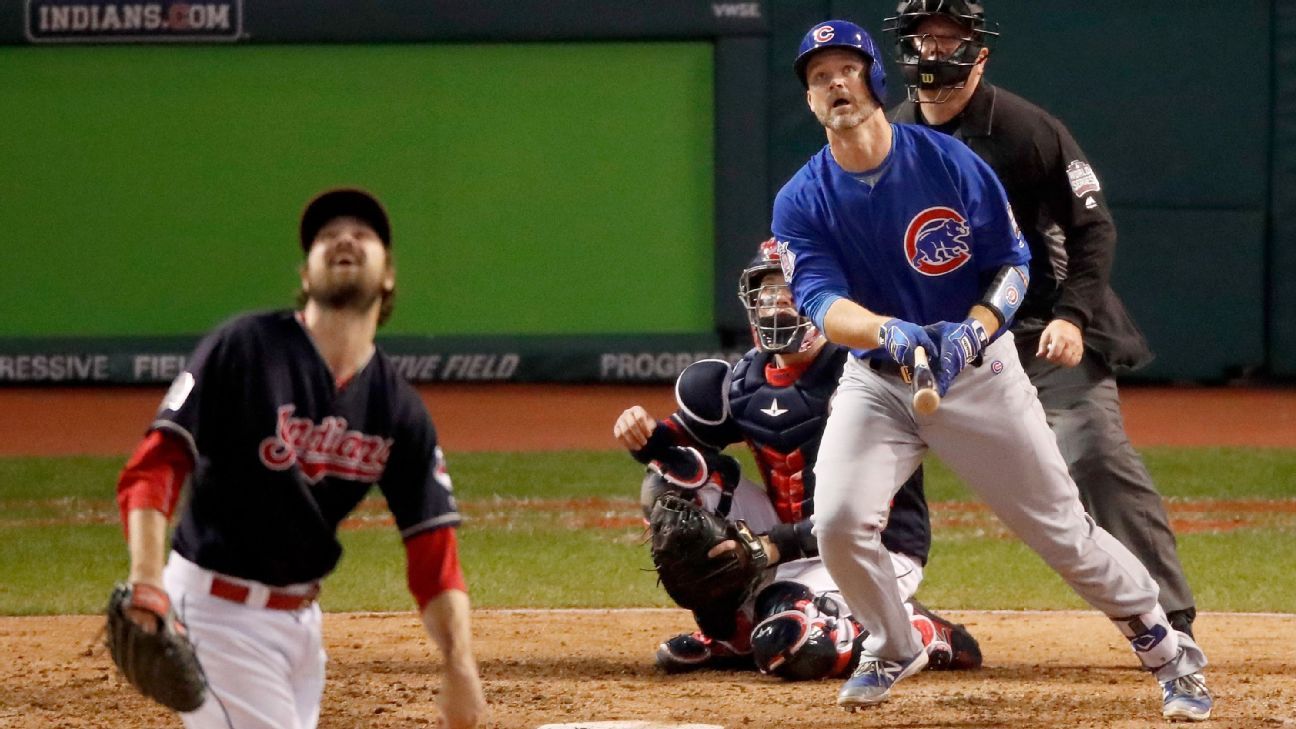
THROUGHOUT THE ANNALSof Major League Baseball, 670 World Series matchups have occurred, yet only four instances involved three backstops playing for a single squad. Still, across all those years and encounters, merely on one occasion did all three catchers additionally register a hit and an RBI — this unprecedented event unfolded during one of the most celebrated Fall Classic contests.
Chicago Cubs manager Joe Maddon approached Game 7 of the 2016 World Series against the Cleveland Indians with a pre-arranged strategy, and despite the tumultuous nature of 10 gripping innings, his trio of backstops — Willson Contreras, David Ross and Miguel Montero — steadfastly performed their duties, contributing pivotal efforts to clinch Chicago’s win.
Ten years subsequent to the Cubs breaking their 108-year World Series hex in Cleveland, this account details the three backstops who forged their distinct legacy during that autumnal evening.
Backstop No. 1
MADDON FORMULATED HISGame 7 strategy in the feverish hours preceding the game after his team necessitated a conclusive ultimate matchup in a series where they had previously been behind 3-1.
Kyle Hendricks, that season’s MLB ERA frontrunner, was slated to begin for the Cubs against Cleveland ace Corey Kluber. Even with more than a century of history influencing the encounter, Maddon selected the 24-year-old Contreras to serve as Hendricks’ catcher, overlooking two more seasoned alternatives.
“That he, a novice, commenced Game 7 was quite astonishing in retrospect,” Ross said recently. “He was exceptionally youthful.”
Contreras made his initial appearance during the middle of the 2016 season, promptly demonstrating his readiness for significant occasions when he connected for a two-run, pinch-hit long ball on his inaugural major league offering on June 17. He participated in 76 contests throughout the regular season and commenced nine in the postseason, being one of three backstops on Chicago’s extensive squad.
“I’ve seldom been part of teams where one senses competition among catchers,” Ross said. “Our individual statistics were not our primary concern. My departure was imminent. Miggy [Montero] possessed an assured agreement, and Willson, having been called up from the minor leagues, was eager to join the collective.”
As Contreras positioned himself behind home plate, Hendricks maneuvered through Cleveland’s batting order, conceding only a single earned run over the game’s first 4⅔ innings. Upon Hendricks’ departure in the fifth frame, the Cubs appeared to be in command, leading 5-1, Contreras having plated one of those scores via a fourth-inning two-bagger.
“The gravity of the situation did not daunt him,” Maddon said recently. “A tenacious competitor who embraced his fervor immediately after his morning routine. I placed my confidence in him. He performed diligently and was driven to triumph. Though perhaps youthful, he constituted a significant element in our success in Game 7.”
Backstop No. 1 had fulfilled his duty.
Backstop No. 2
MADDON INITIATED THE SECOND PHASEof his strategy when he substituted Hendricks following his walk of Carlos Santana, influenced by some debatable ball-strike determinations. As the left-handed batter Jason Kipnis approached the plate for Cleveland — and with Jon Lester coming into the contest, the moment arrived for his designated backstop, Ross, to join him.
The swift removal of a starter who had smoothly progressed through the initial four-plus frames has drawn scrutiny in the years subsequent to Chicago’s triumph, yet Ross recently provided his rationale for Maddon’s tactical move.
“One ought not to delay excessively in Game 7,” he said. “While being premature is acceptable, tardiness is not. Moreover, Jon was unleashing powerful pitches in the bullpen.”
Removing the powerful hitting Contreras implied a diminished offensive capability, however, Maddon deemed it justifiable to afford Lester the accustomed presence of Ross, who had previously announced that Game 7 would mark the conclusion of his professional playing days.
“That had been a topic of conversation the preceding day,” Maddon said in a phone interview recently. “Jonny Lester was intended to play a significant role in that contest. And I informed David the day prior, ‘Hear me, when Jon enters, you will accompany him. Regardless of the timing, you will participate in the game.'”
“I likewise forewarned Willson, too, that this scenario was impending. My intention was not to surprise him suddenly.”
Affectionately dubbed Grandpa Ross, the 39-year-old embodied the spirit and core of the Cubs’ locker room, maintaining a relaxed atmosphere during a high-stakes season while also serving as the firm authority when required. It appeared appropriate for him to assume the catching position for some of the concluding outs as Chicago advanced towards its historic achievement.
“Approaching my ultimate game, it was gratifying to possess a strategy ensuring my participation irrespective of circumstances,” Ross said. “However, I entered and nearly jeopardized it.”
During the sixth delivery of the plate appearance, Kipnis minimally connected with a ground ball that traveled a short distance before home plate. Ross swiftly pounced on it, then spun to hurl the ball to first baseman Anthony Rizzo.
Ross, recalling the incident ten years hence, shook his head: “I launched the ball into the spectator area, nearly harming Rizz.”
The toss sailed high and off target, resulting in a minor impact between Kipnis and Rizzo, with Santana advancing to third and Kipnis being granted second base. After two more pitches, Lester unleashed a curveball that violently struck Ross’s helmet, sending him to the ground and thus enabling Santana andKipnis to score. The tally stood at 5-3, and the Cubs’ situation was deteriorating rapidly.
“Hold on, I am renowned for my defensive prowess,” Ross was thinking. “What in the world is transpiring?”
In the subsequent inning, Ross seized an opportunity to compensate for his fielding blunders, smashing a 1-2 fastball from relief pitcher Andrew Miller into right-center field, marking the concluding long ball of his fifteen-year tenure.
“Successfully connecting on that pitch brought a measure of solace,” Ross said with a smile. “I permitted two runs, yet I recovered one.”
The situation stabilized for the Cubs subsequent to that home run as Lester continued pitching into the eighth frame prior to Jose Ramirez forcing his exit with an infield base hit.
Maddon’s strategy advanced to its subsequent stage: introducing the formidable relief pitcher Aroldis Chapman for a four-out, World Series Game 7 save opportunity.
Ross remained in, even though he had only been behind the plate with Chapman on the mound
for approximately 4⅓ frames since his July debut.
Their collaboration proved challenging.
As two outs had been recorded and the Cubs held a 6-3 advantage, Ross requested seven consecutive fastballs for outfielder Brandon Guyer. Guyer connected with the final pitch, hitting a double to right-center field and reducing Cleveland’s deficit to two scores.
Undaunted, Ross then summoned an additional seven fastballs for Raja Davis. Davis launched the seventh of these pitches along the left field line for a game-tying home run, igniting chaos within Progressive Field.
“I asked for many heaters,” Ross reminisced, not with affection. “That was likely a significant error. Raja Davis gripped the bat very high, as if 4,000 feet, and made contact.
“An excessive number of fastballs.”
Mike Borzello, the Cubs’ game strategist, further commented: “Then we reached Aroldis. We approached that frame using only heaters, and Davis ultimately made solid contact. The pitch intended to be high was low, allowing him to drive it, and suddenly we’re in a deadlocked contest. Vicious.”
Third Catcher
AT THIS JUNCTURE, MADDON’Sstrategy was almost completely undone. Cleveland had surged ahead, and the specter of another season of Cubs’ sorrow grew larger.
Ross commenced the ninth inning by earning a walk against relief pitcher Cody Allen. He was subsequently substituted by a pinch runner, bringing his evening — and professional career — to a close.
“That proved an extraordinary manner to conclude,” he remarked. “I am simply relieved things ultimately unfolded favorably for us.”
Through an uncommon maneuver, the Cubs opted to change catchers between the eighth and ninth frames, yet retained the same pitchers. Typically, the reverse occurs during a contest. However, naturally, this was no ordinary match.
Consequently, the remainder of the evening’s catching duties fell to Montero. He had commenced the 2016 campaign as Chicago’s primary backstop but experienced a decrease in his game time following Contreras’s arrival in June. Montero nevertheless continued as a vital component of the squad, demonstrating his crucial skill by smashing a colossal pinch-hit grand slam versus the Dodgers merely days prior in the NLCS.
His assignment for Game 7 was formidable: guide a rattled Chapman through the ninth frame without incident. Having been on the bench for eight innings, the fate of the contest now rested with Montero.
“The process began the preceding evening when Joe informed us of the strategic blueprint,” Borzello recounted. “We understood Willson would commence and catch for Kyle, continuing for as long as feasible. Subsequently, we planned to swap the battery, introducing Rossy and Lester. These elements were predetermined.
“Miggy’s involvement was improvised.”
Montero and Chapman needed to swiftly solidify a tactical approach when facing the formidable top of Cleveland’s batting order: Santana, Kipnis, and Francisco Lindor.
“The single aspect that made me most apprehensive was my lack of familiarity with the batters,” Montero stated. “I hadn’t caught a single game throughout the playoffs. To enter with the game deadlocked, it’s f—ing nerve-racking.”
Notwithstanding that sensation, he exhibited composure before Chapman. Rather than requesting fastballs as Ross had done, Montero diversified his pitch selection with various off-speed deliveries. Borzello had anticipated this instance the previous evening and recognized Montero’s limited recent experience behind home plate.
“I sensed there was likely some resentment present,” Borzello remarked. “I informed him, ‘You will participate in this game. You must be completely focused.’
“We’ll need to outwit them. Sliders and a few split-finger pitches. Chapman’s fastball lacked its usual velocity. Miggy performed a remarkable feat.”
Chapman flawlessly retired the batters in sequence. He and Montero fulfilled their duties during that exceptionally tense juncture, one player emotionally drained and the other having just entered from the dugout.
“I believed if we could navigate the ninth inning, I would be content,” Montero stated. “Yet, I remained uncertain. Chapman was exhausted, trulyworn out.We were confronting their strongest hitters at the top of the lineup.
“As I previously mentioned, it was profoundly f—ing stressful.”
Jed Hoyer, a Cubs executive, further commented: “The ninth inning was unequivocally the most agonizing. We were utterly vulnerable then, with an exhausted Chapman on the pitcher’s mound, and he was struggling. Nevertheless, Miggy executed an outstanding performance.”
Montero’s engagement for the evening had only just commenced.
Following a brief precipitation-induced pause that halted the game for 17 minutes, the Cubs stepped up to bat in the initial half of the 10thinning and achieved a breakthrough. Ben Zobrist hit a double, scoring a run, and subsequently, Addison Russell received an intentional walk, thereby filling the bases with Montero due up.
Having spent nine frames on the sidelines, followed by one in active play, and then enduring a weather-related stoppage, Montero at last found himself batting, presented with an opportunity to extend Chicago’s advantage. He sharply hit a 1-1 cutter pitch from relief pitcher Bryan Shaw through the left infield, securing an RBI single, and expanding the Cubs’ lead to 8-6.
Similar to his two predecessors, the third catcher recorded his own hit and brought in a run.
“The circumstance that every one of the three catchers participated defensively, took turns at bat, and each provided significant contributions,” Borzello remarked. “Such an occurrence will never be witnessed again in the annals of baseball. In Game 7? Absolutely never again.”
Borzello’s subsequent reflection?
“Our task is yet incomplete.”
THE CUBS MAINTAINEDtheir advantage, yet they had to navigate the latter half of the 10thinning, and once more, their third catcher of the evening would assume a pivotal role.
Given that their seasoned relief pitchers were expended — and starting pitcher Jake Arrieta was warming up in the bullpen with no rest days — Maddon opted for 24-year-old right-hander Carl Edwards Jr. to secure the three most crucial outs of his career.
Edwards successfully retired the initial two hitters, but signs of his anxiety emerged as he issued a five-pitch walk to Guyer, bringing the potential tying run to bat. Davis, who had hit his game-tying home run just two frames earlier, then produced an RBI single, narrowing Chicago’s lead to 8-7.
Maddon had witnessed sufficient. Aware that Mike Martinez, a sparingly utilized switch-hitting outfielder, was next in the batting order, he consulted Borzello.
“Which direction, which direction?” Maddon inquired.
“Right-handed. We desire him batting right-handed,” Borzello replied.
Borzello’s foresight proved vital, as the entirety of the World Series hinged on a utility infielder who had been inserted earlier in the inning primarily for his defensive capabilities.
“This holds great significance, because in developing a scouting analysis, one must dedicate equal focus to the 25thplayer, as it’s unpredictable when they might make an appearance,” Borzello commented.