
Audio of this article is brought to you by the Air & Space Forces Association, honoring and supporting our Airmen, Guardians, and their families. Find out more at afa.org
In early April 2026, a U.S. Air Force F-15E Strike Eagle aircraft was shot down over Iranian territory. Its pilot and weapons systems officer (WSO) successfully ejected into an area considered hostile, prompting an immediate and extensive rescue operation by U.S. forces. Personnel focused on locating the downed Airmen, listening for distress signals, and searching for indications of their survival, as rescue helicopters and support aircraft were rapidly deployed to potential landing sites.
The operational directive for such incidents is unequivocal: the United States is committed to recovering all service members. Airmen undergo rigorous training in survival, evasion, resistance, and escape (SERE) techniques. This commitment extends across all levels of military operations, from ground support crews to rescue personnel and commanders, who are tasked with executing all feasible measures to bring downed Airmen home.
For two former Airmen, the approximately 48-hour period between the shootdown and the successful rescue of the second crew member evoked vivid, at times challenging, memories of their own experiences surviving after being shot down in the former Yugoslavia during the 1990s. Former Air Force Capt. Scott O’Grady and retired Air Force Gen. David L. Goldfein each ejected from an F-16 combat aircraft during conflicts involving Serbia; O’Grady in 1995 and Goldfein in 1999.
In the 27 years preceding this April 2026 incident, and despite sustained military engagements, no other American Airmen had faced similar circumstances of being shot down in hostile territory. During this period, approaches to, investment in, and planning for future combat search and rescue (CSAR) operations have undergone multiple evaluations as Air Force strategists adapt to evolving warfare landscapes and the complexities of rescuing personnel under contested conditions.
Rescue of DUDE 44B
Within hours of the F-15’s shootdown on April 3, 2026, U.S. Air Force combat search and rescue assets were mobilized. This initial response involved 21 military aircraft and dozens of Airmen, who conducted a daylight mission into Iranian airspace to rescue the jet’s pilot, identified by the call sign DUDE 44A. Miles away, the weapons systems officer, DUDE 44B, remained concealed and could only observe as his crewmate was extracted.
The subsequent phase of the operation presented significant challenges. Over the following day and a half, as DUDE 44B maintained his hidden position, Iranian state television broadcasters announced a reward for his capture. Concurrently, U.S. and Iranian forces intensified efforts to locate and recover him.
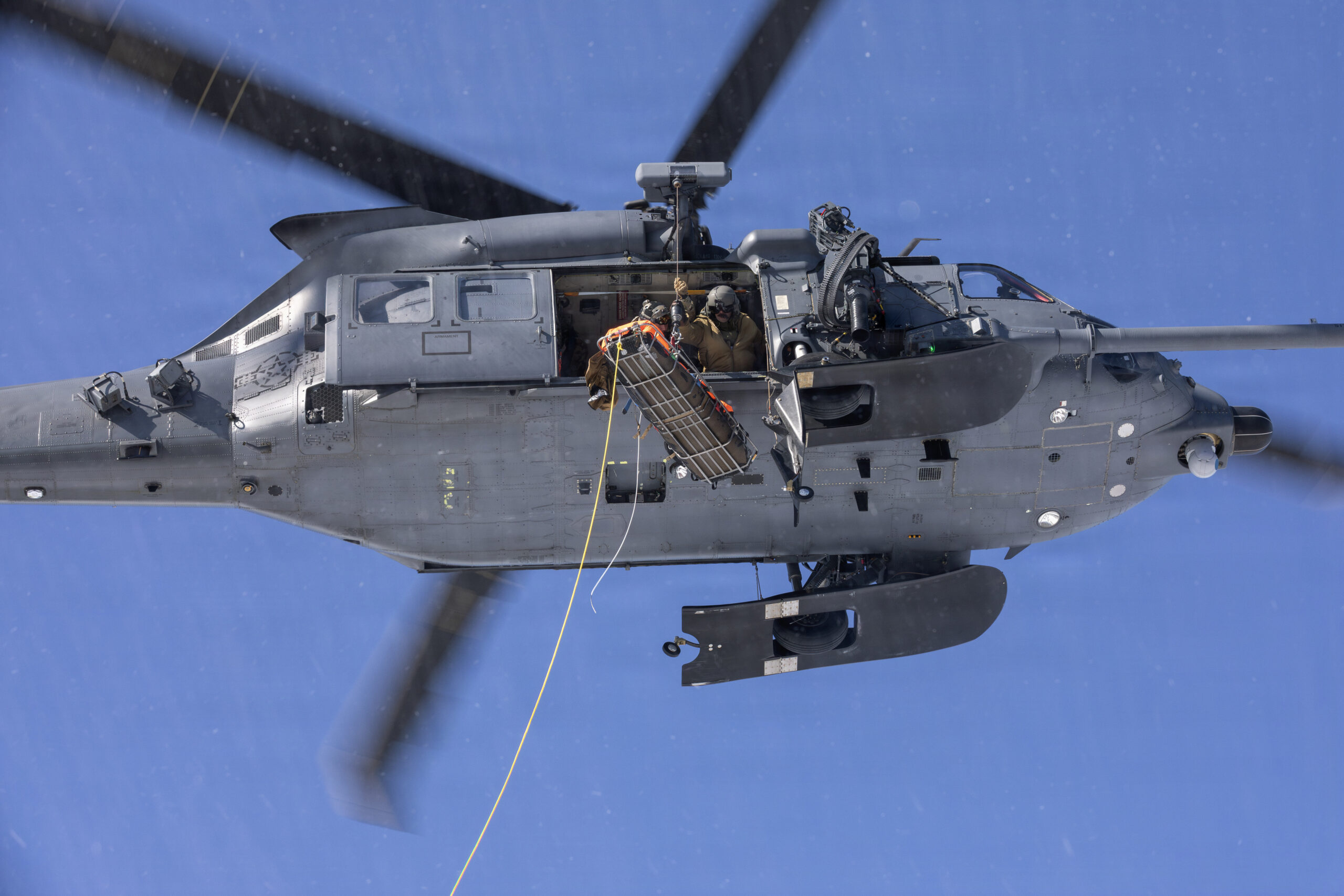
The joint force team ultimately responsible for securing DUDE 44B’s safety was directed by the Joint Special Operations Command (JSOC). This team included a range of Air Force assets such as A-10 attack jets, HC-130 combat rescue airlifters, and HH-60W rescue helicopters, alongside other supporting aircraft. The operation encountered resistance and logistical difficulties. By its conclusion, two HC-130s and two Army MH-6 helicopters became immobilized in soft terrain and were subsequently destroyed to prevent their capture. Additionally, an A-10 aircraft sustained damage from anti-aircraft fire and was ditched in friendly territory.
These material losses amounted to an estimated minimum of $300 million, potentially higher. However, the mission successfully secured the life of DUDE 44B.
Reflecting on the rescue, Chairman of the Joint Chiefs of Staff Gen. Dan Caine commended the rescue personnel for their determination and courage. He stated that their heroism demonstrated “yet again that the United States of America and our joint force will always place more value in humans than we ever will in hardware.”
‘It’s a Race’
When retired Gen. David Goldfein learned of the F-15E shootdown over Iran in April 2026, he described being able to empathize with the experience of the DUDE 44 Airmen. Approximately 27 years prior, on May 2, 1999, Goldfein’s F-16 was struck by a surface-to-air missile over Serbia. He subsequently ejected, descending under a parachute as his aircraft fell.
“It’s a race, right?” Goldfein commented. “The race is on between who gets to them first. It was the same in my situation.”
Former Air Force Capt. Scott O’Grady similarly understood the situation. Recalling the recent shootdown days after it occurred, O’Grady stated he prayed for the Airmen’s rescue. “I prayed for them, for their safety, and for their health and their lives,” he said.
O’Grady’s F-16 was shot down 47 months to the day before Goldfein’s incident, on June 2, 1995. He was struck by a Soviet-made SA-6 surface-to-air missile fired by Serbian forces during the Bosnian War.
“Missile impact was very violent—it came with very little warning,” O’Grady recounted. The aircraft disintegrated into two sections. “I thought I was dead. But I still reached the ejection handle. I came out actually parallel with the horizon. Debris was flying all around me.”
Burning jet fuel caused searing on his clothes and skin. His parachute deployment seemed to occur in slow motion, with seconds feeling like minutes during his descent.
“I literally could see the greeting party and their troop carrier and two other vehicles matching my drift rate across the ground,” O’Grady recalled. “I knew they weren’t just driving up the highway. They were driving up to try to reach me when I landed.”
O’Grady located a hide site almost immediately upon landing. “You go right to your training on what you need to do,” he stated. Serb forces subsequently converged on the area, with some approaching “six feet from me.” He deactivated his radio to prevent detection and successfully evaded capture for six days.
“What people don’t realize is that downed pilots or aircrew members become political pawns,” O’Grady explained. As media outlets report on such events, the public closely follows developments. The capture of an American service member can represent a significant propaganda victory for adversaries. Over time, these adversaries have learned to manipulate media coverage and public anxiety, aiming to leverage captured personnel to gain an advantage against larger military powers such as the United States.
The 1993 Battle of Mogadishu serves as a historical example. Army Master Sergeant Gary Gordon and Sergeant First Class Randy Shughart were killed after fast-roping from a helicopter to defend its surviving pilot, Chief Warrant Officer Mike Durant, against enemy fire. Images of deceased American soldiers being desecrated in the city’s streets garnered significant public attention and concern. Durant was subsequently captured and held prisoner for 11 days. This incident contributed to the eventual withdrawal of American forces from Somalia five months later.
“What kind of impact did it have when … their mutilated bodies—naked and stripped—were dragged in front of the cameras?” O’Grady asked, referring to the Mogadishu incident. “That had an impact of an image in every single household in America that then had a propaganda impact on the will and the heart to stay in the fight.”
The stakes of an operation escalate dramatically when an American pilot is downed, a sentiment echoed by others. Retired Air Force Col. Brandon Losacker, who served as an HH-60G Pave Hawk weapons officer and CSAR team member throughout his career, suggested that the entire outcome of Operation Epic Fury might have been altered had the rescue missions for pilot DUDE 44A and WSO DUDE 44B failed.
“CSAR is a strategic mission,” he stated. “Imagine the world that we would be in right now if our CSAR and the SOF personnel recovery missions had failed, and the Iranians had our downed crew. What would that have done to the president’s decision space? We would be in a totally different geopolitical situation.”
Why This Matters
The shootdown of a U.S. F-15E over Iran and the subsequent complex rescue operation highlights several critical aspects of modern military operations, international relations, and national security policy.
- Strategic Importance of Personnel Recovery:The U.S. military’s unwavering commitment to the “no warrior left behind” principle is not merely a moral imperative but a strategic one. Successfully recovering downed personnel boosts morale across the armed forces, reinforces trust in leadership, and serves as a powerful message to both allies and adversaries about the value the U.S. places on its service members. A failure to recover personnel, especially in a high-profile incident, could severely undermine morale and public confidence.
- Geopolitical Implications and Deterrence:Conducting a complex rescue mission within the airspace of a country like Iran, which maintains an adversarial relationship with the U.S., demonstrates a significant projection of military power and resolve. It underscores the U.S.’s capability and willingness to operate globally to protect its interests and personnel, even in contested environments. Such an operation can act as a deterrent, signaling that actions against U.S. forces will incur a robust response, while also carrying inherent risks of escalation.
- Financial and Material Cost of CSAR:The loss of multiple aircraft and an estimated $300 million in material during the DUDE 44B rescue highlights the substantial financial and resource investment required for CSAR operations. This cost-benefit analysis — valuing human life over hardware — is a core tenet of U.S. military doctrine but also raises questions about sustainability and the allocation of defense budgets, particularly in an era of potential peer-to-peer conflict.
- Propaganda and Information Warfare:As noted by former Capt. O’Grady, downed personnel can become potent political pawns. Adversaries can exploit captures for propaganda, seeking to sow dissent among the American public or extract concessions. Successful rescues deny adversaries this leverage, while failures or the mistreatment of captured personnel can ignite public outrage and significantly impact national will to continue military engagements, as seen in the aftermath of the Battle of Mogadishu.
- Evolution of Warfare and CSAR Challenges:The incident underscores the evolving challenges of CSAR in an era of sophisticated anti-access/area denial (A2/AD) capabilities. Operating against a near-peer or well-equipped adversary requires advanced planning, technology, and robust training to overcome sophisticated air defenses, electronic warfare, and rapid response forces. This incident serves as a case study for future investments in CSAR platforms, tactics, and intelligence gathering in highly contested environments.
- Impact on Presidential Decision Space:The successful recovery of both Airmen preserved the President’s strategic options by avoiding a potentially disastrous scenario of U.S. personnel being held captive by Iran. A different outcome could have severely constrained diplomatic and military responses, forcing difficult choices with significant regional and global ramifications.
Sacred Trust: The Enduring Mission of Combat Search and Rescue
The mission of Combat Search and Rescue (CSAR)—to retrieve downed personnel from hostile territory—stands as a critical pillar of military operations, embodying a profound commitment to leave no one behind. Recent discussions and high-profile incidents, including a complex rescue operation in Iran identified by the call sign “DUDE 44,” underscore both the enduring necessity and evolving challenges of this specialized warfare. These operations highlight the intricate coordination, advanced technology, and unwavering dedication required, often drawing on a “whole of government” approach.
The harrowing experiences of U.S. Air Force General David Goldfein (Ret.) and Captain Scott O’Grady (Ret.) from the 1990s offer stark reminders of the personal stakes and the profound impact of successful CSAR missions. Both aviators were shot down over hostile territory during their careers, and their narratives emphasize the deep bond forged between those rescued and their saviors.
General Goldfein’s rescue in May 1999 during the Kosovo conflict was a relatively swift, though intensely dangerous, operation. After his F-16 was struck, Goldfein spent a few hours on the ground, maneuvering to avoid landmines and Serbian patrols. He recounted that Serb forces were initially unaware of his precise location. However, once the extraction effort commenced, the situation escalated rapidly. Two pararescuemen and a combat controller rappelled from an HH-60 Pave Hawk helicopter to retrieve Goldfein, who emerged from his creek-bed cover exhausted and disoriented. As dawn broke, the team quickly moved him into the helicopter while enemy forces unleashed fire, attempting to thwart the evacuation. Goldfein reflected on the inherent vulnerability of rescue crews operating in daylight over enemy territory, underscoring the immense courage required.
To this day, Goldfein commemorates May 2nd annually, sending bottles of Scotch to the units involved in his rescue. Beyond this gesture, he has maintained close personal friendships with his rescuers, extending support through their own challenges, including post-traumatic stress and substance abuse. This enduring connection exemplifies the “sacred trust” that develops between those who risk their lives for others.
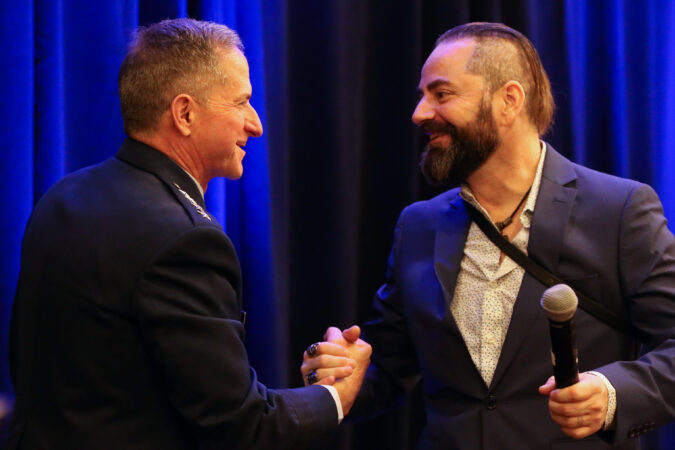
Similarly, Captain O’Grady, whose F-16 was shot down over Bosnia in June 1995, maintains a strong bond with the 61 Marines who participated in his rescue, describing them as his “instant brothers.” O’Grady’s ordeal lasted six days, during which his wingman could not confirm his parachute deployment, leading to initial doubts about his survival. Throughout this period, O’Grady relied on his faith, his desire to return to his family, and an unshakeable trust in his fellow service members and the American people, believing they would not abandon him.
These historical precedents underscore a consistent theme: CSAR operations transcend single service branches. From O’Grady’s and Goldfein’s rescues to the more recent “DUDE 44” incident, these missions invariably involve extensive inter-service and inter-agency cooperation. The complex rescue of “DUDE 44” in Iran, for instance, saw the Central Intelligence Agency (CIA) executing an intricate misdirection strategy to divert Iranian attention while special operations forces engaged hostile elements closing in on the downed Weapon Systems Officer (WSO). Simultaneously, Space Force Guardians and intelligence analysts meticulously gathered and verified data from emergency beacons to ensure the pilot’s safety. General Goldfein emphasized that it is characteristic for the entire government to mobilize resources for such a critical mission, often without the downed individual immediately grasping the full scope of the effort. He continues to encounter individuals, even decades later, who played a role in his own rescue, highlighting the vast, often unseen, network involved.
CSAR in the Future: Adapting to New Realities
Technological advancements consistently reshape CSAR capabilities. The “DUDE 44” rescue benefited from bespoke technology, including systems capable of detecting a WSO’s heartbeat from miles away. General Goldfein noted that “every rescue advances the technology, the tactics, and the procedures.” While his own rescue incorporated pioneering technologies, the modern battlefield presents a unique set of challenges and opportunities.
In the Vietnam era, shootdowns were frequent, and rescues were relatively common, though many airmen ultimately became prisoners. Today, the scale of potential losses in a highly contested scenario, such as multiple pilots downed simultaneously, could be overwhelming. Retired Colonel Russell Cook, former commander of the 347th Rescue Wing, articulated the universal desire among commanders for readily available combat rescue assets. However, Captain O’Grady cautioned against diluting CSAR capabilities, stressing that “special skill sets…and special capabilities” are unique to these dedicated units. He lauded CSAR teams for their willingness to “put it all on the line to go save someone else’s life,” viewing it as their core mission and purpose.
Nevertheless, questions persist regarding the feasibility of traditional CSAR in a conflict against a peer adversary like China, particularly across the vast distances and highly defended airspace of the Pacific. Concerns over the limited range and survivability of helicopters in such environments have led to strategic debates within the U.S. Air Force.
This uncertainty directly impacted the acquisition of the HH-60W Jolly Green II combat rescue helicopters, intended to replace the aging Pave Hawk fleet. Originally slated for 113 aircraft, the Air Force cut the order to 85 in 2023, citing the need to explore unmanned, autonomous, and other alternative aircraft for future rescue missions. Congress, however, pushed back, securing funding for an additional 16 aircraft over two years, bringing the current fleet to 89 production aircraft, with two more expected. Captain O’Grady expressed bewilderment at any move to dismantle dedicated CSAR capabilities, arguing against entrusting such a critical mission to units without specialized focus, proficiency, and equipment.
General Goldfein, drawing on his experience as former Air Force Chief of Staff, acknowledged the complexities of resource allocation. He advocated for a diverse portfolio of CSAR capabilities, tailored to different threat environments. In highly contested scenarios like the “DUDE 44” rescue in Iran, a robust, heavily supported force is essential. Conversely, less contested areas might allow for options like uncrewed rescue aircraft functioning as a rapid “taxi service” for waiting aviators.
Compounding these challenges is the pervasive influence of social media. The rapid dissemination of crowdsourced data, photos, videos, and even fake imagery, including names and locations, creates new complexities. In the “DUDE 44” incident, Iranian state media exploited American social media platforms to circulate images of wreckage and rescue operations, aiming to incite “bounty hunters” to locate the Americans first. Goldfein emphasized the need to integrate these advancements into future tactics and technology, transforming potential disadvantages into strategic assets.
Ultimately, speed remains paramount. Goldfein highlighted that in enemy territory, “every second counts—not every minute, every second.” The notion of an airman evading capture for three weeks, as occurred in Vietnam, seems almost inconceivable in today’s hyper-connected world. He concluded that “all the tools readily available, a team that’s highly trained, a communications system that’s robust and secure” must be in place beforehand, as a life depends on the team “you’ve already built.”
Why This Matters
The debate and evolution of Combat Search and Rescue (CSAR) capabilities hold profound implications that extend far beyond military strategy:
- Morale and Deterrence:The guarantee that every effort will be made to retrieve downed personnel is a cornerstone of military morale. It instills confidence in service members, knowing they will not be abandoned, which is vital for maintaining combat effectiveness and willingness to operate in high-risk environments. This commitment also serves as a deterrent, signaling to adversaries that targeting or capturing U.S. personnel will incur a significant and complex response.
- Strategic Projection and Freedom of Action:Robust CSAR capabilities enable military forces to operate more freely and aggressively in contested airspace, knowing there’s a safety net for those who face an emergency. Without this assurance, commanders might be more hesitant to deploy assets to high-threat areas, thus limiting strategic options and influence.
- Technological Innovation:The unique and life-critical demands of CSAR drive innovation in military technology, from advanced sensors that can detect vital signs remotely to autonomous aircraft and secure communication systems. These advancements often have broader applications across military and civilian sectors.
- Inter-agency and International Cooperation:Successful CSAR missions are rarely unilateral. They demonstrate the critical importance of seamless collaboration among different military branches, intelligence agencies (like the CIA), and even international partners. This multi-faceted approach builds crucial interoperability and strengthens alliances.
- Humanitarian and Ethical Imperative:At its core, CSAR reflects a fundamental ethical commitment to the value of individual human life, even amidst the chaos of conflict. It underscores a nation’s responsibility to its service members, reinforcing the principle that no one is expendable.
- Adapting to Modern Warfare:The challenges posed by social media and advanced peer adversaries highlight the need for militaries to constantly adapt their tactics, techniques, and procedures. The future of CSAR will be a litmus test for how effectively armed forces can integrate new technologies and counter evolving threats in the information age.