
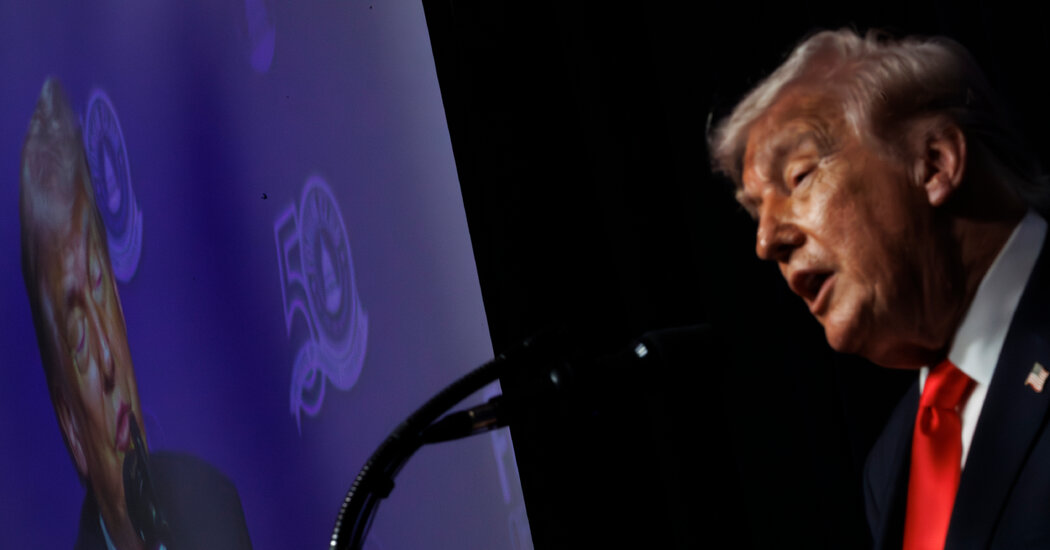
Negotiations for a sustained cease-fire between the United States and Iran remained in a state of uncertainty following comments from U.S. President Donald Trump on Saturday evening. Via social media, President Trump indicated that he was reviewing Iran’s most recent peace proposal, but expressed significant skepticism, stating he “can’t imagine that it would be acceptable.”
These remarks came a day after President Trump had explicitly voiced his dissatisfaction with the new offer from Tehran. Iranian state media reported that the proposal was delivered to Pakistani intermediaries on Thursday evening. However, during a brief exchange with reporters on Saturday evening, the President clarified his earlier stance, explaining that he had only received a briefing on the “concept of the deal” and had not yet reviewed its specific details.
“They’re going to give me the exact wording now,” President Trump stated to the press corps just prior to boarding an aircraft in Palm Beach, Florida. Despite this pending review of the full text, his public statement on Truth Social conveyed deep reservations regarding the proposal’s potential to meet his administration’s demands. President Trump asserted that Iran has “not yet paid a big enough price for what they have done to Humanity, and the World, over the last 47 years,” casting doubt on the likelihood of the current offer proving satisfactory.
Concurrently, in Tehran, Iran’s Deputy Foreign Minister, Kazem Gharibabadi, conveyed a different perspective on the ongoing diplomatic stalemate. During a meeting with foreign diplomats on Friday, Gharibabadi placed the responsibility for de-escalation squarely on the United States. “The ball is now in the United States’ court to choose between diplomacy or continuing a confrontational approach,” he was quoted as saying by Iranian state media. He further emphasized Iran’s preparedness to engage in renewed military conflict should the current cease-fire agreement collapse.
On the same day, President Trump publicly acknowledged that his administration was evaluating all available options, including the potential termination of the existing cease-fire. Addressing reporters at the White House, he outlined the stark choices facing the United States: “Do we want to go and just blast the hell out of them and finish them forever, or do we want to try and make a deal? I mean, those are the options.”
Details emerging from senior Iranian officials indicate that Iran’s latest proposal represents a notable shift in its preconditions for negotiations. Previously, Iran had insisted that President Trump lift the blockade on Iranian shipping in the Strait of Hormuz before any direct, face-to-face meetings between negotiators could occur. Under the new offer, this requirement has reportedly been dropped. The same officials stated that Iran is now willing to reopen the Strait of Hormuz, a critical global oil transit route, even before President Trump formally announces an end to the blockade. The Strait of Hormuz is strategically vital, as approximately one-fifth of the world’s oil supply traversed this waterway prior to the onset of the conflict.
Despite this apparent concession regarding the Strait, Iranian officials clarified that discussions concerning the future of the country’s nuclear program would not commence until a later phase of talks, specifically after a permanent cease-fire has been firmly established. This sequencing represents a key point of divergence with the U.S. position.
Speaking at an event in Florida on Friday evening, President Trump reiterated his administration’s firm stance on the terms of a lasting agreement. “They’re not coming through with the kind of deal that we have to have, and we’re going to get this thing done properly. We’re not going to leave early and then have the problem arise in three more years,” he stated. This comment underscores a central objective of the U.S. administration: to secure a comprehensive and durable resolution to the long-standing tensions.
A significant and persistent obstacle in the negotiations remains the issue of Iran’s nuclear capabilities. President Trump has consistently maintained that Iran must not possess nuclear weapons and should completely halt all uranium enrichment activities. This demand is a major sticking point, appearing difficult, if not impossible, to reconcile with Iran’s long-held position. Tehran has repeatedly asserted its sovereign right to nuclear enrichment for peaceful purposes, in line with international treaties it has signed.
The current cease-fire, which is now under review, was initially extended by President Trump on April 21, despite a notable stalling in direct talks between U.S. and Iranian negotiators. Days subsequent to that extension, President Trump abruptly canceled a diplomatic trip by two of his senior negotiators to Pakistan, indicating that Iran needed to present a more favorable offer directly to him. This sequence of events highlights the fluctuating nature of the diplomatic efforts and the personal involvement of the U.S. President in the negotiation process.
Yeganeh Torbati and Leily Nikounazar contributed reporting.
Why This Matters
The ongoing and uncertain status of the cease-fire negotiations between the United States and Iran carries profound implications for global security, economic stability, and regional dynamics in the Middle East. The dialogue, or lack thereof, directly impacts several critical areas:
Geopolitical Stability:The relationship between the U.S. and Iran is a cornerstone of Middle Eastern geopolitics. A stable cease-fire and eventual peace agreement could significantly de-escalate tensions across the region, potentially curbing proxy conflicts and fostering greater stability. Conversely, a breakdown in talks and a resumption of hostilities would plunge an already volatile region into deeper crisis, with ripple effects extending globally. The prospect of military action, as articulated by President Trump, underscores the gravity of the situation and the potential for widespread conflict.
Global Energy Markets:The Strait of Hormuz, central to Iran’s latest proposal, is one of the world’s most critical chokepoints for oil transit. Disruption or conflict in this waterway directly affects global oil prices, impacting economies worldwide. Iran’s willingness to reopen the strait is a significant development, as it could ease concerns about energy supply disruptions. However, the broader context of a stalled peace agreement means that this vital artery remains vulnerable to future tensions, maintaining an element of uncertainty in energy markets.
Nuclear Non-Proliferation:The dispute over Iran’s nuclear program is arguably the most sensitive aspect of these negotiations. The U.S. insistence on halting all enrichment and Iran’s assertion of its right to peaceful nuclear technology create a significant diplomatic challenge. The failure to reach an agreement on this issue raises concerns about the potential for nuclear proliferation in the Middle East, which could trigger an arms race in a region already prone to conflict and fundamentally alter the global security landscape.
International Diplomacy and Precedent:The outcome of these negotiations will set an important precedent for future diplomatic efforts in resolving complex international disputes. The methods employed, the concessions made, and the ultimate resolution (or lack thereof) will be closely observed by other nations facing similar challenges. The perceived effectiveness or failure of U.S. diplomacy, particularly President Trump’s direct and often unconventional approach, will influence international relations and the role of mediators like Pakistan.
Humanitarian Impact:Beyond geopolitical and economic considerations, the specter of renewed conflict carries severe humanitarian consequences. Escalated hostilities would inevitably lead to loss of life, displacement of populations, and a further exacerbation of existing humanitarian crises in the broader region. The well-being of millions of people in Iran and neighboring countries hinges on the successful de-escalation of this enduring standoff.
In summary, the delicate dance of diplomacy between Washington and Tehran is not merely a bilateral issue but a global concern with far-reaching implications for peace, prosperity, and the rules-based international order. The path chosen by both sides in the coming days and weeks will determine the trajectory of one of the world’s most critical geopolitical rivalries.