
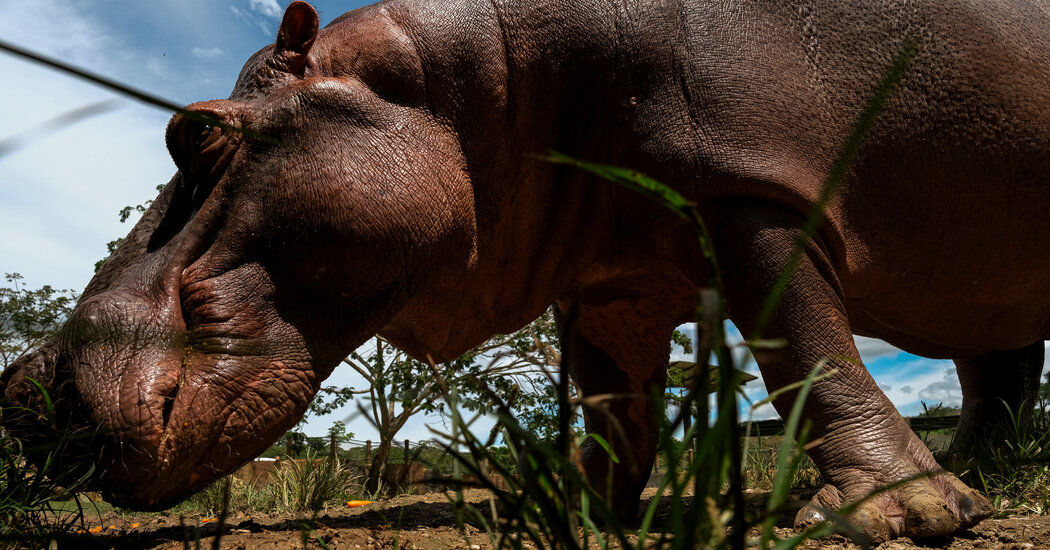
In the small Colombian village of Doradal, the usual nightly quiet is increasingly punctuated by the heavy, rhythmic thuds of 3,000-pound hippopotamuses making their way through residential areas. These large, semi-aquatic mammals, far from their native African habitats, have become an undeniable presence, impacting daily life, the local ecosystem, and the economy along Colombia’s Magdalena River.
Fishermen, who once relied on the river’s bounty, now report emptier nets, attributing the decline to the activities of these beasts. There is also a pervasive fear of casting lines after dark. Giovanny Contreras, a local fisherman, articulated the sentiment, stating, “They’ve changed our lifestyle,” as he navigated his boat past a hippo’s watchful eyes.
The proliferation of hippos in Colombia traces back to the eccentric acquisitions of notorious drug lord Pablo Escobar. In the 1980s, Escobar imported four hippos as exotic pets for his sprawling Hacienda Nápoles estate. Following his death in 1993, the 5,000-acre property fell into disarray. Most of the other exotic animals were relocated to zoos, but the hippos, left to their own devices in the ideal conditions of the Colombian countryside, thrived. With abundant water sources, lush grazing lands, and no natural predators, their numbers rapidly increased.
Today, an estimated 200 hippos roam freely, a population that scientists project could exceed 1,000 by 2035. Colombia officially declared the hippos an invasive species in 2022, recognizing the significant threat they pose to the nation’s biodiversity and human communities. These animals, which can grow to be the largest land mammals after elephants and rhinos, are known for their territorial nature and aggressive behavior, capable of outrunning humans on land and possessing immense power in water.
The Colombian government has explored various strategies to manage the escalating population. Attempts have been made to relocate hippos to international wildlife parks, but finding willing recipients for such large and potentially dangerous animals has proven challenging. Another method involves chemical castration, a complex and dangerous procedure requiring a team of at least eight individuals to trap, sedate, and operate on each animal. The scale of the problem makes these individual efforts largely insufficient to control the overall population growth.
Faced with the limited success of previous interventions and the rapidly expanding numbers, Colombian officials announced a controversial $2 million plan in April. This plan includes culling approximately 80 hippos, alongside continued efforts for relocation. The proposed methods for culling involve lethal chemical injections for animals that can be corralled, and in other cases, shooting them on sight, followed by on-site burial.
This decision has ignited a fierce debate, pitting animal rights organizations against conservationists. Environmental experts argue that without drastic measures, the hippos will continue to displace native species, disrupt delicate aquatic ecosystems by altering water chemistry through their waste, and degrade riverbanks through their grazing habits. Conversely, animal welfare groups contend that culling is inhumane, advocating for non-lethal solutions. An offer from an Indian billionaire to house some of the condemned hippos in his private wildlife park has emerged, but the logistical feasibility of such an intercontinental transfer for dozens of large animals remains uncertain.
The planned culling has also deeply divided the residents of Doradal, the town closest to Escobar’s former hacienda. For many, the hippos have become an integral part of the local identity and a significant driver of tourism. Kitsch hippo statues adorn the town, local businesses offer hippo-watching tours, and some residents even express a sense of pride and affection for the animals, despite their inherent danger. There have been reports of individuals attempting to breed baby hippos as pets, illustrating the complex relationship between the community and these unintended residents.
Samy Castaño, a 35-year-old resident whose home is near a hippo-filled pond, articulated the internal conflict: “I’m personally conflicted because I’m conscious that they have to eliminate or move them. But they’re also just animals, animals that aren’t to blame for the decisions of Pablo Escobar.” He also criticized the government for what he perceived as a delayed and insufficient response over the years. His 11-year-old daughter, Luciana, offered a more direct plea: “I don’t want them to kill them!” recounting a memorable encounter where a hippo attempted to peer into their living room window.
While often viewed with a mix of awe and caution, the danger posed by hippos is undeniable. In Africa, they are responsible for hundreds of human fatalities annually. In Colombia, serious incidents have been relatively limited but are growing. In 2020, a farmer suffered broken ribs in a hippo attack while gathering water. In 2023, a hippo was killed after being struck by a vehicle on a highway, though the driver escaped unharmed. Experts like Katherine Corrales, an invasive species specialist with a government environmental agency, warn that it is “only a matter of time before people die in such encounters” as the hippo population and its territorial expansion accelerate. “There is no invasive animal in the world that is so big,” Corrales emphasized.
A Drug Lord’s Exotic Zoo
Pablo Escobar’s Hacienda Nápoles, located in Doradal, was a testament to his immense wealth and eccentricities at the peak of his power. The property featured a Mediterranean-style mansion, a private airstrip, a bullfighting ring, and dozens of man-made lakes. To populate his private zoo, Escobar illegally imported a diverse collection of exotic animals, including elephants, giraffes, camels, rhinos, kangaroos, ostriches, deer, and the now infamous four hippos.
José Conrado Montoya Toro, an 85-year-old former caretaker at the estate, recalled the meticulous care provided to these animals in the 1980s. “All the animals had their specialized feeders,” he said, describing regular deliveries of fresh vegetables like cabbage, carrots, and lettuce for the entire menagerie.
After Escobar’s death in a shootout in Medellín, Hacienda Nápoles eventually fell into disrepair. The majority of the zoo’s animals were transferred to legitimate zoos across Colombia and beyond. However, the hippos, due to their size, aggression, and the logistical challenges of capture and relocation, were largely abandoned on the property. They quickly adapted to the lush environment, escaped the confines of the hacienda, and began to reproduce in the wild.
In an effort to erase the mythology surrounding Escobar, the Colombian government transformed Hacienda Nápoles into a privately run theme park. Complete with water slides and a zoo, the park has become a popular tourist attraction. A museum on the site deliberately minimizes direct references to Escobar, instead focusing on the violent history of his Medellín cartel and the thousands of lives lost during its reign of terror.
Why This Matters
The situation with Colombia’s hippos is more than just an unusual animal story; it represents a complex intersection of environmental, social, and historical issues with significant global implications. Environmentally, it serves as a stark case study in the challenges of managing invasive species, particularly large, long-lived mammals with high reproductive rates and no natural predators. The ecological impact—from altering freshwater ecosystems and displacing native wildlife to potentially affecting water quality and local agriculture—underscores the fragility of biodiversity and the ripple effects of human actions.
Socially, the conflict highlights the difficult balance between human safety, economic opportunity (tourism), and animal welfare. Local communities are directly impacted, facing both the dangers and the potential benefits of coexisting with these animals. It forces a conversation about who bears responsibility for the consequences of past decisions—in this case, those of a criminal figure—and how governments should address the ethical dilemmas of managing such populations. The division within Doradal reflects broader societal debates about conservation ethics and the role of sentimentality versus scientific necessity in environmental policy.
Historically, the “cocaine hippos” are a living legacy of Pablo Escobar, symbolizing the lasting and often unpredictable consequences of his illicit empire on Colombian society and its natural environment. It’s a poignant reminder that the actions of a few can have generations-long impacts, even affecting the very ecology of a nation. As the world grapples with increasing environmental pressures and the unintended consequences of human activity, Colombia’s hippo dilemma offers valuable lessons in invasive species management, post-conflict environmental remediation, and the enduring power of history to shape contemporary challenges.
Colombia Grapples with Legacy of Escobar’s Hippos as Invasive Species
In the heart of Colombia, a unique and complex environmental crisis is unfolding, rooted in the eccentricities of one of history’s most notorious drug lords. Decades after the death of Pablo Escobar, the hippopotamuses he illegally imported for his private zoo at Hacienda Nápoles have thrived beyond their enclosures, multiplying unchecked in the country’s fertile waterways. What began as a curiosity has evolved into a formidable ecological and socio-economic challenge, forcing Colombian authorities to confront difficult choices regarding an animal now officially designated an invasive species.
The story of Colombia’s hippos begins in the 1980s when Pablo Escobar, then at the height of his power and wealth, established a sprawling private menagerie on his Hacienda Nápoles estate. Among the exotic animals he collected, four hippopotamuses — one male and three females — were illegally brought from Africa. Following Escobar’s death in 1993 and the subsequent abandonment of the hacienda, most of the larger animals were relocated to zoos. However, the hippos, proving too large and logistically challenging to move, were left behind, believed to be contained within the estate’s extensive lakes. Unbeknownst to officials at the time, some had already escaped into the wild, marking the quiet genesis of a major ecological dilemma.
Today, Hacienda Nápoles operates as a popular theme park, a testament to its paradoxical transformation from a symbol of illicit wealth to a family-friendly tourist attraction. Visitors to the park can observe wild hippos from a safe distance on the former estate’s lakes, utilizing designated observation decks. The park also maintains two captive hippos, named Paco and Juaco, which tourists are permitted to feed carrots, offering a close-up encounter with these massive animals. Henri Samil Perez, a caretaker at the park, underscores the unique appeal: “They’re not animals you see every day. Having them here is a privilege for us,” he stated, while supervising families and cautioning children against approaching the corral.
A Growing Presence on the Magdalena River
While the hippos at Hacienda Nápoles remain a contained attraction, dozens of their descendants have ventured far beyond the estate’s boundaries. These wild hippos have migrated north along the Magdalena River, a vital and biodiverse artery that spans approximately 1,000 miles through Colombia. In this new habitat, these African giants face none of their natural predators, such as lions or crocodiles, which would typically regulate their populations in their native environment. This absence of natural checks has allowed their numbers to explode, with estimates suggesting a population of over 160 individuals and a potential to reach thousands within decades if left unmanaged.
The burgeoning hippo population poses a significant threat to Colombia’s delicate riverine ecosystems. Scientists express serious concerns that these large herbivores could displace native species, such as manatees and capybaras, from critical feeding grounds, disrupting the local food web. Furthermore, their sheer size and movements could alter riverbanks, leading to erosion and habitat degradation. Perhaps most critically, the massive amounts of excrement produced by hippos can significantly change the aquatic chemistry of the river, impacting water quality and threatening fish populations, which are a crucial food source and economic backbone for many local communities.
The Colombian government’s initial attempts to address the issue proved politically fraught. In 2009, state-sanctioned hunters culled an particularly aggressive male hippo known as “Pepe.” However, a leaked photograph showing smiling soldiers posing over the animal’s carcass ignited widespread national outrage and condemnation from animal welfare groups. The public backlash was so intense that a judge subsequently issued a ban on further culling, compelling officials to seek out non-lethal methods for managing the growing herd.
The primary responsibility for implementing these non-lethal strategies fell largely on David Echeverri, a Colombian biologist and local environmental official whose expertise was initially in botany. Echeverri and his team were forced to rapidly learn about hippo behavior and management. Their efforts involved luring some of the hippos into paddocks using vegetables, successfully capturing eight individuals who were then relocated to Colombian zoos. Dozens more underwent tranquilization and surgical castration, a challenging and labor-intensive undertaking often requiring six to eight hours of nighttime work per animal. Despite these dedicated efforts, Mr. Echeverri acknowledged the limitations: “The most complicated part is capturing the hippos,” he stated. “We weren’t able to stop population growth.” The difficulties associated with tracking, tranquilizing, and castrating such large, semi-aquatic animals in challenging terrain proved insurmountable in controlling the overall population expansion.
Faced with a rapidly increasing population and the ineffectiveness of non-lethal methods alone, scientific consensus began to shift. In 2021, a comprehensive study conducted by a group of scientists concluded that culling was one of the most effective and necessary ways to protect the fragile ecosystem of the Magdalena River. This scientific recommendation paved the way for a pivotal policy change: in 2022, the Colombian government officially declared the hippos an invasive species, a designation that legally opened the door to euthanasia as a management option.
For many local residents, particularly those whose livelihoods depend on the river, the call for culling is met with urgency. Mr. Contreras, a 48-year-old fisherman, expresses his eagerness for such measures to begin. He has largely abandoned fishing after dark, forfeiting what used to be his most lucrative hauls. The danger posed by hippos, massive and often invisible beneath the moonlight, is profound. Fishermen live in fear of unknowingly navigating their boats over a submerged hippo or, worse, provoking a territorial male, which can easily capsize and destroy a boat with a powerful toss of its head. “Instead of thinking so much about the lives of the animals,” Mr. Contreras remarked, articulating the sentiment of many in his community, “why don’t they think about the suffering of the fishermen and the poor who live on the river’s edge?” His plea highlights the stark human dimension of this ecological crisis, where the preservation of a introduced species comes at the cost of human safety and economic stability.
Why This Matters
The case of Colombia’s invasive hippos transcends a local environmental issue, serving as a compelling microcosm of complex global challenges in conservation and wildlife management. Firstly, it underscores the profound and often unforeseen consequences of introducing non-native species into new ecosystems. What might seem like an isolated act—the creation of a private zoo—can have ripple effects for decades, disrupting biodiversity and posing existential threats to indigenous flora and fauna. This highlights the critical importance of rigorous regulation and foresight in preventing such introductions worldwide.
Secondly, the dilemma surrounding the hippos exposes the deep ethical tensions inherent in conservation efforts. The public outcry over culling, contrasted with the scientific consensus supporting it as a necessary measure for ecological protection and human safety, illustrates the conflict between animal welfare sentiments and the pragmatic, often difficult decisions required to maintain ecosystem health. Governments and conservationists globally frequently grapple with similar choices when managing invasive species, from feral cats impacting bird populations to pythons devastating native wildlife. The Colombian experience offers a stark lesson in balancing public opinion, scientific evidence, and the welfare of both humans and native species.
Finally, this situation has significant socio-economic implications. The impact on fishermen like Mr. Contreras demonstrates how ecological disruptions directly affect human livelihoods and safety. The costs associated with managing invasive species—whether through non-lethal methods like capture and castration, or through culling—are substantial, burdening national and local economies. The case of Colombia’s hippos serves as a vital reminder that environmental policy decisions have direct and often profound consequences for communities, demanding integrated solutions that consider ecological integrity, human well-being, and long-term sustainability. It prompts a global conversation about shared responsibility for environmental stewardship and the challenging trade-offs involved in rectifying past mistakes.