
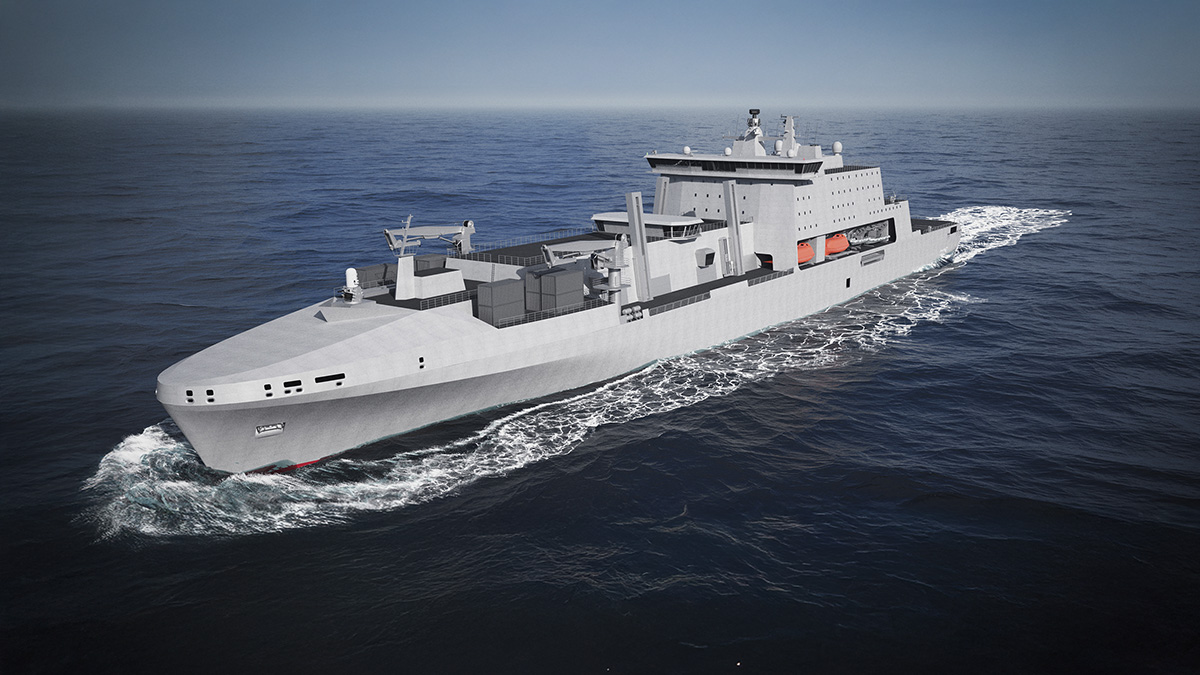
Production Underway for Royal Navy’s Fleet Solid Support Ships Across UK and Spain
Navantia UK has announced that production for the Royal Navy’s new Fleet Solid Support (FSS) ships is now actively underway across all its United Kingdom sites, working in tandem with facilities in Spain. This marks a significant milestone in a programme designed to enhance the operational capabilities of the Royal Navy and rejuvenate the UK’s shipbuilding industrial base.
The extensive manufacturing effort is proceeding concurrently across four key locations. In the UK, work is progressing at yards in Belfast, Appledore, and Methil. These sites are collaborating with Navantia’s established shipbuilding facilities in Spain, creating an integrated international production pipeline. Specific roles have been allocated to each site: Belfast is currently constructing test blocks for the vessels, while Appledore, situated in Devon, is focusing on the fabrication of bow sections. Concurrently, larger structural blocks are being manufactured at Navantia’s yards in Spain.
Methil, on the east coast of Scotland, plays a crucial role through its specialisation in fabrication and logistics. A notable contribution from Methil is the completion of a new transport barge, christened Navantia UK Seahorse. This purpose-built vessel is designed to facilitate the efficient movement of ship blocks between the various UK production sites, optimising the logistical flow of components within the distributed manufacturing model.
The programme is underpinned by substantial financial commitment from Navantia UK, with planned investments totalling £157 million across its four UK shipyards. A significant portion of this capital, specifically over £98.5 million, is being directed into the Belfast facility, while Methil is receiving £26.7 million. When combining the FSS-linked investments in Belfast and Appledore, the total has reached £114.4 million. This figure represents a notable increase over the £77 million initially committed under the pre-acquisition recapitalisation plans, signalling an enhanced commitment to modernising UK shipbuilding infrastructure.
In Belfast, the historic Harland and Wolff yard is undergoing a comprehensive modernisation programme. This includes the installation of state-of-the-art mechanised panel lines, advanced robotic plasma cutting systems, and sophisticated automated quality control processes. These upgrades are anticipated to be fully operational by July of the current year. Navantia describes the revitalised Belfast facility as operating under its ‘Shipyard 5.0’ concept. This advanced manufacturing paradigm integrates cutting-edge technologies such as robotics, extensive automation, and artificial intelligence (AI)-enabled processes directly into the production workflow, aiming for unprecedented levels of efficiency, precision, and safety.
Donato Martínez, CEO of Navantia UK, emphasised the multifaceted benefits of the programme. He stated that it is “not only delivering vital capability for the Royal Navy and Royal Fleet Auxiliary” but is also instrumental in “rebuilding industrial capacity, modernising infrastructure and creating a highly skilled workforce across the UK.” Martínez further characterised the evolving operational model across the sites as “a genuinely integrated shipbuilding enterprise, capable of delivering complex programmes at scale and positioning the UK strongly for future naval opportunities,” highlighting the long-term strategic vision behind the current efforts.
Echoing these sentiments, Alex Du Pre, FSS Project Leader at the National Armaments Director Group, commented on the broader implications of the investment. Du Pre stated that it “strengthens the UK’s sovereign industrial capabilities for the future,” underscoring the importance of domestic capacity in defence manufacturing. He further articulated that the shipbuilding sector is “vitally important, not just for the UK’s industrial resilience and national security, but also as an engine for economic growth,” pointing to the sector’s contribution beyond defence to the national economy and employment.
A crucial element of the programme involves a comprehensive knowledge transfer arrangement between the UK and Spanish teams. Engineers, project teams, and apprentices from across the UK business have undertaken placements alongside their colleagues in Spain. This collaborative initiative is designed to facilitate the exchange of expertise in advanced manufacturing techniques, digital programme management, and modern naval shipbuilding practices. This ongoing development is also reflected in Navantia UK’s commitment to workforce growth, with 222 apprentices currently employed across its sites and an additional 121 individuals scheduled to join the apprenticeship scheme later this year, securing a pipeline of skilled labour for the future.
The Fleet Solid Support ships are designated to perform a critical logistical role for the Royal Navy. These vessels will be responsible for resupplying carrier strike groups with essential provisions, including ammunition, stores, and general supplies, thereby extending the operational reach and endurance of the fleet. The final integration phase of these complex vessels is planned to take place in Belfast, signifying a full-circle contribution from the UK sites. Further significant production milestones are anticipated across all participating sites towards late 2026, as the programme continues its progression towards delivery.
Why This Matters
The commencement of production for the Fleet Solid Support (FSS) ships holds significant implications for the United Kingdom’s national security, industrial landscape, and economic future. These vessels are more than just supply ships; they are a critical enabler for the Royal Navy’s global ambitions and operational effectiveness.
From a **National Security** perspective, the FSS ships are indispensable. By providing sustained logistical support—including ammunition, food, and spare parts—to carrier strike groups, they significantly enhance the Royal Navy’s ability to operate independently and project power worldwide for extended periods. This reduces reliance on foreign port calls and strengthens the UK’s capacity to respond to international crises, participate in multinational exercises, and maintain its presence in key strategic regions. Their absence would severely curtail the operational reach and endurance of major naval assets like the Queen Elizabeth-class aircraft carriers, thereby diminishing the UK’s global influence and defensive posture.
For **Industrial Revival and Sovereign Capability**, this programme represents a pivotal moment. Decades of decline in UK shipbuilding capacity are being directly addressed through substantial investment and modernisation. The £157 million commitment from Navantia UK, particularly the upgrades at the Belfast yard to a ‘Shipyard 5.0’ model, signifies a commitment to state-of-the-art manufacturing. This not only creates immediate jobs but also rebuilds critical industrial skills and infrastructure, ensuring the UK can design, build, and maintain complex naval vessels. Strengthening sovereign industrial capabilities reduces dependency on foreign supply chains for defence assets, enhancing national resilience and the ability to maintain independent defence policies.
The focus on **Technological Advancement and Workforce Development** is also crucial. The ‘Shipyard 5.0’ concept, integrating robotics, automation, and AI, positions the UK’s shipbuilding sector at the forefront of modern manufacturing. This technological leap contributes to higher efficiency, precision, and safety standards, making the UK competitive for future advanced manufacturing contracts. Simultaneously, the extensive apprenticeship scheme and knowledge transfer programme with Navantia’s Spanish facilities are vital for cultivating a highly skilled workforce, ensuring the long-term sustainability and expertise within the industry. This investment in human capital prevents skill gaps and provides stable, high-value employment opportunities.
Finally, the project contributes significantly to **Economic Growth and Regional Development**. The substantial investments are creating jobs directly within the shipyards and indirectly across a wide supply chain, benefiting local economies in Belfast, Appledore, and Methil. This economic stimulus is particularly important for regions that have historically relied on heavy industry. The programme demonstrates a model of successful international industrial collaboration, leveraging expertise from both the UK and Spain to deliver a complex defence project, showcasing a path for future partnerships that can drive economic and strategic benefits for all involved.