
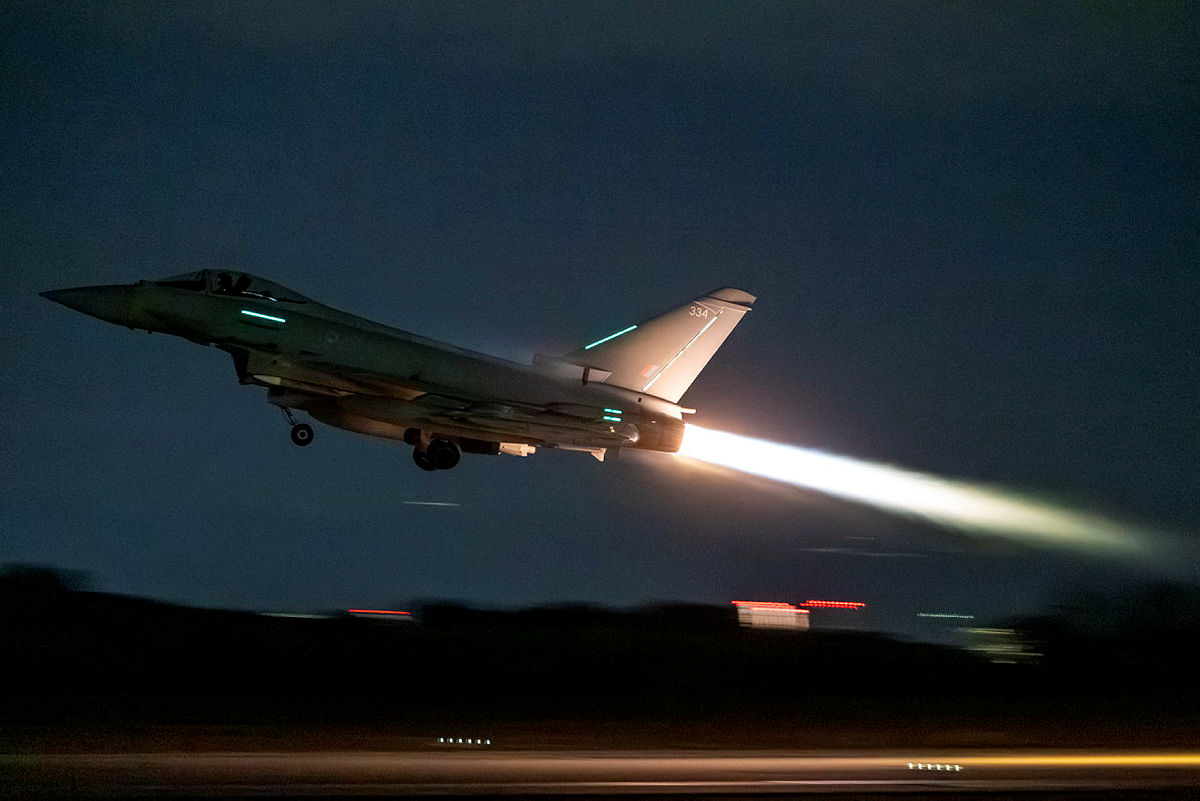
RAF Jets Scrambled to Respond to Unidentified Air Activity Near UK Airspace
On May 25, Royal Air Force (RAF) Quick Reaction Alert (QRA) Typhoon fighter aircraft were launched from RAF Lossiemouth, Scotland, in response to an unidentified aircraft detected heading towards UK and NATO-monitored airspace. The operation, which involved patrolling northeast of Shetland, was understood to be linked to potential Russian air activity.
The incident began when an aircraft, reportedly not in communication with air traffic control, was detected tracking down the Norwegian coast. Its trajectory indicated a potential approach towards airspace managed by the United Kingdom and its NATO allies. In response, RAF Lossiemouth initiated a QRA scramble, deploying Typhoon jets to intercept and identify the contact.
While the Ministry of Defence (MoD) did not explicitly name Russia in its public statement regarding this specific incident, defence sources indicated that the tasking was understood to be related to potential Russian air activity near NATO and national airspace. Such interactions are not uncommon in the strategically significant airspace of Northern Europe.
An RAF spokesperson confirmed the launch, stating: “RAF Quick Reaction Alert Typhoon fighter aircraft were launched on 25 May from RAF Lossiemouth this afternoon. The Typhoons were supported by a Voyager from RAF Brize Norton.” This statement underscores the coordinated nature of such air defence operations, which often involve multiple assets working in concert.
Supporting the Typhoon fighters was a KC.2 Voyager tanker aircraft, identified through open-source flight tracking with the callsign TARTAN 11 and registration ZZ336. This aircraft was observed routing from RAF Brize Norton, in Oxfordshire, towards the vicinity of Lossiemouth prior to the tasking. The Voyager’s role as an aerial refuelling platform is crucial in extending the operational range and endurance of fighter jets during prolonged patrols or interception missions. A Typhoon FGR.4, operating under the callsign PHANTOM 12, was also identified through similar tracking methods as being airborne in connection with the scramble, providing further detail on the assets deployed.
Quick Reaction Alert is a fundamental and routine component of the RAF’s broader air defence responsibilities. Its primary function is to safeguard the integrity of national airspace. QRA aircraft are maintained at an extremely high state of readiness, enabling them to take off within minutes of being alerted. These immediate response capabilities are vital for intercepting unidentified contacts that fail to adhere to international aviation norms. This includes aircraft that are not in communication with civilian or military air traffic control, have not filed a flight plan, or are not transmitting a recognisable secondary surveillance radar (SSR) code, which helps identify an aircraft’s identity and altitude.
The RAF’s overarching duty is to maintain control of the air over the United Kingdom and, when necessary, to protect UK interests overseas. This commitment is upheld through a network of strategically located air defence assets. Multirole Typhoon squadrons, which form the backbone of the RAF’s fighter fleet, are responsible for QRA duties from multiple bases. Key locations include RAF Lossiemouth in Scotland, RAF Coningsby in Lincolnshire, England, and in the Falkland Islands, providing comprehensive coverage across different regions of UK responsibility. The command and control of these operations are centralised, with Air Battlespace Controllers at RAF Boulmer in Northumberland directing fighter aircraft to intercept, identify, and, if required, intervene against aircraft approaching UK shores. This layered defence system ensures a robust response to any potential aerial threat or violation of airspace sovereignty.
Why This Matters
The scrambling of RAF Quick Reaction Alert jets, even for what is described as a routine procedure, carries significant implications across several dimensions, from national security to international relations:
Safeguarding National Sovereignty:At its core, a QRA launch is a robust demonstration of a nation’s commitment to defending its airspace sovereignty. Any unidentified aircraft approaching or entering national airspace without proper communication or identification protocols is a potential security concern. The rapid deployment of fighter jets asserts the right of a nation to control its skies and sends a clear message that such boundaries will be actively defended and monitored. This action reinforces the principle that all aircraft operating in international airspace near sovereign territory must adhere to established international aviation laws and procedures.
Maintaining Operational Readiness:These incidents serve as critical real-world drills for the Royal Air Force. They test the readiness, coordination, and capabilities of pilots, ground crews, air traffic controllers, and command structures. The ability to launch aircraft within minutes, conduct mid-air refuelling, and execute an interception operation under real-world pressure ensures that the RAF remains highly proficient and prepared for a range of contingencies, from benign identification to more hostile scenarios. It demonstrates that the substantial investment in advanced platforms like the Typhoon and Voyager is justified by their operational effectiveness.
Contribution to NATO Collective Defence:When incidents involve potential Russian air activity near NATO borders, as was understood to be the case here, the RAF’s response contributes directly to the broader collective defence posture of the North Atlantic Treaty Organization. NATO members routinely monitor and respond to non-cooperative aircraft in or near allied airspace. These coordinated responses demonstrate solidarity and a shared commitment to regional security, reassuring allies and signaling deterrence to potential adversaries. The UK’s actions in its area of responsibility are an integral part of this wider alliance framework.
Deterrence and Messaging:The consistent interception of non-compliant aircraft acts as a deterrent. It communicates to any nation or entity considering probing or testing air defence systems that such actions will be met with an immediate and professional response. While such flights may sometimes be intelligence-gathering missions or demonstrations of capability, the act of intercepting them ensures they are monitored, identified, and potentially escorted away, limiting their operational effectiveness and conveying a clear message about unacceptable behaviour in international airspace.
Geopolitical Context:Incidents involving Russian military aircraft near European airspace have increased in frequency since Russia’s invasion of Ukraine and preceding events. These interactions are often viewed through the lens of heightened geopolitical tensions. Each QRA scramble in this context serves as a reminder of the ongoing need for vigilance and robust air defence capabilities in Europe, highlighting the dynamic and sometimes unpredictable nature of international security. While the intent of such flights can vary, the necessity for a prepared and responsive air force remains constant.