
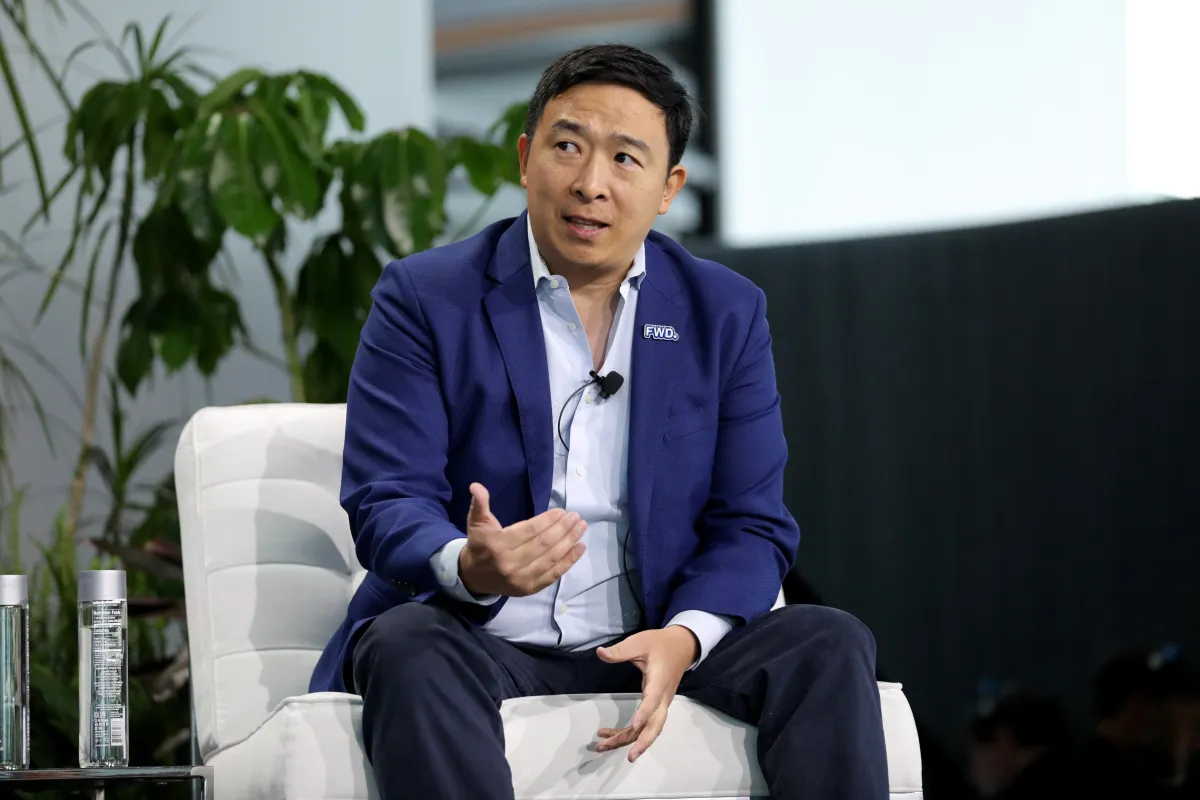
Key Takeaways: The “Give Back” Economy
- A New Business Imperative:Andrew Yang posits that the next wave of startup innovation will focus on businesses designed to reduce living costs and return value to customers, rather than maximizing extraction, a direct response to rising expenses and AI’s economic impact.
- Market-Driven Affordability:Drawing from his Universal Basic Income advocacy, Yang champions market solutions where companies like Cost Plus Drugs and his Noble Mobile proactively lower prices and share profits, making essential services more accessible.
- Shifting Investment Paradigms:While traditional VC still favors high-margin, AI-centric ventures, Yang argues that long-term economic stability and consumer buying power necessitate a shift towards socially beneficial, “give back” models, despite their thinner margins.
Andrew Yang’s Radical Proposition: What if Businesses Gave Money Back?
In an era increasingly defined by rapid technological advancement, particularly the rise of artificial intelligence, and a persistent squeeze on the average consumer’s wallet, a fundamental question emerges for entrepreneurs: what if the business model wasn’t about extracting maximum value, but rather about returning it?
This provocative query forms the bedrock of Andrew Yang’s latest entrepreneurial endeavor and his broader vision for the future of commerce. The former presidential candidate, known for his advocacy of Universal Basic Income (UBI), is now championing a new category of startups: those built on the principle of giving money back to customers, directly challenging the extractive nature of many traditional industries.
Inspired by Disruption: The Cost Plus Model
Yang’s epiphany, he shares, was sparked not by the usual titans of wealth, but by Mark Cuban’s groundbreaking venture, Cost Plus Drugs. Cuban’s audacious move to sell pharmaceuticals at cost, fundamentally disrupting a notoriously opaque and profit-driven industry, illuminated a path forward. “Housing, education, food, fuel, transportation, media, and wireless,” Yang detailed to TechCrunch’s Equity podcast, are the “things we all spend money on” — and thus, ripe for similar disruption.
The logic is compelling: as AI promises to reshape the workforce, potentially compressing wages and displacing millions, the imperative to reduce the cost of living becomes paramount. Yang sees not just a societal need, but a profound business opportunity in making basic necessities less expensive. This isn’t charity; it’s a recalibration of capitalism where value proposition is measured not just by service delivery, but by the margin returned to the customer.
Noble Mobile: A Personal Case Study in “Giving Back”
Putting his theory into practice, Yang last September launchedNoble Mobile, a mobile virtual network operator (MVNO). Unlike traditional carriers that incentivize data consumption, Noble Mobile offers cell service at a fraction of the cost and, crucially, gives customers money back if they use less data. This innovative approach aligns the company’s success with the customer’s financial well-being.
Since its launch, Noble Mobile has rapidly scaled to “thousands and thousands” of customers, generating “millions in revenue.” Yang underscores its operational efficiency: “We’re unit profitable per customer, but we just share the profits with our subscribers with the idea that it’ll make you happy, you’ll stay around, and maybe you’ll tell your friends and family.” The pitch is elegantly simple and financially impactful: an average monthly savings of $50, compounded over 40 years, could accumulate to a substantial $24,000 – a meaningful sum for a retirement down payment in today’s economy.
The Broader Ecosystem of Affordability
Noble Mobile is not an isolated experiment but an early standard-bearer for an emerging category. Alongside Cost Plus Drugs, other examples include the online grocery store Misfits Markets, which salvages “imperfect” produce to sell at lower prices, and even companies like Light Phone, which offer “dumb phones” as a minimalist, cost-effective alternative to expensive smartphones. These ventures collectively illustrate a growing trend where the core value proposition is the direct financial benefit to the consumer, achieved through operational efficiency, reduced overhead, or a deliberate choice to share margins.
The UBI Thesis Meets Market Reality
Yang’s focus on affordability and value redistribution is a direct evolution of his 2020 presidential campaign, where Universal Basic Income was central to his platform for combating AI-driven workforce displacement and wealth concentration. While government-led UBI remains a solution in his eyes, Yang is increasingly exploring how the market itself can become a vehicle for similar redistribution. “There is room for a direct connection between the money and the people,” he asserts, suggesting that where policy might falter or be inefficient, entrepreneurial innovation can step in.
He views AI not just as a threat, but as a catalyst. The immense value generated by AI companies, Yang argues, needs to find its way back into the hands of average Americans to sustain consumer demand and societal stability. Whether through government programs or, as he’s demonstrating, through market mechanisms, the principle remains the same: ensuring people can meet basic needs in an increasingly automated world.
Navigating Investor Skepticism in the Age of AI
Despite the compelling societal need and evident customer traction, attracting capital for “give back” businesses presents a unique challenge. In Silicon Valley, where venture capital often chases hyper-growth, high-margin, and increasingly, AI-centric endeavors, consumer-facing businesses with thin margins and a social mission can be a hard sell.
“I had at least one investor say to me around Noble Mobile, ‘Love you, Andrew, want to work with you — if you could just make this an AI company, we’ll invest,’” Yang recounts, highlighting the prevailing investor mindset. The immediate allure of AI’s potential for exponential returns often overshadows models focused on sustainable, socially beneficial growth.
However, Yang posits that this tide *must* change. Even the most profitable, “extractive” companies ultimately depend on an economy where consumers possess sufficient buying power to purchase their products and services. “The value being concentrated in the hands of a handful of folks and firms is just bad for everybody,” he states, echoing concerns about economic inequality and potential social instability. He notes that some forward-thinking individuals in Silicon Valley are beginning to recognize this, if only for pragmatic reasons like avoiding the need for “private security.”
The Entrepreneur’s Mandate: Think Bigger, Build Better
Yang’s message to aspiring founders and investors is clear: look beyond the immediate hype cycles. “Think bigger and more broadly about trying to tackle problems and don’t subscribe so much to groupthink, because there are some valuable opportunities out there,” he advises. The opportunity isn’t just in building the next AI platform, but in rethinking the foundational economic models that support society. It’s about building valuable enterprises that are intrinsically aligned with improving the lives of everyday people.
Bottom Line
Andrew Yang’s “give back” economy represents a potent paradigm shift, proposing that profitability and societal benefit are not mutually exclusive but can be deeply intertwined. As automation reshapes our economic landscape, businesses that prioritize reducing costs and redistributing value to consumers may not just be a niche, but a vital component of a more resilient and equitable future. While challenging prevailing venture capital norms, the long-term necessity of such models for widespread economic stability suggests they could very well define the next frontier of impactful innovation.
When you purchase through links in our articles, we may earn a small commission. This doesn’t affect our editorial independence.
{content}
Source:{feed_title}