
Modular Design Aims to Combat Rapid Obsolescence in Defence Technology
The defence industry has long grappled with the challenge of deploying systems that are technologically outdated almost as soon as they enter service. This issue is particularly acute in areas reliant on rapidly evolving digital technologies, such as sensors and computing. IDV, a defence vehicle manufacturer, states it has addressed this fundamental problem by designing its uncrewed ground vehicles (UGVs) with inherent modularity and upgradability, acknowledging the accelerated pace of technological advancement.
Dr. Geoff Davis, the managing director of IDV UK, highlights that the rate of improvement in key technologies like lidar, cameras, and processing units now dictates the development rhythm for the entire sector. He articulated that the capability of these sensors and their associated computing power effectively doubles approximately every eighteen months, often accompanied by a reduction in cost. This observation reflects a principle akin to Moore’s Law, originally posited by Intel co-founder Gordon Moore in 1965, which described the exponential growth in the number of transistors on a microchip while costs decreased. This principle has historically driven significant progress in computing, making devices smaller, faster, and more affordable. IDV’s argument is that a vehicle designed to ride this curve, rather than being fixed at its initial design specifications, can maintain relevance over its operational lifespan.
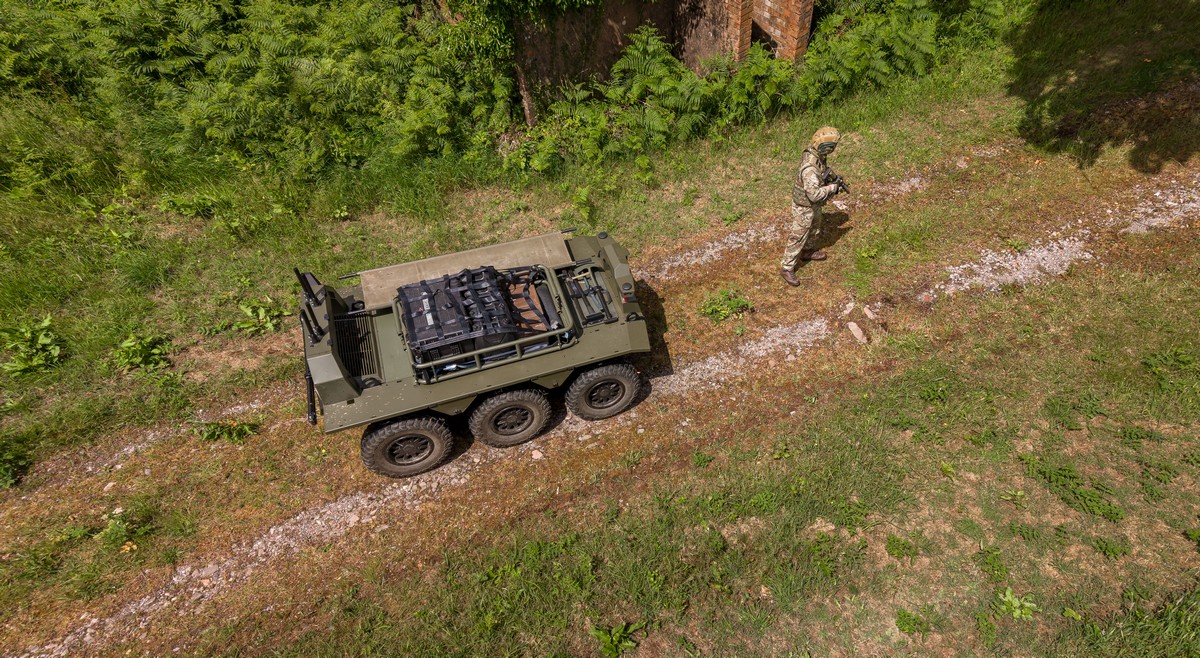
Dr. Davis offered a critical assessment of traditional defence acquisition methods, drawing a parallel with established industry practices. He described a conventional approach where significant time is allocated to design and testing – often five years for each phase – resulting in equipment that is potentially a decade behind current technology by the time it is deployed. In contrast, IDV’s strategy for its platforms, such as the Viking UGV, focuses on enabling multiple re-rolings and re-lifings. This is achieved by designing the base platform to be durable while allowing for the straightforward replacement and upgrade of its computational capabilities and sensors as new technologies emerge. According to Dr. Davis, a vehicle purchased today could receive next-generation lidar, cameras, and an entirely new compute capability within three years, transforming it from potentially obsolete to state-of-the-art.
The latest iteration of the Viking UGV exemplifies this philosophy. While retaining a familiar appearance to previous versions, it incorporates substantial re-engineering based on a decade of user trials. This includes repositioned and upgraded sensors, the latest computing hardware, and a transition from a parallel to a series hybrid drive system. These continuous refinements are central to IDV’s approach to maintaining technological currency.
Beyond initial deployment, the same modular thinking extends to battlefield repair and maintenance, a critical consideration underscored by recent conflicts, such as the war in Ukraine, where relatively inexpensive drones can neutralize high-value vehicles. Andrew Maloney, head of technology and chief engineer at IDV Robotics, emphasized the vehicle’s design for ease of field maintenance. He noted that changing a wheel is comparable to performing the same task on a conventional car. The vehicle is constructed around Line-Replaceable Units (LRUs), which are designed for rapid removal and replacement with minimal specialized tooling. For instance, batteries can be swapped by unplugging cooling pipes and electrical connectors, facilitating quick turnaround times in operational environments. This modularity extends to major components like the engine, further simplifying field logistics.
Payload integration also adheres to this flexible design logic. Standardized power and data connectors enable new mission systems to be quickly installed and integrated. The vehicle’s software is then designed to automatically detect these new payloads, providing the necessary menus and functions for their operation. Furthermore, the underlying artificial intelligence models responsible for detection and other functions can be retrained and reloaded as improvements become available, a process that can involve collaboration with international partners, including those within the Five Eyes intelligence alliance.
In essence, IDV’s proposition is a vehicle designed to age gracefully, akin to a fleet of mobile phones where the core hardware endures while its defining capabilities are regularly refreshed. This contrasts sharply with the traditional defence paradigm of long-lifecycle platforms that are difficult to update. The fundamental question that remains is whether established defence procurement systems, which are typically structured around multi-decade programs, can adapt to this accelerated pace of technological integration and acquisition. This shift in procurement strategy is a key challenge that initiatives like the Defence Investment Plan will need to address.
Why This Matters
The approach championed by IDV and similar innovators signifies a potentially transformative shift in military acquisition and strategic capability. The traditional model of defence procurement, characterized by protracted development cycles and long-term deployment of fixed systems, struggles to keep pace with the exponential growth in digital technologies. This often results in military forces operating with equipment that is technologically inferior to potential adversaries or even commercial innovations.
Firstly, this modular and upgradable design philosophy offers the prospect of **sustained military advantage**. By enabling rapid integration of the latest sensors, computing power, and AI, military platforms can remain at the cutting edge throughout their operational lives. This not only enhances performance in areas like reconnaissance, targeting, and autonomous operation but also ensures that defence forces maintain a qualitative edge, which is crucial for deterrence and effective response in modern conflicts. The ability to quickly update AI models, for example, could significantly improve threat detection and decision-making speed.
Secondly, it has profound implications for **cost-efficiency and resource management**. While the initial investment in a modular platform might be comparable, the long-term costs of ownership could be significantly reduced. Instead of procuring entirely new systems every decade, defence ministries could invest in targeted upgrades, extending the relevance and utility of existing assets. This shifts expenditure from outright replacement to continuous improvement, potentially freeing up budgets for other critical defence needs. Furthermore, simplified field maintenance, utilizing Line-Replaceable Units, reduces the logistical burden and costs associated with extensive factory-level repairs, improving operational availability.
Thirdly, the emphasis on **operational readiness and adaptability** is paramount. In an era of evolving geopolitical landscapes and hybrid threats, military forces require systems that can quickly adapt to new mission requirements and emerging threats. A modular architecture allows for the rapid integration of diverse payloads and software updates, enabling a single platform to serve multiple roles or adapt its capabilities to a changing battlefield environment. This agility is a distinct advantage over rigid, single-purpose platforms.
Finally, this paradigm challenges and could ultimately **reshape the defence industrial base**. It necessitates closer collaboration between military end-users and technology developers, fostering a culture of continuous innovation rather than discrete, project-based development. Defence contractors may need to evolve their business models to support long-term upgrade pathways rather than solely focusing on initial system sales. For governments, it means developing procurement strategies that can accommodate faster acquisition cycles and flexible contracting mechanisms, moving away from multi-year contracts for static platforms towards iterative development and ongoing technological refresh. This fundamental shift is not merely about new vehicles; it’s about redefining how nations equip their forces for the future.