
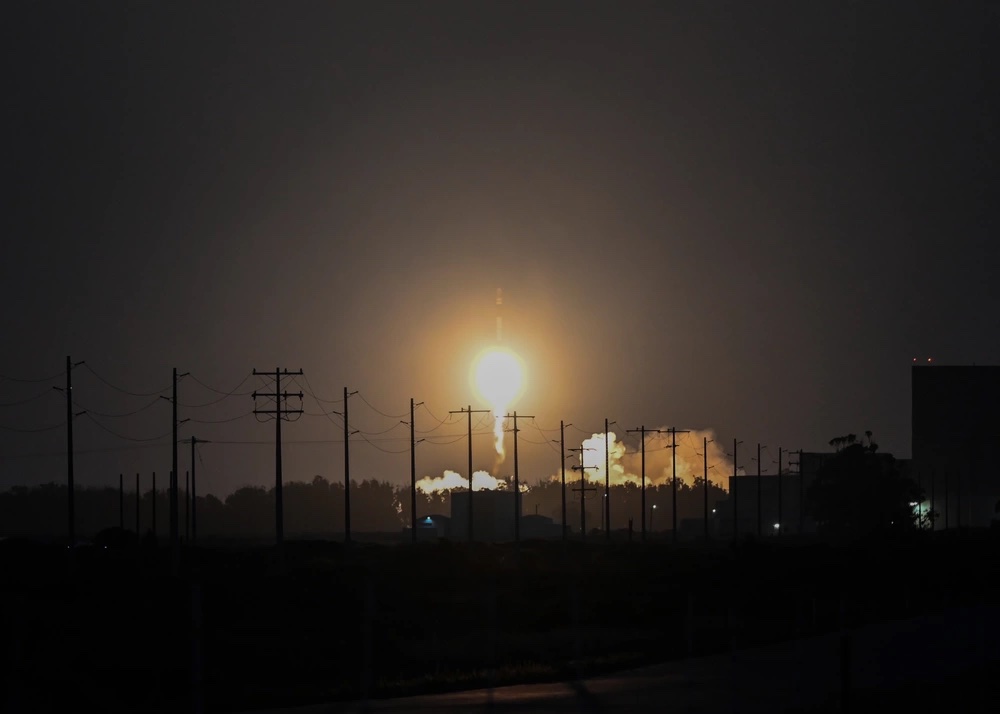
The Defense Advanced Research Projects Agency (DARPA) has initiated a search for advanced technological solutions to bolster the U.S. Space Force’s capabilities in rapidly responding to in-orbit threats and expanding critical “gap-filler” options during periods of crisis. This effort aligns with the Space Force’s ongoing development of mechanisms to address real-time orbital challenges.
Earlier this month, DARPA issued a Request for Information (RFI) titled “Rapid Reconstitution of Space Services.” This RFI invites companies to submit proposals detailing “technical solutions and operational concepts and strategies” aimed at enabling the Space Force to swiftly replace satellites that may be lost or damaged in an orbital attack. The initiative underscores a growing focus on maintaining space superiority and resilience in an increasingly contested domain.
“The overarching objective is to develop and implement effective response mechanisms that can swiftly restore critical space services to minimum operational levels, or even higher, within tactical timelines ranging from hours to weeks,” DARPA stated in its June 12 notice. This rapid restoration capability is deemed essential to address “demand surge needs, lost assets resulting from potential adversaries’ anti-satellite (ASAT) engagements, or orbital debris collisions.” The urgency of these timelines reflects the rapid pace of modern warfare and the indispensable role of space assets.
The Space Force is already pursuing several programs designed to enhance its ability to respond to threats in space. Two of the most prominent initiatives are the Tactically Responsive Space (TacRS) program and the Commercial Augmentation Space Reserve (CASR). TacRS primarily focuses on streamlining the processes for launching new satellites and delivering them into orbit, aiming to drastically reduce the time from conception to deployment. CASR, on the other hand, is establishing the necessary procedural, contractual, and policy frameworks to enable the Space Force to integrate and leverage commercial space services, such as satellite communications and space domain awareness, during times of heightened tension or conflict.
To date, the Space Force has conducted two significant TacRS missions. The first, Victus Nox, took place in 2023 and successfully demonstrated the ability to collaborate with satellite manufacturers and launch providers to deliver a spacecraft within a few months, followed by its deployment into low-Earth orbit a mere 27 hours after receiving the official launch order. This mission set a new benchmark for responsive space operations. Victus Diem, conducted earlier this year, was a tabletop exercise designed to further refine and solidify the service’s responsive launch protocols and decision-making processes, identifying potential friction points and optimizing workflows.
The Space Force has ambitious plans for at least four more TacRS missions, each designed to push the boundaries of scheduling, demonstrate novel operational concepts, and test new technologies. The next mission in this series, Victus Haze, was initially slated for launch last year but experienced delays due to issues with its designated launch provider, Firefly. While a spokesperson did not immediately confirm the precise timeframe, the service has indicated that Victus Haze is expected to fly within the current year, continuing the effort to validate and expand responsive space capabilities.
Concurrently, the Space Force has awarded initial CASR contracts to four specialized space domain awareness companies. These pilot contracts are crucial for testing the viability and efficacy of the commercial reserve fleet concept, allowing the service to integrate commercial capabilities into its operational framework. The Space Force plans to issue a broader solicitation later this year to scale up this capability, expanding the pool of commercial providers. Furthermore, it will initiate a pilot program for a new, as-yet-unnamed capability area, signaling its intent to continuously broaden the scope of commercial integration.
DARPA’s “Rapid Reconstitution of Space Services” RFI is specifically designed to concentrate on the underlying technologies that would enable the Space Force to swiftly adapt and maintain crucial capabilities in the aftermath of events such as an attack on its satellite infrastructure. This focus distinguishes DARPA’s initiative from the more operational and procedural emphasis of TacRS and CASR.
Steven Chambers, a program manager at DARPA, elaborated on this distinction in a statement to Air & Space Forces Magazine. “TacRS and CASR are actively working on improvements to address existing barriers related to space launch and the provision of space operations support by commercial entities,” Chambers explained. “This RFI aims to broaden that scope, exploring technologies that can overcome additional roadblocks to space resilience. DARPA’s ultimate goal is to develop and transition compelling new capabilities to the military services, filling critical technology gaps.”
The RFI presents a comprehensive list of 20 diverse examples of technologies and concepts that DARPA is interested in exploring. These range from fundamental advancements to highly specialized applications, all geared toward enhancing the resilience and responsiveness of space systems. Key areas of interest include:
- **Alternative positioning, navigation, and timing (PNT) solutions:** Technologies that can provide accurate PNT data independently of, or as a backup to, traditional GPS systems, which could be disrupted.
- **Technologies for very low-Earth orbit (VLEO) operations:** Innovations enabling satellites to operate efficiently and for extended periods in VLEO, offering advantages like reduced latency and improved resolution.
- **Cost-effective spacecraft to enable large-scale constellations:** Development of affordable, mass-producible satellites suitable for deploying large, resilient constellations that can absorb losses.
- **Launch vehicle payload integration advancements:** Solutions that streamline and accelerate the process of integrating diverse payloads onto various launch vehicles, reducing launch preparation times.
- **Spacecraft survivability and resiliency enhancements:** Technologies designed to make satellites more resistant to physical attack, electronic warfare, or extreme space environments.
- **Radiation-hardened electronics:** Development of electronic components capable of withstanding the harsh radiation environment of space, crucial for long-duration missions and resilience.
DARPA’s request highlights that current launch infrastructure constraints and the ever-increasing demand for lift capacity necessitate that the Space Force gain access to more reliable, resilient, and inherently flexible space systems. These systems must be capable of rapid assembly, launch, and deployment to meet emergent operational requirements.
“Reconstitution solutions must be designed with seamless integration into existing space architectures in mind,” DARPA emphasizes in the RFI. The agency suggests that potential solutions could involve the development of reconfigurable, software-defined, multifunctional, and multi-mission payloads. Furthermore, it points to the potential of proliferated/mesh architectures – where numerous, interconnected satellites create a robust network – and rapid on-orbit deployment concepts as promising avenues for achieving these goals.
Chambers clarified that this RFI is not directly linked to a larger, pre-existing DARPA project. Instead, it serves as a crucial mechanism for the agency to stimulate innovative ideas from industry and academia, and to keep its research interests transparently communicated to potential partners. He also noted that responses are welcome across the spectrum of technological maturity, encompassing both mature, “ready-now” solutions and more nascent, cutting-edge technologies that hold significant future promise.
Why This Matters
The U.S. military’s increasing emphasis on rapidly reconstituting space services holds profound implications for national security, economic stability, and the future of global power dynamics. Space has transitioned from a benign domain of scientific exploration to a critical, contested theater of operations. The ability to quickly replace or restore essential satellite functions in the face of attack or malfunction is no longer a luxury but a strategic imperative.
From a national security perspective, military operations across air, land, and sea are intrinsically linked to space-based assets. Satellites provide indispensable services such as precision navigation and timing (PNT) for weapon systems and troop movements, secure global communications, intelligence, surveillance, and reconnaissance (ISR), and missile warning. A sustained disruption of these services could severely cripple a military’s operational effectiveness, jeopardizing national interests and potentially putting personnel at risk. By developing rapid reconstitution capabilities, the U.S. aims to deter potential adversaries by demonstrating that any attempt to degrade its space assets would be met with swift recovery, negating the strategic advantage sought by such an attack. This capability bolsters the nation’s ability to project power and maintain situational awareness in a crisis.
Beyond military applications, civilian life is deeply intertwined with space infrastructure. Global Positioning System (GPS) supports everything from air traffic control and logistics to ride-sharing apps and banking transactions. Satellite communications enable internet access, television broadcasts, and emergency services in remote areas. Weather satellites provide crucial data for forecasting, impacting agriculture, disaster preparedness, and aviation. The economic impact of a widespread, prolonged disruption of these services would be catastrophic, leading to market instability, supply chain breakdowns, and societal chaos. DARPA’s efforts to find technologies for “minimum levels or higher” restoration within weeks or even hours underscore the recognition of space as a global public good that requires robust protection and resilience.
In the geopolitical landscape, several nations are actively developing and testing anti-satellite (ASAT) weapons, including ground-based missiles, co-orbital systems, and cyber capabilities. This burgeoning ASAT threat environment makes the ability to reconstitute space services a crucial element of strategic stability and deterrence. If a nation can quickly replace lost assets, it lessens the incentive for an adversary to initiate an ASAT attack, as the strategic benefit would be transient. Furthermore, investments in technologies like radiation-hardened electronics and alternative PNT solutions showcase a commitment to operating effectively even in degraded or contested space environments, enhancing overall resilience. This RFI also signals to the commercial space industry that their innovation is vital for national defense, potentially spurring further investment and technological advancements in the private sector.