
UK Indefinitely Pauses Critical Security Upgrades for Ministerial Jets
The United Kingdom’s Ministry of Defence (MoD) has confirmed that work to equip the Royal Air Force’s Envoy IV ministerial jets for operations in what is termed “non-benign airspace” has been paused indefinitely. This programme, crucial for enhancing the security of senior government and military officials during travel to high-threat zones, currently has no set date for recommencement, with the department citing a prioritisation of other defence activities.
The confirmation came in a written answer to a parliamentary question posed by Conservative MP Ben Obese-Jecty. He had sought clarification following an earlier response from June 8, asking until what specific date the work had been halted. Luke Pollard, the Minister for Defence Readiness and Industry, responded: “The work to enable Envoy IV aircraft operations in non-benign airspace has been paused, and there is currently no definitive date for when this activity will recommence. The Department’s programme priorities are kept under regular review to ensure alignment with operational requirements and available resources.”
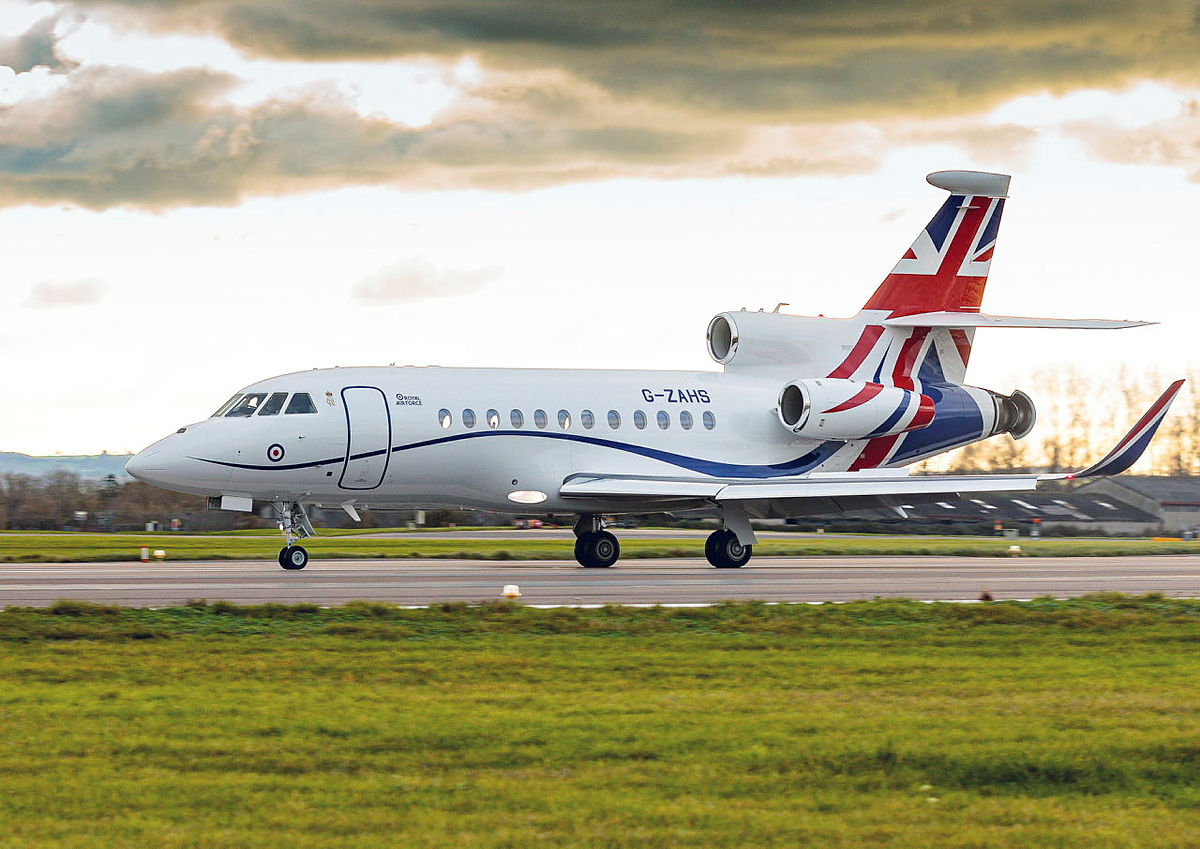
This latest statement provides no firmer indication of a restart point for what is intended to be the second, critical phase of the Command Support Air Transport (CSAT) recapitalisation programme. This contractual line item is designed to transition the RAF’s two Dassault Falcon 900LX jets onto the full Military Aircraft Register and integrate the advanced defensive systems necessary for safe operation in theatres where the threat picture is considerably more demanding and fluid.
The Envoy IV designation refers to two Dassault Falcon 900LX business jets procured by the Ministry of Defence following the 2021 Integrated Review. These aircraft were acquired to replace the long-serving fleet of four BAE Systems 146 jets, which for many years had transported prime ministers, senior officials, and high-ranking military commanders into various theatres of operation, including challenging environments like Iraq and Afghanistan.
The Falcon jets formally entered service in June 2022. While owned by the military, they are currently registered with the civilian aviation regulator. Their crews comprise a mix of military and civilian pilots, supported by RAF cabin staff. The initial understanding and intention behind their acquisition was that they would eventually transition to a fully military footing, a move that would unlock their full strategic potential.
This anticipated transition, constituting the second phase of the Command Support Air Transport programme, was always envisioned to bring the new fleet up to the same robust, hard-edged standard that the predecessor BAe 146s had maintained. The essential fit-out includes a sophisticated defensive aid suite, specifically engineered to detect, confuse, and defeat incoming threats such as missiles and other seeker-equipped weapons. Alongside this, a secure communications package is critical for maintaining robust and uncompromised command and control in sensitive areas. Furthermore, the aircraft require specific military certification to operate safely and effectively in airspace where the operating environment can degrade or change rapidly, often without warning. This phase was also intended to consolidate aircraft operation under sole RAF crew control, supported by a long-term maintenance agreement projected to run through to 2037.
Minister Pollard’s earlier answer on June 8, which prompted the recent follow-up question, had informed Parliament that the Envoy IV aircraft were continuing to provide vital command support across a range of air mobility tasks. At that time, he stated that several options were being considered to expand the fleet’s future capability, explicitly mentioning the planned military modifications. He had then indicated that the work was “currently paused whilst other activity has been prioritised.” The latest parliamentary answer now clarifies that this pause is not a temporary delay with a defined end-point, but rather an open-ended cessation of activity.
This position places the United Kingdom in a notably different strategic posture compared to many of its key allied air forces. A number of allied nations maintain dedicated, militarised executive jets, specifically equipped and certified to carry their political and military leadership into contested and high-risk theatres. The defensive aid suites typically integrated into such aircraft are designed to counter a spectrum of threats, most notably man-portable air defence systems (MANPADS), which have become increasingly widespread and accessible globally in recent years, as well as infrared-guided weapons more generally. The absence of such a capability for the UK’s leadership could have significant implications for national security and international engagement.
Why This Matters
The indefinite pause in upgrading the UK’s Envoy IV ministerial jets has several critical implications for national security, strategic flexibility, and the safety of high-ranking officials. Firstly, and most directly, it impacts the safety of the Prime Minister, senior government ministers, and top military commanders when they need to travel to regions experiencing conflict, instability, or heightened geopolitical tensions. Without the planned defensive aid suites, secure communications, and military certification, these aircraft remain vulnerable to threats such as man-portable air defence systems (MANPADS) – inexpensive yet highly effective weapons that are increasingly prevalent in various global hotspots. This vulnerability could either expose leaders to unacceptable risk or severely restrict their ability to visit critical theatres, potentially requiring reliance on less flexible commercial charters or the transport assets of allied nations, which could entail delays or compromise operational secrecy.
Secondly, this decision creates a significant capability gap compared to key international partners. Major allies such as the United States, France, and Germany operate dedicated fleets of hardened executive transport aircraft designed specifically for operations in “non-benign airspace.” By not equipping its own fleet to a similar standard, the UK loses a degree of strategic autonomy and flexibility, potentially hindering its ability to project influence, conduct urgent diplomacy, or provide immediate, high-level support to military operations in contested environments. In an increasingly complex and volatile global security landscape, the ability to rapidly and securely deploy national leadership is a crucial component of statecraft and defence readiness.
Thirdly, the pause raises questions about the efficiency and long-term vision for the Command Support Air Transport programme. A significant investment has already been made in acquiring the Dassault Falcon 900LX jets to replace the older BAe 146 fleet. However, by not proceeding with the second phase of modifications, the UK is not fully realising the strategic benefits of this investment. The aircraft, while capable, are essentially operating below their intended and necessary capability ceiling for high-risk missions. This could be seen as an underutilisation of assets, where the full return on investment in terms of enhanced security and operational readiness is not being achieved.
Finally, the indefinite nature of the pause, driven by “other priorities” and “available resources,” signals potential pressures within the Ministry of Defence’s budget and strategic planning. While resource allocation is always a complex balancing act, deferring critical safety and operational enhancements for national leadership transport in a period of heightened global instability prompts scrutiny. It underscores the challenges facing defence planners in matching capabilities with evolving threats, and highlights the ongoing debate about the UK’s defence posture and its capacity to respond effectively across the full spectrum of modern security challenges.