
Unlock the Editor’s Digest for free
Roula Khalaf, Editor of the FT, selects her favourite stories in this weekly newsletter.
Key Takeaways
- AI’s Budget Reallocation Power:IBM’s significant profit warning underscores how the generative AI boom is rapidly reordering corporate IT budgets, prioritizing specialized compute infrastructure and cloud resources over traditional enterprise software and mainframe investments.
- Execution and Adaptability Challenges:Despite strategic pivots towards hybrid cloud and software, IBM’s miss highlights the profound difficulties even established tech giants face in executing swiftly and anticipating the magnitude of market shifts driven by transformative technologies.
- Broader Market Scrutiny for Enterprise Tech:This event signals potential headwinds and increased investor scrutiny for other established enterprise technology vendors, as clients re-evaluate spending patterns, potentially favoring AI foundational investments and hyperscaler solutions over legacy systems.
In a stark illustration of how rapidly the generative artificial intelligence boom is reshaping corporate IT spending, IBM issued a profit warning that sent its shares plunging more than 20 per cent. The tech giant revealed that enterprise customers are aggressively redirecting their capital expenditure towards securing supply-constrained AI-optimized servers and storage infrastructure, ahead of anticipated price increases, rather than funneling budgets into traditional mainframe systems and related software as IBM had expected.
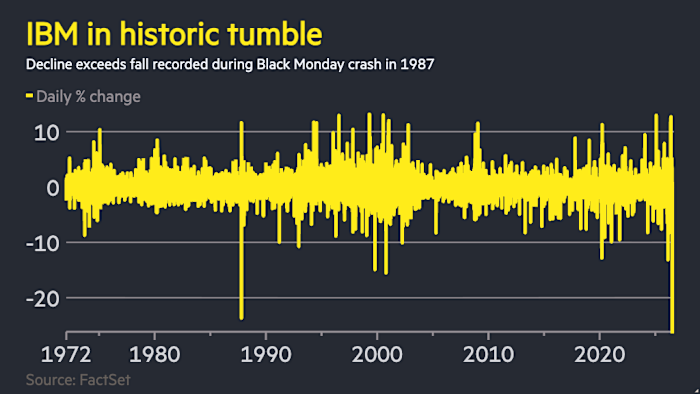
The market’s reaction was swift and brutal. Shares closed 25 per cent lower, marking the biggest single-day drop since at least 1972 and surpassing even the fall recorded during the infamous 1987 Black Monday crash. This seismic shift in investor confidence reflects a growing apprehension about the future of legacy tech companies amidst an unprecedented AI investment cycle.
IBM, long striving to recast itself from a hardware-centric entity to a faster-growing hybrid cloud and software group, had forecast robust sales in its mainframe division and associated software. However, the reality proved dramatically different, as corporate clients opted to procure computing infrastructure from alternative providers, often the hyperscale cloud giants or specialized hardware manufacturers benefiting directly from the AI gold rush.
“These conditions require our teams to execute perfectly, and this quarter we faltered,” admitted chief executive Arvind Krishna. His candor highlighted a critical lapse in anticipating market dynamics. “We did not adapt and move quickly enough, and numerous large deals failed to close on the timelines we expected, driving the majority of our shortfall.” This admission resonates deeply with investors who are increasingly punishing companies perceived as slow to react to technological paradigm shifts, especially in a challenging macroeconomic environment characterized by persistent inflationary pressures and higher interest rates.
The financial figures painted a concerning picture. Infrastructure revenue, a key segment for IBM, tumbled 7 per cent in the second quarter, significantly worse than the “low single-digit” decline the company had projected. While software revenue managed a modest 5 per cent rise, it was insufficient to offset the broader weakness. Overall revenues came in at $17.2bn, up a mere 1 per cent on the same period a year ago, but critically, fell short of analyst estimates of $17.8bn. Earnings per share also disappointed, dropping 2 per cent to $2.27 and missing forecasts, further signaling a broader erosion of profitability.
This warning exposes the significant challenge facing IBM as it navigates a dual transformation: pivoting from its mainframe heritage while simultaneously contending with a market-wide AI investment cycle that is actively siphoning corporate budgets. After spending tens of billions of dollars on strategic acquisitions, including Red Hat, HashiCorp, and Confluent, IBM aimed to bolster its hybrid cloud and enterprise software offerings. However, the current environment raises new questions over the durability and growth prospects of established software businesses when foundational AI infrastructure demands dominate enterprise spending priorities.
Krishna had previously sought to position IBM to capitalize on the AI boom, describing the acquisition of data streaming platform Confluent in December as an opportunity to “deploy generative and agentic AI better and faster.” Yet, he conceded that IBM had failed to anticipate the “magnitude” of the shift in spending, as clients raced “to secure supply-constrained infrastructure ahead of expected price increases.” This phenomenon is largely driven by the insatiable demand for high-performance GPUs and specialized AI processing units, where supply chains remain tight and pricing power is firmly with the manufacturers and cloud providers who can secure components.
Compounding these challenges, Krishna added that customers had also been “distracted” by “rapidly evolving, industry-wide cyber security concerns.” While cybersecurity is a critical area of spending, this commentary suggests that even in areas of heightened concern, IBM may not be capturing the full benefit, or that these concerns are diverting budgets away from other planned IT projects.
The US group has also struggled to shake off investor concerns about the long-term outlook for established software companies. In February, the company’s shares tumbled after Anthropic, a leading AI startup, announced that its Claude Code AI tool could help modernize a programming language used on IBM’s mainframes. Such developments highlight the potential for generative AI to not only create new markets but also to fundamentally disrupt existing ones, potentially commoditizing or diminishing the value of legacy systems and the companies built around them.
Market Impact
IBM’s dramatic profit warning serves as a significant bellwether for the entire enterprise technology sector. It underscores the profound and rapid re-prioritization of IT budgets driven by the generative AI revolution, signaling that traditional hardware and software vendors with significant legacy footprints may face increasing headwinds. Investors are likely to scrutinize other established players for similar signs of budget reallocation, favoring companies with direct exposure to AI infrastructure, cloud hyperscalers, and specialized AI software providers. This event could accelerate the shift of capital expenditure away from on-premise solutions and into public cloud environments that offer scalable AI resources, putting pressure on hybrid cloud strategies that rely heavily on traditional infrastructure sales. Ultimately, IBM’s struggles reflect a market in flux, where adaptability, agility, and a clear AI strategy are no longer optional but essential for maintaining investor confidence and long-term growth.
Additional reporting by Emily Herbert in London