
**Key Takeaways**
* **Geopolitical Risk Ignites Oil Price Shock:** Brent crude surged past $87 a barrel following intensified US-Iran confrontations over the strategically critical Strait of Hormuz, immediately re-igniting fears of global supply disruptions and threatening to derail disinflationary trends.
* **Inflationary Pressures Threaten Monetary Policy Outlook:** Sovereign bond yields in major economies spiked, reflecting investor concerns that central banks may be forced to maintain higher interest rates for longer, or even consider further hikes, to combat renewed energy-driven price pressures, complicating the path to economic stabilization.
* **Equity Markets Face Stagflationary Headwinds:** Global stock indices retreated broadly, as the dual specter of elevated energy costs eroding corporate margins and consumer purchasing power, combined with the prospect of prolonged tight monetary policy, amplified concerns about a potential stagflationary environment and a slowdown in corporate earnings growth.
Stay informed with free updates
Simply sign up to the Oil myFT Digest — delivered directly to your inbox.
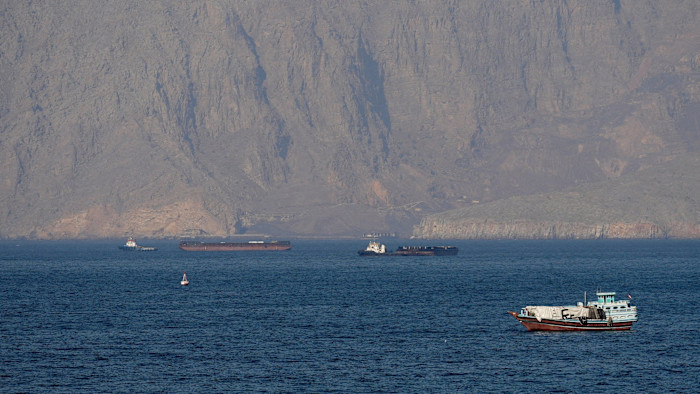
The global financial landscape was rattled on Tuesday as **oil climbed past $87** for the first time since the US and Iran agreed to extend their ceasefire, with the **intensifying battle for control of the Strait of Hormuz** sending a shockwave through energy and broader financial markets. This significant escalation in geopolitical tensions, centered on one of the world’s most vital energy chokepoints, has swiftly re-calibrated market expectations for inflation, interest rates, and global economic growth.
Brent crude, the international benchmark, **jumped as much as 5 per cent to $87.55 a barrel, extending gains made on Monday, when prices surged almost 10 per cent.** This rapid ascent underscores the market’s acute sensitivity to supply disruptions, particularly from a region responsible for roughly one-fifth of global oil consumption and a significant portion of liquefied natural gas (LNG) traffic. The Strait’s strategic importance cannot be overstated; any sustained disruption would have profound consequences for energy security and prices worldwide.
The **higher oil price reverberated across global markets, hitting stocks and bonds amid fears of a renewed inflation shock.** Investors are now grappling with the potential for crude’s surge to permeate through supply chains, increasing input costs for businesses and reducing discretionary spending power for consumers. This directly challenges the narrative of moderating inflation that central banks have been attempting to foster, creating a difficult dilemma for policymakers.
“Clearly this is escalating,” said Mike Bell, head of market strategy at RBC BlueBay Asset Management, adding that “we are starting from a worse place in terms of global oil inventories now” compared with the initial oil price surge in March. Bell’s assessment highlights a critical vulnerability: **global oil reserves have been diminished since March, as countries tapped into their stockpiles to shield their economies from the effects of the strait’s closure.** The Strategic Petroleum Reserve (SPR) in the US, for instance, has been drawn down significantly in recent years. This reduction in available buffers means the global economy is far less prepared to absorb a prolonged supply shock, making the current escalation particularly dangerous for price stability. “If the Strait of Hormuz is closed for another prolonged period from here, it’s a much worse starting point than when the initial conflict kicked off,” Bell added, underscoring the precarious state of global energy security.
The immediate fallout was evident in sovereign debt markets. **UK government borrowing costs, which are particularly sensitive to high energy costs, climbed back above 5 per cent for the first time since May**, indicating a sharp repricing of inflation expectations and the perceived trajectory of the Bank of England’s monetary policy. Similarly, **the 10-year US Treasury yield was up 0.01 percentage points at 4.62 per cent**, signaling a broader investor shift towards demanding higher compensation for holding government debt in an environment of elevated inflation risk. Bond investors are effectively signaling that central banks, particularly the Federal Reserve and the Bank of England, may be forced to maintain a hawkish stance for longer than previously anticipated, potentially pushing back the timeline for interest rate cuts or even necessitating further hikes.
Equity markets, too, felt the immediate strain. **The Stoxx Europe 600 slipped 0.6 per cent, while the FTSE 100 was down 0.4 per cent.** Across the Atlantic, **US stocks closed lower on Monday, with the blue-chip S&P 500 index down 0.8 per cent and the tech-heavy Nasdaq Composite falling 1.6 per cent. Futures tracking the S&P were flat on Tuesday**, indicating a cautious start to the trading day as investors digested the full implications of the geopolitical developments. The sell-off was broad-based, with sectors heavily reliant on energy inputs, such as airlines, transportation, and manufacturing, particularly vulnerable. Tech stocks, which often benefit from lower interest rates and stable growth, also suffered as higher bond yields make future earnings less attractive and borrowing costs for growth companies rise.
“Rising tensions in the Middle East are dominating markets,” said Mohit Kumar, a strategist at Jefferies, succinctly capturing the prevailing sentiment. The geopolitical premium embedded in oil prices reflects not just current supply concerns but also the elevated risk of further escalation, which could lead to more severe disruptions. **The strait has become an explosive flashpoint between Washington and Tehran, with both sides claiming to control a waterway that is critical to supplying the world with oil and gas.** This fundamental disagreement over sovereignty and transit rights, coupled with direct military actions, creates an exceptionally volatile environment.
“With the road to normalised energy supply out of the Gulf seemingly blocked . . . bonds are taking the view that the inflation pulse might exist for longer,” said Stephen Jones, CIO at Aegon Asset Management. This perspective underscores the shift from hopes of “transitory” inflation to a more entrenched, supply-side driven inflationary pressure that central banks have fewer tools to address without triggering a significant economic slowdown. The risk of “stagflation” – a combination of high inflation and stagnant economic growth – looms larger over the global economy.
**US forces struck Iran overnight, the sixth wave of attacks since President Donald Trump last week resumed air strikes in retaliation for Iran hitting commercial vessels in the strait, with the Islamic republic targeting two tankers with cruise missiles.** This direct military engagement marks a significant escalation from previous proxy conflicts or maritime incidents, indicating a more aggressive posture from both sides. **Oil’s rally accelerated on Monday after Trump said the US would reinstate its naval blockade of Iran and charge a 20 per cent fee on cargo moving through the contested waterway.** A naval blockade would severely restrict commercial shipping, effectively cutting off a significant portion of global oil supply. The imposition of a “toll” or fee, regardless of its enforceability or legality under international law, adds another layer of cost and uncertainty for shippers, directly impacting global trade and energy prices.
Jim Reid, a strategist at Deutsche Bank, said that “the very spectre of tolls will make markets nervous.” Indeed, the uncertainty alone can drive up insurance premiums for tankers, deter shipping companies, and ultimately lead to higher prices for consumers. This punitive measure, if implemented, could further fragment global trade routes and exacerbate inflationary pressures.
The renewed hostilities over the strait come ahead of US inflation figures on Tuesday, which are expected to show that price growth eased from 4.2 per cent in May to 3.8 per cent in June, according to a poll of economists. However, any positive news from these backward-looking figures is likely to be overshadowed by the forward-looking inflation risks posed by the surging oil prices. Central bankers, who have been hoping for a clear path to disinflation, now face a significantly more complex and challenging landscape, potentially forcing a re-evaluation of their monetary policy strategies. The geopolitical wild card has injected profound uncertainty into the disinflationary trend.
Market Impact
The immediate market impact is a sharp de-risking across asset classes. Investors are fleeing equities for perceived safety, albeit with government bonds offering less refuge due to inflation fears. Higher oil prices directly translate into increased operational costs for businesses, potentially squeezing profit margins and leading to downward revisions of corporate earnings forecasts. Consumers will face higher fuel and utility bills, eroding disposable income and dampening retail sales, thus slowing economic activity. Central banks are confronted with a difficult choice: aggressively combat inflation at the risk of inducing a recession, or tolerate higher prices and risk de-anchoring inflation expectations. This geopolitical shock significantly increases the probability of a “higher for longer” interest rate environment, impacting capital flows, currency valuations, and the sustainability of global debt, while amplifying the risk of a broad-based economic slowdown or stagflation.