
Unlock the Editor’s Digest for free
Roula Khalaf, Editor of the FT, selects her favourite stories in this weekly newsletter.
Key Takeaways:
- Hawkish Pivot Amid Inflationary Pressure:The Bank of Korea’s (BoK) 25 basis point rate hike marks a significant shift towards a hawkish monetary policy, directly addressing persistent inflation (3.2% in June) and the weakening Korean Won, signaling a prioritization of price stability over unbridled growth despite robust economic data.
- Balancing Act: Semiconductor Boom vs. External Headwinds:While Korea’s economy enjoys an AI-driven semiconductor export boom – pushing exports up 70.9% and leading to an upgraded 2026 growth forecast to 3% – the central bank is grappling with imported inflation exacerbated by a depreciating Won and escalating global energy costs stemming from Middle East tensions.
- Currency Under Scrutiny & Financial Imbalances:The Won’s continued weakness against the dollar, despite a record current account surplus, highlights deep structural issues like capital outflows from corporate reinvestment abroad and overseas equity purchases. This depreciation fuels import-driven inflation and contributes to concerns over domestic financial imbalances, including surging housing prices and high household debt.
Seoul Signals Monetary Tightening Amid Global Headwinds and Domestic Boom
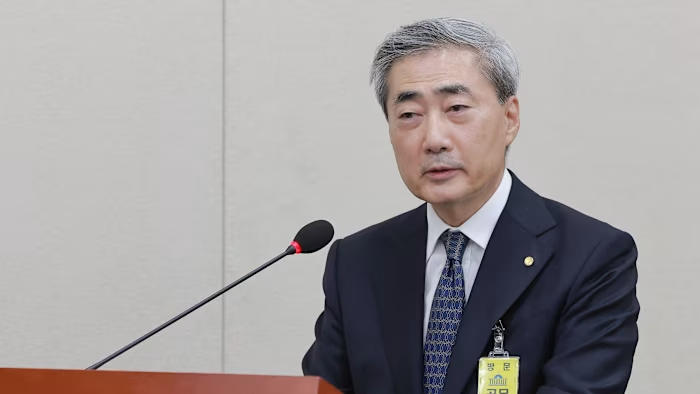
The Bank of Korea (BoK) has delivered a decisive monetary policy pivot, raising its benchmark interest rate by 0.25 percentage points to 2.75 per cent. This move, the first rate increase in over three years and the inaugural policy decision under the stewardship of Governor Shin Hyun-song, a renowned international economist who assumed leadership in April, signals a firm commitment to reining in inflationary pressures that threaten the nation’s economic stability. The decision follows a prolonged period where rates were held steady at 2.5 per cent, reflecting a significant shift in the central bank’s macroeconomic assessment.
This tightening cycle unfolds against a complex backdrop. Globally, renewed conflict in the Middle East has roiled energy markets, pushing up crude oil prices and subsequently increasing import costs for energy-dependent economies like South Korea. Domestically, while the economy is experiencing a robust recovery fueled by an unprecedented semiconductor boom, it simultaneously grapples with a persistently weak Korean Won and inflation running well above the BoK’s target. These factors collectively informed Governor Shin’s stressed need for a tighter monetary stance, acknowledging both the country’s economic strengths and its vulnerabilities.
The Won’s Conundrum: Depreciation Despite Surplus
A central concern for the BoK has been the Korean Won’s performance, which has depreciated to its lowest level against the US dollar since the 2008 global financial crisis. This currency weakness directly exacerbates inflationary pressures by making imported goods, particularly crucial energy supplies, more expensive. The paradox lies in the fact that this depreciation has occurred despite South Korea posting a record current account surplus, typically a bullish signal for a nation’s currency.
Analysts attribute the Won’s perplexing weakness to a combination of factors related to capital flows. A significant portion of the surplus is reportedly being retained overseas by Korean exporters for reinvestment purposes, rather than being repatriated. Concurrently, a surge in overseas equity purchases by both Korean institutional and retail investors represents a sustained outflow of capital, further dampening demand for the Won. This structural capital outflow dynamic presents a formidable challenge for the central bank, as traditional tools like interest rate differentials might have a muted impact if the underlying issue is rooted in investment behavior rather than pure trade balance dynamics.
Inflationary Pressures and Domestic Imbalances
Consumer inflation has gathered unwelcome pace, accelerating to 3.2 per cent in June from a year earlier – its fastest rate since December 2023. This upward trend extends beyond imported costs, with domestic factors also contributing significantly. Surging housing prices in Seoul and surrounding metropolitan areas, coupled with alarmingly high household debt levels, pose significant financial stability risks that Korean authorities are keen to address. The BoK’s rate hike serves a dual purpose: to cool demand-side inflationary pressures and to mitigate the risks associated with an overheated property market and excessive leverage.
Governor Shin has explicitly warned that the semiconductor export boom, while beneficial for overall growth, is also feeding through to stronger household spending, robust wage growth, and increased investment. This virtuous cycle, if left unchecked, significantly increases the risk that inflation will remain elevated for a considerable period. The central bank has pointed to substantial bonus payments at leading chipmakers such as Samsung Electronics and SK Hynix as potential catalysts for broader wage gains across sectors and stronger overall consumer demand, reinforcing the need for preemptive monetary action.
The Semiconductor Catalyst and Growth Outlook
Despite the inflationary headwinds, South Korea’s economy continues to benefit immensely from the artificial intelligence-driven semiconductor boom. Exports surged an impressive 70.9 per cent in June from a year earlier, marking the fastest growth rate in nearly half a century, overwhelmingly driven by soaring global demand for semiconductors. This export prowess translated into South Korea posting its strongest growth last quarter in nearly six years, underscoring the resilience and dynamism of its high-tech manufacturing sector.
The government, buoyed by this performance, recently upgraded its economic growth forecast for 2026 to 3 per cent from an earlier projection of 2 per cent, exceeding the International Monetary Fund’s (IMF) more conservative 2.6 per cent projection. Officials remain optimistic that the memory chip boom will continue to offset the economic effects of the Middle East conflict and other global uncertainties, though the BoK’s recent rate hike suggests a more cautious approach to managing the ancillary effects of this growth.
Regional Context and Future Outlook
South Korea’s decision to tighten monetary policy aligns it with a growing cohort of Asia-Pacific economies, including Japan, Australia, New Zealand, Indonesia, and the Philippines, which have all moved to raise interest rates in recent months. This regional trend reflects a broader global shift away from ultra-loose monetary policies, as central banks worldwide grapple with post-pandemic inflation and the ripple effects of geopolitical tensions.
Looking ahead, economists anticipate a sustained tightening trajectory for the BoK. The consensus expectation is for another 0.25 percentage-point rise in October, followed by potentially two additional increases next year. This would incrementally lift interest rates to an estimated 3.5 per cent by the first half of 2027, signaling a prolonged period of monetary restraint aimed at firmly anchoring inflation expectations and restoring equilibrium to financial markets.
Market Impact
The BoK’s rate hike had immediate, albeit mixed, market reactions. The Kospi stock index experienced a notable decline of almost 7 per cent following the announcement, reflecting investor concerns over the potential dampening effect of higher borrowing costs on corporate earnings and economic growth. Particularly vulnerable are interest-rate sensitive sectors like real estate, construction, and heavily leveraged small and medium-sized enterprises. Conversely, the Korean Won strengthened slightly to Won1,486 to the dollar, offering some immediate relief to import-driven inflation fears, though its long-term trajectory will depend on persistent capital flow dynamics and global dollar strength. Bond markets are likely to see yields rise as new issues price in higher rates, impacting government and corporate borrowing costs. Financial institutions, particularly banks, may see improved net interest margins in the medium term, while households with variable-rate debt will face increased repayment burdens. The move signals a potential re-evaluation of growth versus inflation by international investors, possibly leading to a more discerning approach to Korean assets, favoring export-oriented tech giants less sensitive to domestic rates, but adding a layer of caution to broader equity indices.