
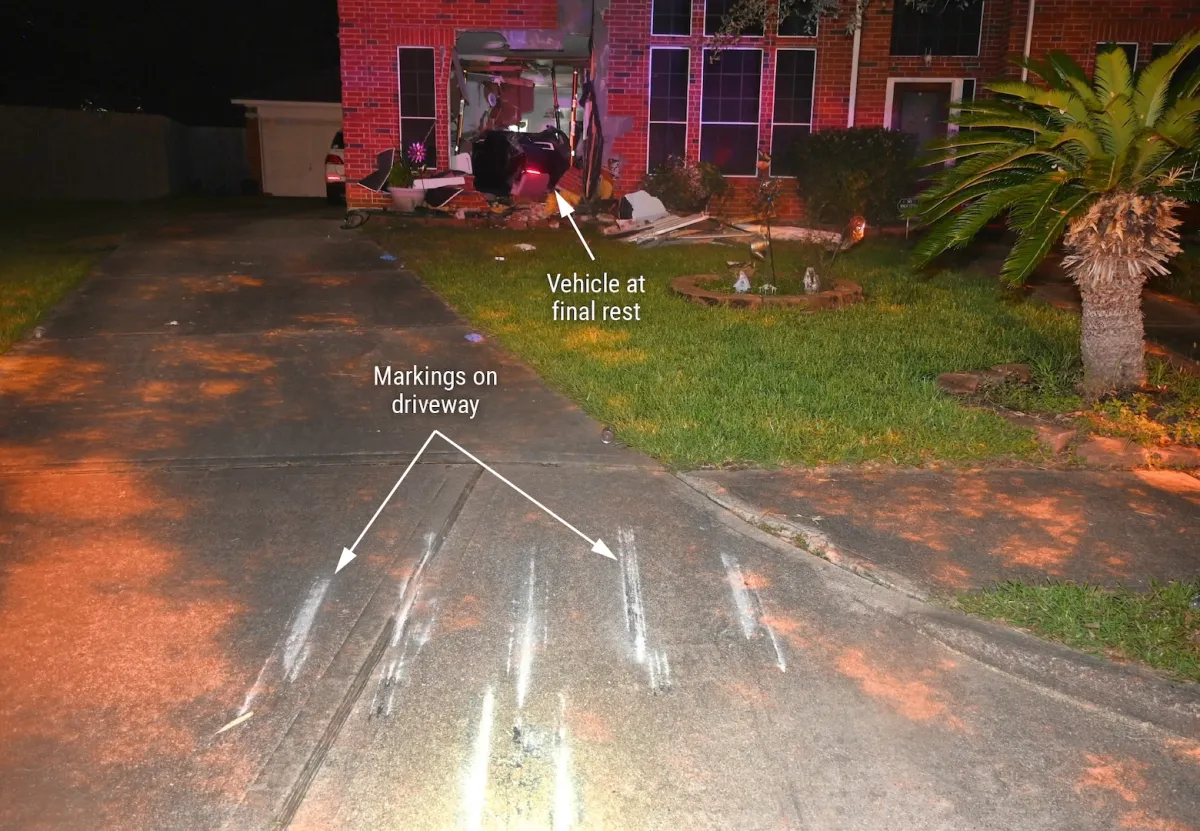
The National Transportation Safety Board (NTSB) said Wednesday that the driver of a Tesla who crashed into a house in June had pressed the accelerator pedal to 100%, overriding the company’s Full Self-Driving (Supervised) software.
Data recovered from the Tesla showed that the vehicle was traveling more than 70 miles per hour when it struck a house in Katy, Texas, killing 76-year-old resident Martha Avila, according to the NTSB. The family of the victim has since sued the alleged driver, 44-year-old Michael Butler, and Tesla, claiming negligence. Butler has also been charged with manslaughter.
The safety board shared the information as part of a preliminary report on the progress of its investigation into the crash. The National Highway Traffic Safety Administration is also probing the incident.
The data confirms Tesla’s account of the crash, which the company shared in the days after it happened in order to show that its advanced driver assistance system wasn’t to blame. “[T]his [allegation] makes no sense. FSD drives slowly through neighborhood streets and this was a high speed crash!” Tesla CEO Elon Musk wrote on X shortly after the crash.
The NTSB said Wednesday that the 44-year-old driver was using Full Self-Driving (Supervised) on Rose Hollow Lane, a residential two-lane road with a speed limit of 30 miles per hour, prior to the crash. Security camera footage obtained by the safety board showed the car accelerating through an intersection, leaving the road, and hitting the house. The “weather was clear, the roadway was dry, and daylight conditions were present,” according to the NTSB.
Tesla requires that drivers using Full Self-Driving (Supervised) pay attention to the road and be ready to take control at any moment. Butler allegedly told authorities that he had “passed out” and that he was using Tesla’s driver assistance system. Police reportedly discovered that his Google searches included the terms “Tesla FSD not aggressive enough 2026,” “Tesla not aggressive enough,” and “Tesla FSD too timid,” according to local ABC news affiliate station KTRK TV.
When you purchase through links in our articles, we may earn a small commission. This doesn’t affect our editorial independence.
{content}
Source:{feed_title}
—
Key Takeaways
- **Driver Override Confirmed:** The NTSB’s preliminary report confirms the Tesla driver pressed the accelerator to 100%, overriding Full Self-Driving (Supervised) and causing a fatal crash.
- **”Supervised” Responsibility:** The incident underscores the critical importance of driver attention and intervention in advanced driver-assistance systems (ADAS), even when using “self-driving” features.
- **Intensified Scrutiny:** This case adds to the ongoing debate over ADAS safety, regulatory oversight, and the sometimes-misleading naming conventions that shape public perception of autonomous technology.
NTSB Data Pinpoints Driver Action in Fatal Tesla Crash, Intensifying ADAS Debate
A tragic incident in Katy, Texas, which saw a Tesla careen into a house, killing a 76-year-old resident, has received a crucial update from the National Transportation Safety Board (NTSB). In a preliminary report released Wednesday, the NTSB confirmed that the driver of the Tesla had pressed the accelerator pedal to its maximum — 100% — effectively overriding the vehicle’s Full Self-Driving (Supervised) software. This finding provides a definitive answer to the cause of the high-speed collision and re-centers the conversation on driver responsibility in the age of advanced driver-assistance systems (ADAS).
The incident, which occurred in June, involved a Tesla traveling at more than 70 miles per hour on a residential street with a 30 mph speed limit before it struck the home of Martha Avila, who tragically died. The victim’s family has since filed a lawsuit against the alleged driver, 44-year-old Michael Butler, and Tesla, alleging negligence. Butler faces a manslaughter charge, further highlighting the severe consequences of the crash.
The Data Speaks: Overriding Autonomy
The NTSB’s investigation leveraged critical data recovered from the vehicle, which proved indispensable in reconstructing the moments leading up to the collision. This data provides robust support for Tesla’s initial defense following the crash. Soon after the incident, Tesla CEO Elon Musk took to X (formerly Twitter) to dismiss claims that the company’s ADAS was at fault, stating, “[T]his [allegation] makes no sense. FSD drives slowly through neighborhood streets and this was a high speed crash!” The NTSB’s findings align squarely with Musk’s assertion, indicating that the system was indeed overridden by explicit driver input.
According to the safety board, the 44-year-old driver was actively using Full Self-Driving (Supervised) on Rose Hollow Lane, a typical residential two-lane road, just before the crash. Security camera footage obtained by the NTSB further corroborates the data, showing the vehicle rapidly accelerating through an intersection, departing the roadway, and violently colliding with the house. The NTSB’s report also noted optimal driving conditions: “weather was clear, the roadway was dry, and daylight conditions were present,” eliminating environmental factors as contributors to the accident.
Understanding “Full Self-Driving (Supervised)” and Driver Responsibility
The term “Full Self-Driving (Supervised)” itself often sparks confusion. While the nomenclature suggests a high degree of autonomy, Tesla explicitly requires drivers using this feature to remain attentive to the road and be prepared to take immediate control at any moment. This “supervised” aspect is paramount and forms the core of driver accountability when engaging such systems. It implies a partnership between human and machine, where the human is the ultimate failsafe.
The NTSB’s findings, coupled with additional details emerging from the investigation, paint a concerning picture of the driver’s alleged actions. Butler reportedly told authorities that he had “passed out” while FSD was engaged. However, police reportedly uncovered telling Google searches made by Butler, including phrases like “Tesla FSD not aggressive enough 2026,” “Tesla not aggressive enough,” and “Tesla FSD too timid.” These searches suggest a potential predisposition to wanting a more assertive — and perhaps risky — driving experience from the ADAS, potentially leading to the decision to manually intervene with full acceleration.
This juxtaposition of claiming incapacitation while simultaneously searching for ways to make FSD more “aggressive” raises serious questions about driver intent, awareness, and the responsible use of advanced vehicle technologies. It highlights the psychological challenge of human-machine interaction, where drivers might develop overreliance or even a desire to push the boundaries of automated systems.
Regulatory Spotlight and Broader Implications for ADAS
This incident is not an isolated event but rather one of many under the scrutiny of federal regulators. Both the NTSB and the National Highway Traffic Safety Administration (NHTSA) have ongoing investigations into crashes involving Tesla’s ADAS features. These probes are crucial for understanding the safety implications of these technologies, informing future regulations, and ensuring public safety as vehicles become increasingly automated.
The outcome of this investigation will undoubtedly feed into the broader industry discourse surrounding ADAS. It reinforces the argument that while these systems offer significant safety benefits when used correctly, they are not infallible and still demand a vigilant human operator. The case also reignites debates around the naming conventions of ADAS features, with critics arguing that terms like “Full Self-Driving” can create a false sense of security or exaggerate current capabilities, thereby contributing to misuse.
As autonomous technology continues to evolve, the interface between human drivers and increasingly sophisticated vehicle systems will remain a complex and critical area of focus. Incidents like the Katy, Texas crash serve as stark reminders that technological advancement must be paired with clear understanding, rigorous regulation, and unwavering driver responsibility.
Bottom Line
The NTSB’s definitive findings in the Katy, Texas Tesla crash underscore a fundamental truth in the evolving landscape of automotive technology: while advanced driver-assistance systems offer incredible potential, the ultimate responsibility for safe operation remains firmly with the human driver. This tragedy serves as a potent reminder that “supervised” autonomy means constant vigilance, not abdication of control, highlighting the critical need for both responsible system design and informed, attentive human engagement to prevent future incidents.