
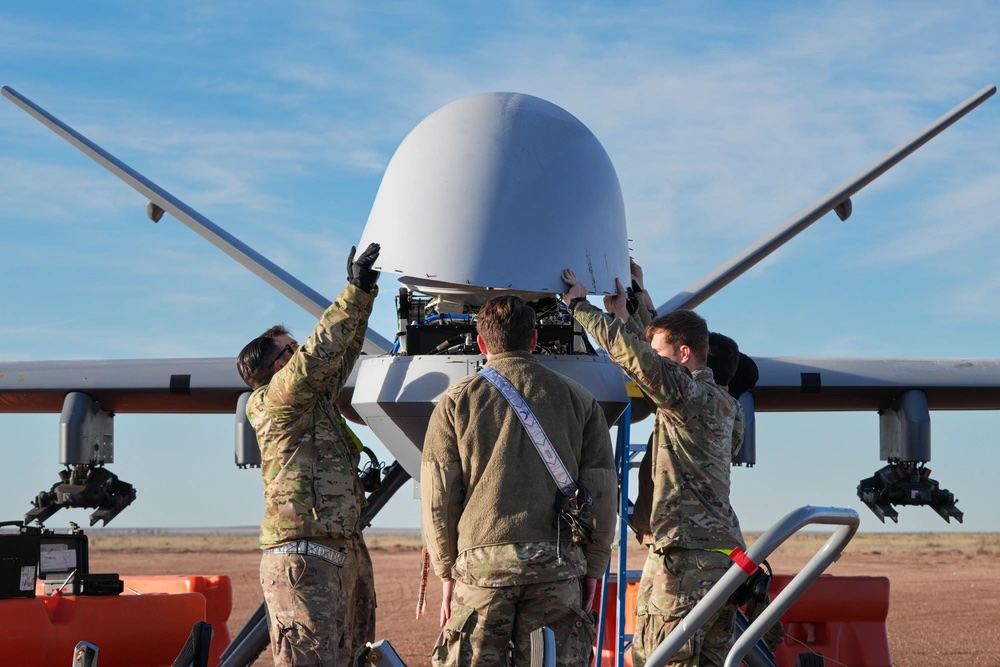
General Atomics Proposes New ‘Attritable’ Drone Design to Redefine U.S. Military Airpower
General Atomics Aeronautical Systems (GA-ASI), a prominent manufacturer of unmanned aircraft, has announced its intention to pitch a novel drone design aimed at fulfilling missions currently undertaken by its widely recognized MQ-9 Reaper. This new concept, emphasizing low-cost and “attritable” characteristics, represents a significant strategic shift in how the U.S. military plans to approach future aerial operations, particularly against advanced adversaries.
In a statement released on July 21, General Atomics spokesman C. Mark Brinkley confirmed to Air & Space Forces Magazine that the company is developing a “clean-sheet” design. This proposal is a direct response to a solicitation from the Pentagon’s Defense Innovation Unit (DIU) for a new class of unmanned aerial vehicles (UAVs) dubbed “Massed Modular Aircraft,” or MMA. The news was initially reported by Breaking Defense, following an interview with Dave Alexander, CEO of General Atomics Aeronautical Systems, conducted at the Farnborough International Airshow in England.
The Defense Innovation Unit, established to accelerate the adoption of commercial technology for military use, issued its solicitation on July 7. The core idea behind the MMA concept is to deploy large groups, or “masses,” of relatively inexpensive drones. These swarms would be designed to overwhelm enemy defenses, even if some aircraft were inevitably shot down – a characteristic known as “attritability.” This means the drones are designed to be lost without significant financial or strategic impact, contrasting sharply with the current approach to high-value military assets. The U.S. Air Force has subsequently indicated its collaborative involvement with DIU on this critical initiative, signaling a unified strategic direction for future air combat capabilities.
The requirements outlined by the Air Force and DIU for these MMA drones are comprehensive. They mandate a fully loaded combat radius of at least 2,300 nautical miles, enabling deep strike and reconnaissance capabilities far into contested territory. Furthermore, these drones must be versatile enough to perform a variety of mission sets, including launching weapons against designated targets, collecting critical intelligence through advanced sensors, conducting electronic warfare operations to disrupt enemy systems, or acting as communication relays to extend network reach in challenging environments. The overarching goal is to present a multi-faceted and persistent threat that can exhaust an adversary’s defenses and resources over time.
Modularity is another cornerstone of the MMA design. The specification requires the drones to be highly adaptable, capable of carrying diverse payloads weighing at least 2,800 pounds. This substantial payload capacity is crucial for accommodating a wide range of sensors and mission equipment, including full-motion video sensors for persistent surveillance. This adaptability will enable them to effectively assume many of the intelligence, surveillance, and reconnaissance (ISR) roles currently performed by the MQ-9 Reaper. The MQ-9, a propeller-driven, medium-altitude, long-endurance (MALE) UAV, has been a workhorse for the U.S. military for over two decades, known for its precision strike and ISR capabilities, particularly in permissive air environments.
General Atomics brings extensive experience to this endeavor, having manufactured hundreds of MQ-9 Reapers and other unmanned aircraft systems over more than 20 years. Spokesman C. Mark Brinkley underscored the company’s plan to leverage this deep institutional knowledge and existing infrastructure. “We don’t have to reinvent every wheel here,” Brinkley stated. “We have a lot of qualified parts and processes in place, from a lot of programs, and it makes sense to use many of those in new ways.” This approach suggests a focus on efficient design and production, capitalizing on proven components and manufacturing lines to meet the cost-efficiency demands of the MMA program, rather than starting entirely from scratch.
The imperative for the MMA approach stems from a stark reality check for the military: the current reliance on “exquisite” aircraft, with individual units costing upwards of $30 million, is deemed unsustainable in future high-intensity conflicts. This financial burden is compounded when these high-value assets face adversaries equipped with increasingly sophisticated, yet low-cost, anti-aircraft capabilities and layered air defenses. The Pentagon’s assessment was heavily influenced by the loss of approximately 30 MQ-9s during operations against Iran-backed forces in recent years, as well as the extensive and effective use of low-cost drones by Ukraine against Russia. These conflicts have demonstrated the vulnerability of traditional air superiority concepts and the effectiveness of distributed, attritable assets.
Addressing the critical aspect of cost, GA-ASI CEO Dave Alexander expressed confidence in his company’s ability to offer a drone within DIU’s price range, though the specific figures for that range have not been publicly disclosed. However, Alexander also raised questions about the practicality of the lowest-end cost requirements, commenting, “anybody that bids that number is very suspicious.” This highlights the inherent tension between achieving advanced capabilities and maintaining extreme cost reductions, a persistent challenge in high-tech defense procurement, where performance often correlates with price.
Brinkley reiterated General Atomics’ understanding of the government’s priorities. He affirmed that keeping costs down on MMA drones is paramount, alongside scalability, manufacturing feasibility, and operational capability. Acknowledging the complexity of balancing these demands, Brinkley described it as “a lot to chew on” as General Atomics refines its proposal. He emphasized the company’s commitment to delivering a viable solution: “We’re hearing the government on this and we understand what the ask is. We’re going to submit an honest, scalable, buildable, flyable, reliable aircraft. No one wants the government to waste money here on junk.” This statement underscores GA-ASI’s intent to provide a credible and practical platform rather than an unachievable, low-cost concept that would fail to meet operational needs.
***
Why This Matters
The development of “Massed Modular Aircraft” (MMA) and General Atomics’ participation in this initiative signals a profound shift in global military strategy, with far-reaching implications for defense, technology, and international relations. This move away from solely relying on expensive, highly sophisticated “exquisite” aircraft towards a complementary force of numerous, lower-cost, “attritable” drones represents an adaptation to the evolving nature of modern warfare.
Firstly, it addresses the economic and strategic challenges posed by sophisticated adversaries. In contemporary conflicts, even non-state actors or less technologically advanced nations can field relatively inexpensive anti-aircraft systems capable of threatening multi-million dollar aircraft. The losses of MQ-9 Reapers and the lessons from the Ukraine conflict have starkly demonstrated that relying on a few high-value assets in contested airspace is becoming unsustainable. By deploying attritable drones in mass, militaries can overwhelm defenses, accept losses, and sustain operations without incurring prohibitive financial costs or disproportionately risking highly trained human pilots, thereby preserving more expensive assets for missions in less contested environments.
Secondly, it could redefine the concept of air superiority and deterrence. The ability to deploy swarms of drones capable of diverse missions – from electronic warfare and intelligence gathering to direct strike – introduces a new layer of complexity for adversaries. Such systems could create persistent, multi-domain threats, exhausting enemy resources and decision cycles, and potentially creating windows of opportunity for manned aircraft or other assets. This paradigm shift could compel potential adversaries to invest more heavily in defensive measures against drone swarms, diverting resources from other areas, thereby enhancing overall deterrence.
Thirdly, it drives significant technological innovation and industrial transformation. The demand for low-cost, rapidly producible, and modular drones will accelerate advancements in autonomous systems, artificial intelligence for sophisticated swarm coordination, advanced manufacturing techniques, and standardized payload interfaces. Companies like General Atomics, by leveraging existing expertise while innovating, could lead to a new industrial base focused on rapid prototyping and scaled production of unmanned systems. This could also foster greater collaboration between traditional defense contractors and commercial tech companies, bridging the gap between cutting-edge civilian technology and military application.
Finally, the MMA program has global implications for arms races and military doctrine. As the U.S. and its allies pursue this strategy, other major powers are likely to follow suit, leading to an intensified focus on drone technology and counter-drone systems worldwide. This could fundamentally alter how nations perceive and prepare for future conflicts, influencing defense budgets, strategic alliances, and the proliferation of advanced unmanned capabilities across the globe. The success or failure of the MMA concept will serve as a crucial benchmark for the future trajectory of aerial warfare, potentially establishing a new standard for military power projection and survivability in contested environments.