
R ‘Ray’ Wang discusses Alphabet’s massive AI CapEx spending and the market’s expectation for continued investment. He also analyzes Tesla’s shift toward full self-driving, robotaxis and Optimus robots, beyond just car manufacturing.
Key Takeaways:
- Robust Safety Claims Bolster Investor Confidence: Tesla’s report of over 380,000 unsupervised robotaxi miles with “zero notable incidents” provides critical data supporting its safety narrative, potentially easing regulatory concerns and reinforcing investor belief in its Full Self-Driving (FSD) technology.
- Camera-Centric Strategy Validated: By touting successful autonomous operation without lidar or extensive HD maps, Tesla challenges industry norms, signaling a potentially more cost-effective and scalable path to widespread autonomy that could differentiate it significantly from competitors.
- Strategic Shift Towards AI & Robotics Accelerated: The rapid growth and planned expansion of its robotaxi fleet underscore Tesla’s pivot beyond automotive manufacturing into a dominant AI, software, and robotics enterprise, a vision crucial for justifying its long-term valuation and future revenue streams.
In a development poised to reshape investor perceptions of its autonomous driving capabilities, Tesla (NASDAQ: TSLA) announced Wednesday that its burgeoning robotaxi fleet has successfully traversed over 380,000 unsupervised miles across six cities in two states, recording what the company described as a “zero notable incident” safety record. This milestone, revealed during the electric vehicle maker’s second-quarter earnings call, is a critical data point as Tesla endeavors to validate its ambitious vision for a self-driving future and solidify its standing as an AI and robotics powerhouse.
Ashok Elluswamy, Tesla’s vice president of AI software, underscored the fleet’s impeccable safety performance, assuring investors that any reported incidents stemmed from “other actors impacting us when we were stationary.” This clarification is vital in a market highly sensitive to autonomous vehicle safety, where regulatory scrutiny and public trust remain paramount hurdles for widespread adoption. “I’d like to emphasize how safe the operation has been so far,” Elluswamy asserted, “Zero notable incidents over 380,000 miles.” For investors, this data offers a tangible measure of progress and a potential counter-narrative to persistent safety concerns surrounding FSD beta deployments.
The implications of such a safety record extend far beyond mere operational statistics. It directly addresses the market’s expectation for continuous investment in AI capabilities, as highlighted by industry analysts like R ‘Ray’ Wang regarding Alphabet’s (NASDAQ: GOOGL) substantial AI CapEx spending. Tesla’s significant R&D outlay in AI, software, and specialized hardware — including the previously announced plans for an advanced chip manufacturing facility with SpaceX — is an investment gamble that requires proof of concept. These safety metrics provide critical validation that the capital is being deployed effectively, moving the company closer to monetizing its sophisticated AI stack.

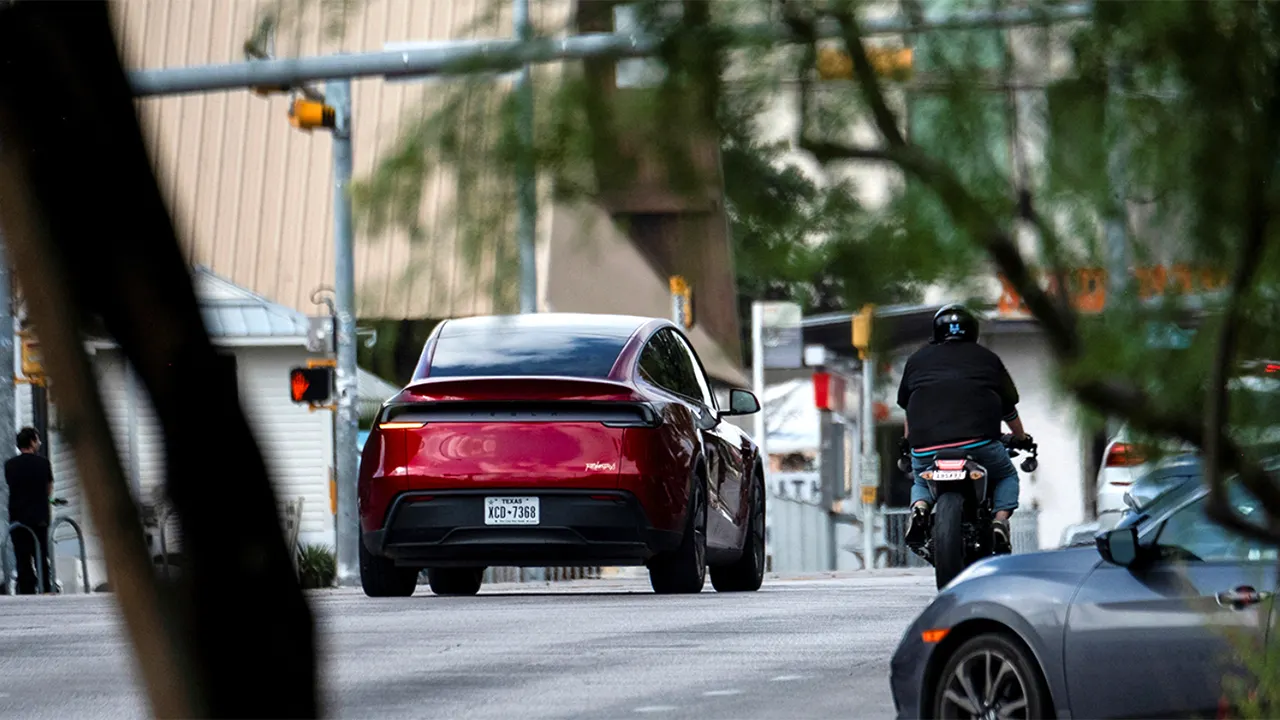
A Tesla robotaxi travels along South Congress Avenue in Austin, Texas, June 22, 2025. Tesla said that its robotaxi fleet has logged more than 380,000 unsupervised miles across six cities in two states without what the company described as a “notable” (Reuters/Joel Angel Juarez / Reuters)
Elluswamy’s remarks also served as a direct challenge to conventional wisdom within the autonomous driving sector, particularly regarding sensor suites. “Historically, the so-called experts have always claimed that you need lidars, radars, HD maps and the entire kitchen sink to drive safely,” he stated. “Here, we show that such is not true. You can have safe, comfortable and affordable autonomy with just cameras.” This “vision-only” approach has been a cornerstone of Tesla’s strategy, promising a more cost-effective and scalable solution compared to rivals like Waymo (owned by Alphabet) and Cruise (owned by General Motors), which heavily rely on expensive lidar sensors and high-definition mapping. Should Tesla unequivocally prove the efficacy and safety of its camera-based system at scale, it could fundamentally alter the economics of autonomous vehicle deployment, giving it a distinct competitive advantage in reaching mass market penetration and profitability.
The operational growth trajectory further fuels this optimistic outlook. Tesla reported that mileage traveled by its unsupervised robotaxi fleet has grown at a double-digit weekly rate for months, a compounding rate that suggests an aggressive and successful scaling strategy. “Not only that, we expect to continue growing at such a large rate through the rest of this year,” Elluswamy added. This sustained expansion is crucial for investors who are pricing in significant future revenue streams from FSD software sales and a highly profitable robotaxi network. Rapid scaling means faster data collection, accelerated AI model refinement, and a quicker path to achieving critical mass for a viable transportation-as-a-service offering.

A Tesla robotaxi operates on South Congress Avenue in Austin, Texas, on June 22, 2025. (Reuters/Joel Angel Juarez / Reuters)
The company’s expansion strategy is also rapidly accelerating. The remarks came one day after Tesla expanded its robotaxi service to Orlando and Tampa, building on initial launches in Austin in June 2025, followed by Dallas, Houston, and Miami. This systematic city-by-city rollout, combined with Elluswamy’s projection that “the time to launch to a new city will continue to trend towards zero, towards an end where we operate in entire states as a whole, instead of going city by city,” signals a sophisticated, software-driven deployment model. This network effect, where each new operational area adds data and refines the core AI, is critical for achieving a self-sustaining and rapidly expanding autonomous fleet.
Stocks In This Article:
This progress also positions Tesla squarely in the ongoing regulatory debate. The news arrived just as autonomous driving companies like Waymo and Tesla are slated to testify before a key Senate Committee on regulating the growing industry. Tesla’s ability to present concrete, positive safety data on its unsupervised robotaxi operations could be instrumental in shaping future legislation, potentially easing the path for broader deployment. Conversely, any regulatory hurdles or public pushback could temper the market’s enthusiasm, irrespective of the technological advancements.

Passengers exit a Waymo self-driving car, Dec. 26, 2025, in San Francisco. Unlike Waymo, which uses lidar sensors, Tesla relies mainly on cameras and AI software. (John J. Kim/Chicago Tribune/Tribune News Service via Getty Images / Getty Images)
The long-term narrative for Tesla, often championed by CEO Elon Musk, centers on its evolution into an AI and robotics company far “beyond car manufacturing.” The robotaxi initiative, alongside developments in Optimus robots and advanced chip manufacturing, forms the bedrock of this strategic transformation. For investors, the ability to generate recurring, high-margin revenue from FSD software and robotaxi services, rather than solely relying on vehicle sales, is fundamental to sustaining and justifying its premium valuation.
GET FOX BUSINESS ON THE GO BY CLICKING HERE
Tesla could not immediately be reached by FOX Business for comment.
Reuters contributed to this report.
Market Impact:
The announcement of over 380,000 unsupervised robotaxi miles with “zero notable incidents” is a significant catalyst for Tesla’s stock, potentially reinforcing the bull case for its long-term AI and robotics strategy. In the near term, investors are likely to react positively, viewing this as tangible progress towards monetizing Full Self-Driving and the eventual robotaxi network, which analysts project could unlock trillions in market value. The strong safety claims, if sustained, could alleviate regulatory pressures and investor skepticism, narrowing the valuation gap between Tesla’s automotive and AI divisions. Furthermore, the validation of Tesla’s camera-centric approach could place immense pressure on competitors relying on more expensive lidar-based systems, potentially shifting investment flows within the autonomous vehicle sector. However, the market will remain vigilant for continued scaling without incident, further regulatory pronouncements, and the actual timeline for commercial profitability, all of which will dictate the sustained impact on TSLA’s share price and its position as a leader in the future of mobility.