
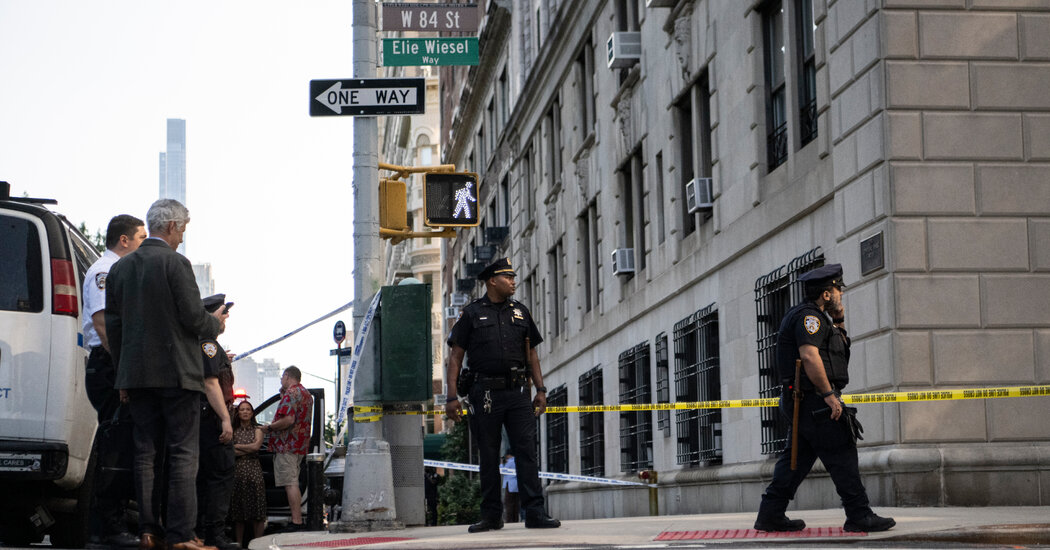
Stabbings in Manhattan Intensify Debate Over Antisemitism and Mayoral Rhetoric
Manhattan, New York – A stabbing incident in Midtown Manhattan on Thursday has heightened anxieties within the city’s Jewish community and fueled an ongoing, contentious debate regarding antisemitism and the public statements of Mayor Zohran Mamdani concerning Israel.
Police reported that Moshe Grunhaus, who was visibly wearing a yarmulke, was stabbed outside a Jewish Center. Shortly before this attack, another individual, Chok Sung, 57, an Asian man, was also stabbed. Authorities arrested Raul Morales on Thursday in connection with the assaults. As of Friday evening, prosecutors had not yet filed formal charges against Morales. According to police accounts, the suspect reportedly shouted “Allahu akbar,” an Arabic phrase meaning “God is the greatest,” during the attack on Mr. Grunhaus.
The assaults have further strained the relationship between numerous Jewish leaders and Mayor Mamdani, who has long been a vocal critic of Israeli policies. For several months, pro-Israel organizations and community advocates have expressed concerns that the mayor’s rhetoric on Israel could inadvertently contribute to an increase in antisemitic sentiment. These concerns intensified after Mayor Mamdani repeatedly stated that the city might potentially enforce an arrest warrant for Israeli Prime Minister Benjamin Netanyahu if he were to visit New York.
In response to the growing public outcry from a segment of the Jewish community, Mayor Mamdani released a direct-to-camera video statement on Tuesday. In the video, he clarified that the city would not, in fact, enforce an arrest warrant for Prime Minister Netanyahu. However, he reiterated his strong criticism of Netanyahu, labeling him a “war criminal” and urging federal law enforcement agencies to pursue his arrest.
The tensions escalated publicly on Friday, as several community leaders and pro-Israel groups explicitly suggested that the mayor’s public comments, including his recent video message, bore some responsibility for fostering an environment conducive to acts such as Thursday’s stabbing. The UJA-Federation of New York, a prominent Jewish philanthropic organization that has emerged as a significant critic of Mayor Mamdani’s approach, co-hosted a news conference. Speakers at the event underscored the profound impact that a perceived rise in antisemitism has had on the city’s Jewish community.
Mark Treyger, the chief executive of the Jewish Community Relations Council and an outspoken critic of the mayor, articulated the community’s palpable fear. He stated that parents are now hesitant to allow their children to openly wear symbols of their faith, such as yarmulkes or Stars of David, in public. Furthermore, he noted that directors of Jewish summer camps are fielding calls from anxious parents inquiring about the safety protocols for their children.
Micah Lasher, the Democratic congressional nominee for the district encompassing the site of Thursday’s attack, appealed for unity and leadership. “I beseech all those in a position of power, including our mayor, to hear our cry from the heart,” Lasher stated. “To please help take the temperature down and provide leadership that makes every New Yorker feel safe in this glorious city.”
Mayor Mamdani, speaking to NY1 later on Friday, actively rejected the accusation that his actions or statements had contributed to Jewish New Yorkers feeling unsafe. “There’s no tolerance for antisemitism or hatred of any kind in this city,” the mayor asserted. He added, “If anyone is perpetrating this kind of bigotry, that kind of hatred, they will be held fully accountable.”
This week’s emotional exchanges underscore the deep integration of Middle East politics into Mayor Mamdani’s relatively new administration. New York City is home to the largest Jewish population outside of Israel, making the local impact of such debates particularly resonant.
During his interview with NY1, the mayor reiterated his position that his criticisms are directed solely at the state of Israel and its leadership, not at Jewish individuals or their faith. “They are critiques of a political leader, not of people of a specific faith or a religion or a background,” Mamdani explained. He emphasized his mayoral duty: “My responsibility as the mayor of this city is to keep every New Yorker safe, no matter where they come from, what they believe in or, frankly, even if they agree with my politics. My job is to keep them safe.”
The mayor’s perspective aligns with a broader shift in public sentiment towards Israel, which has become increasingly critical across New York and the United States. Progressive Jewish organizations have also echoed the mayor’s views, advocating for a distinction between criticism of Israeli government policies and antisemitism.
T’ruah, an organization comprising progressive rabbis, issued a statement advising against making premature assumptions about the motivations behind Thursday’s stabbing. They highlighted that the Police Department had indicated that “the suspect’s mental state may have been a factor” in the incident. T’ruah’s statement further asserted, “We refuse to believe that Jewish safety requires silence about the Israeli government’s actions. A narrative that public criticism of Israel causes antisemitism and therefore must be censored is not only overly simplistic but dangerous to Jews, Palestinians and our democratic values.”
It remains unclear whether this week’s events represent a temporary peak in tensions within Mayor Mamdani’s relationship with pro-Israel Jewish leaders or the beginning of a more sustained deterioration in trust and inter-community relations.
Notably, at Friday’s news conference, several elected officials who typically align with the mayor, including City Public Advocate Jumaane Williams and State Attorney General Letitia James, delivered messages acknowledging the profound impact of antisemitism in the city and urged New Yorkers to unite against intolerance. “It’s important that we reaffirm that hate and violence have no place in New York,” Ms. James stated. “So let us commit ourselves to doing the good and necessary work of standing up together, shoulder to shoulder, arm in arm, with no space between us. Hate will not be tolerated.”
City Council member Susan Zhuang, representing a Brooklyn district, also spoke, drawing attention to the persistent problem of anti-Asian bias, which she noted has “too often been simply ignored.” She added, “The violence, the harassment, the fear continue even when the cameras move on. Our community is still living with consequences, and too many people suffering in silence.” The stabbing on Thursday, occurring in the Upper West Side—a neighborhood recognized for its vibrant Jewish life—has undoubtedly sent shock waves through the community.
Why This Matters
This incident and the subsequent public debate are significant for several reasons, impacting local governance, community relations, and the broader discourse on hate and foreign policy:
- Community Safety and Interfaith Relations: The stabbings, particularly the attack on a visibly Jewish individual, underscore persistent concerns about safety for religious and ethnic minorities in urban environments. New York City, a melting pot of diverse communities, relies on robust interfaith and inter-ethnic relations. Incidents like this test these bonds and raise questions about how effectively the city can protect all its residents from hate-motivated violence.
- The Role of Political Rhetoric: The core of the debate centers on the impact of political leaders’ statements on public sentiment and potential real-world consequences. This case highlights the contentious discussion about whether strong criticism of a foreign government or its leaders by a local official can contribute to a climate that some perceive as permissive to hate crimes against a specific community. It forces a critical examination of the responsibility of elected officials to consider the domestic implications of their foreign policy positions.
- Defining Antisemitism: The controversy also deeply engages with the ongoing, complex discussion about the definition of antisemitism. While many Jewish organizations equate anti-Zionism or criticism of Israeli policies with antisemitism, progressive Jewish groups and others argue for a clear distinction, asserting that criticizing a government’s actions is not inherently discriminatory against an entire people or faith. This incident brings these differing interpretations to the forefront of public consciousness.
- Impact on New York City’s Governance: For Mayor Mamdani’s administration, navigating these intense local and international pressures is a significant challenge. The debate over his rhetoric and its perceived effects could shape his relationship with key community leaders, impact his broader policy agenda, and influence public trust in his ability to govern a diverse metropolis fairly and effectively.
- Broader Trends in Hate Crimes: The mention of anti-Asian bias by a City Council member underscores that hate-motivated violence is not limited to one community and often reflects systemic issues. This incident serves as a stark reminder of the broader challenges many minority groups face regarding safety and the need for comprehensive strategies to combat all forms of bigotry.
- Mental Health and Justice: The police’s indication that the suspect’s mental state might be a factor adds another layer of complexity. It highlights the intersection of criminal justice, mental health support, and the prevention of violence, prompting questions about how the city addresses individuals struggling with mental health issues who may pose a risk to public safety.
NEW YORK, NY – A man has been charged with a hate crime in connection with one of two stabbings that occurred Thursday night in New York City, incidents that have intensified an ongoing debate about rising antisemitic violence and the impact of political rhetoric.
The suspect, 27-year-old Mr. Morales, was apprehended Friday morning following the attacks. Police have charged him with a hate crime for the stabbing of 57-year-old Mr. Grunhaus, a Jewish man, but not for the stabbing of 32-year-old Mr. Sung, an Asian man. It remains unclear whether prosecutors will uphold the charges proposed by the police department. Both victims are expected to survive and are receiving treatment at a local hospital.
The first incident involved Mr. Grunhaus, who was stabbed outside a synagogue on the Upper East Side. The attack occurred on Tisha B’Av, a solemn day in the Jewish calendar commemorating the destruction of the Temples in Jerusalem and other historical tragedies. Shortly after, Mr. Sung was stabbed at a nearby subway station.
The stabbings have prompted swift reactions from city officials and community leaders. A spokesman for Mayor Eric Adams stated that the mayor’s office had contacted the Police Department to connect with the victims. However, the NYPD declined this request on Friday night, explaining that detectives were still interviewing the victims and were not connecting elected officials, including the mayor, at that time.
The incidents unfold against a backdrop of a significant increase in hate crimes targeting Jewish people in New York City. As of early July, more than half of all reported hate crimes in the city this year were antisemitic in nature, disproportionately affecting a community that comprises approximately 10 percent of New York’s population.
In the wake of the stabbings, attention has largely focused on public discourse and its potential influence. Several Jewish leaders, along with other public figures, have pointed to a video released by City Councilman Mamdani as potentially contributing to a climate of danger for Jewish New Yorkers. In the video, Councilman Mamdani described Israeli Prime Minister Benjamin Netanyahu as “a war criminal” and the “architect of genocide” in Gaza.
At a news conference on Friday, Eric Goldstein, the president of UJA-Federation of New York, strongly criticized Councilman Mamdani’s remarks. “His video message about the prime minister was political grandstanding,” Mr. Goldstein stated. “Shame on him for doing this for perceived political benefit when it has real-world consequence for the Jews of New York. He must stop.”
The Israeli government also issued a condemnation. In a statement, Israel’s foreign minister, Gideon Saar, asserted that the violence “did not happen in a vacuum.” He further commented, “Months of incitement against the Jewish state from Mamdani have helped create a climate in which Jews are targeted. Words have consequences.”
Representative Jamaal Bowman, a Democratic colleague of Councilman Mamdani, had previously expressed concerns about Mamdani’s rhetoric. Bowman told reporters that he believed some of Mamdani’s statements were inappropriate and divisive.
On Friday evening, before the commencement of Shabbat, Rabbi Rick Jacobs, president of the Union for Reform Judaism, representing the largest Jewish denomination in the United States, released a statement also criticizing Councilman Mamdani’s “fiery video.” Rabbi Jacobs contended that Mamdani had “vilified Israel and Mr. Netanyahu and created an atmosphere in New York City that makes Jewish people feel less safe and puts us at risk.”
The timing of the attack on Tisha B’Av resonated deeply within the Jewish community. Rabbi Yosie Levine of the Jewish Center reflected on the gravity of the incident, stating on Friday that the stabbing outside his synagogue on such a mournful holy day made it feel like “the evil we gathered to remember stopped belonging to the past.” He added, with a sense of alarm, that “Jewish life in America is starting to feel like Jewish life in Europe—armed guards, bulletproof glass and the constant fear that yesterday’s rhetoric will turn into today’s assault.”
Why This Matters
These stabbings in New York City are significant for several reasons, touching upon issues of public safety, freedom of speech, community relations, and the rise of identity-based violence:
- Rising Hate Crimes: The fact that over half of New York City’s hate crimes this year have targeted Jewish individuals underscores a disturbing trend of antisemitism. This disproportionate targeting signals a heightened vulnerability for specific communities and raises urgent questions about the effectiveness of current anti-hate initiatives and public education efforts.
- Impact of Political Rhetoric: The controversy surrounding Councilman Mamdani’s statements and the strong reactions from Jewish leaders and the Israeli government highlight a critical debate: the line between political criticism and rhetoric that some perceive as inciting or contributing to a hostile environment for certain groups. It prompts a broader discussion on the responsibility of public figures in shaping discourse, especially concerning international conflicts, and the potential for such rhetoric to have “real-world consequences” domestically.
- Community Safety and Fear: The remarks from Rabbi Levine, comparing the current climate in America to Jewish life in Europe, reflect a profound sense of insecurity and fear within the Jewish community. This sentiment, particularly after an attack on a sacred day, indicates a growing concern for physical safety and the preservation of religious and cultural life without constant threat.
- Law Enforcement and Justice: The police charging Mr. Morales with a hate crime in one instance but not the other highlights the complexities of classifying and prosecuting hate-motivated violence. The distinction between the two stabbings, and whether prosecutors will agree with the police’s hate crime assessment, will be closely watched as it could set precedents for how such incidents are addressed in the future.
- Inter-Community Relations: Incidents like these can strain relationships between different communities within a diverse city. The response from public officials, community leaders, and the broader public will be crucial in either fostering unity and understanding or allowing divisions to deepen.
- Broader Societal Implications: The events in New York City are not isolated. They reflect broader national and global challenges concerning tolerance, identity, and the spread of prejudice. How a major global city like New York responds to these challenges can offer important lessons for other communities grappling with similar issues.