
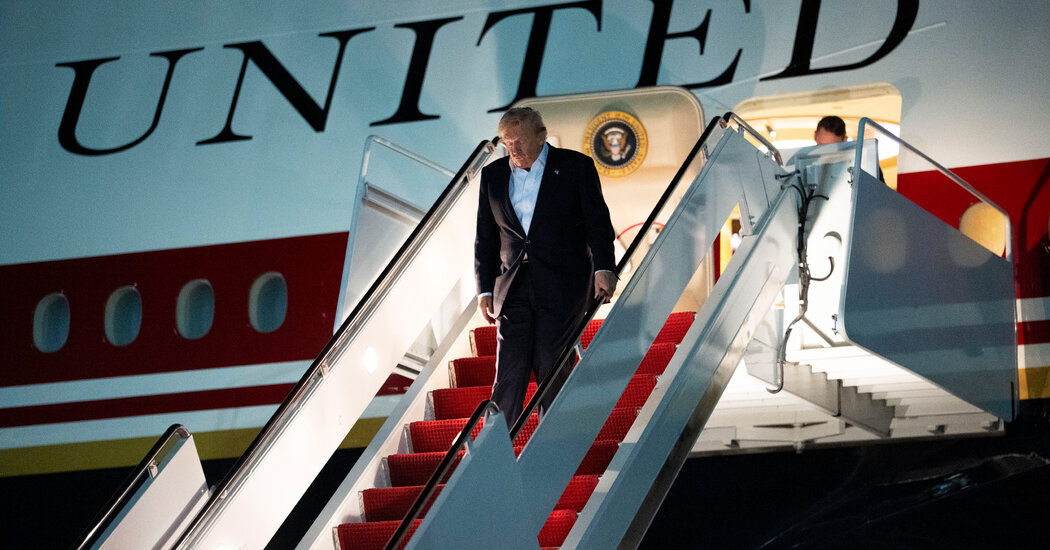
**Washington, D.C. –** A recent investigation by The New York Times has brought to light a series of decisions made during the early weeks of President Donald Trump’s hypothetical second term in February 2025 regarding the acquisition and modification of a luxury Boeing 747-8 to serve as a temporary Air Force One. The investigation suggests that the accelerated timeline for this project, driven by the President’s personal preferences, led to significant compromises in crucial security features, ballooning costs, and questions surrounding fiscal transparency and the ethical implications of foreign donations.
According to the report, President Trump became “entranced” by a double-decker Boeing 747-8, previously outfitted for the Qatari royal family, during a tour on the tarmac of Palm Beach airport. This aircraft, flown from Doha for his inspection, boasted a spacious bedroom adorned with leather and wood, and lounges featuring a chandelier and suede seating. With the two Boeing planes intended as permanent replacements for the aging Air Force One fleet years behind schedule, the President’s team had reportedly sought a temporary solution.
President Trump subsequently decided that this Qatari jet would serve as the interim presidential aircraft. This decision, made in February 2025, initiated a “frantic sprint” within the White House and Pentagon to upgrade the plane. The administration aimed to have the aircraft ready by the nation’s 250th birthday in the summer of 2025, necessitating a highly accelerated retrofit schedule.
The New York Times investigation revealed that this swift implementation process resulted in significant financial outlays and potential trade-offs in safety and security measures. These compromises, the report indicates, may have left President Trump and other travelers on the aircraft vulnerable. Key findings from the investigation include:
President Trump was reportedly “personally engaged” in the decision-making process for retrofitting the donated plane, including giving final approval on the features and security measures. This information comes from individuals familiar with his role, who spoke on condition of anonymity due to the sensitive nature of the details.
Several critical security and safety features typically present on Air Force One aircraft, which have been in use for decades, are reportedly absent from the upgraded Qatari jet. These include a lower-level exit for high-risk situations, additional backup power capacity, and an advanced antimissile system. Public Air Force records and photographs reviewed by The Times corroborate these findings. The new planes currently under construction for the permanent presidential fleet are slated to include all such features.
The 747-8 underwent an overhaul within a severely compressed timeframe of approximately eight months. Experts in aircraft modification and presidential transport programs suggest that a full and comprehensive upgrade of such an aircraft would typically require several years to ensure all necessary systems are integrated and rigorously tested.
Due to the rapid timeline, some White House officials initially anticipated that the Qatari jet would be restricted to domestic travel or trips to allied countries where U.S. military bases could provide additional security layers.
The government incurred “hundreds of millions of dollars” in expenses to acquire equipment necessary for training pilots to operate the 747-8 within the expedited schedule. This cost is reportedly in addition to the approximately $400 million for upgrades that the administration had publicly acknowledged. The Pentagon reportedly attempted to conceal the total expenditure, including from Congress, by drawing funds from a classified budget designated for nuclear modernization.
The context of the jet’s acquisition adds another layer of scrutiny: Qatar agreed to donate the aircraft to the U.S. Department of Defense. This donation is notably unorthodox as the aircraft is eventually slated to be transferred to President Trump’s presidential library. Critics have raised concerns that this arrangement could be perceived as an attempt by the Middle Eastern country to “curry favor” with the president, potentially influencing U.S. foreign policy.
The reported security shortfalls of the new Air Force One became publicly apparent earlier this month when President Trump was compelled to depart Turkey on a different aircraft. This change was reportedly made at the urging of the Secret Service following the identification of a credible threat from Iranian proxy forces. The New York Times subsequently reported that the newly adopted presidential plane lacked some of the defensive countermeasures present on the previous Air Force One models.
While the administration has consistently affirmed the safety of the aircraft, details regarding any new air-defense technologies or security measures incorporated onto the plane remain unclear. Nevertheless, the White House announced this week that the Qatari-donated jet would be taken out of service this fall for unspecified “upgrades and enhancements,” a move it promoted on social media with the term “PLANEMAXXING.”
This reversal underscores the potential risks undertaken by the government to meet President Trump’s desire for an aircraft that he believed would appropriately convey the grandeur of his office. Experts familiar with the Air Force One program have expressed surprise that the Qatari-donated plane was utilized for overseas trips, particularly given its expedited modification.
Frank Kendall, who oversaw the presidential plane modernization project first as the Pentagon acquisition chief and later as the Air Force secretary under President Joseph R. Biden Jr. from 2021 until January 2025, stated, “People need to be aware it has a lot of shortfalls compared to Air Force One; they do add a measure of risk.”
President Trump’s rationale for seeking a new aircraft stemmed from his view that the decades-old planes, which frequently required repairs, were an “embarrassment.” The two 747 jets previously in service had been operational since the early 1990s, with the first carrying President George H.W. Bush from Washington, D.C., to Topeka, Kansas. During a May 2025 interview on a flight to the Middle East with Sean Hannity, Mr. Trump articulated his position: “When you land and you see Saudi Arabia, and you see U.A.E., and you see Qatar and you see all these — and they have these brand-new Boeing 747s mostly, and you see ours next to it, this is like a totally different plane. And we’re the United States of America. I believe that we should have the most impressive plane.”
Air Force officials have not yet released detailed plans for the announced “upgrades and enhancements” or a revised timeline for the aircraft’s re-entry into service.
**Why This Matters**
The controversy surrounding the acquisition and modification of this presidential aircraft carries significant implications across several critical domains, extending far beyond the symbolic importance of Air Force One:
**National Security and Presidential Safety:** The primary concern revolves around the potential compromise of presidential safety. Air Force One is not merely a mode of transport; it is a mobile command center designed to ensure the continuity of government and protect the President in the most hostile environments. Any reduction in defensive capabilities, such as advanced antimissile systems or critical emergency exits, introduces unacceptable risks to the President, Vice President, and other high-ranking officials who travel on board. The incident in Turkey, where the President had to switch planes due to a credible threat, serves as a stark reminder of these vulnerabilities and underscores the vital importance of an aircraft equipped with state-of-the-art protection.
**Fiscal Responsibility and Transparency:** The report highlights a significant lack of transparency regarding the true cost of the project. The alleged practice of drawing “hundreds of millions of dollars” from a classified nuclear modernization budget to fund aspects of the presidential aircraft, ostensibly to mask the total price tag from Congress and the public, raises serious questions about fiscal accountability. Such actions bypass congressional oversight mechanisms designed to ensure responsible spending of taxpayer money, potentially setting a dangerous precedent for future administrations and eroding public trust in government financial management.
**Presidential Precedent and Protocol:** The President’s direct involvement in approving specific features and security measures, coupled with the highly accelerated timeline, represents a deviation from established procurement protocols for presidential aircraft. These protocols are typically meticulously planned over many years, involving extensive expert review and rigorous testing, precisely to avoid the kind of trade-offs now alleged. Allowing personal preferences to override expert military and security assessments could undermine the integrity of future acquisition processes and potentially prioritize aesthetics or personal desires over critical operational requirements.
**International Relations and Ethics:** The acceptance of a luxury jet as a “gift” from Qatar, with the unusual stipulation that it will eventually go to the President’s personal library, raises significant ethical and diplomatic concerns. Such a donation can be perceived as an attempt by a foreign nation to gain favor or exert undue influence, potentially creating conflicts of interest or undermining the perception of impartiality in U.S. foreign policy. It sets a problematic precedent for how foreign governments interact with U.S. presidents and raises questions about the appropriate boundaries for gifts to high-ranking officials.
In essence, this situation underscores the delicate balance between presidential preferences, national security imperatives, fiscal prudence, and ethical governance. The eventual outcome of the announced “upgrades and enhancements” and the transparency surrounding their implementation will be crucial in restoring confidence in the management of one of the nation’s most iconic and vital assets.
U.S. Deploys Retrofitted Qatari Jet as Interim Presidential Aircraft Amid Air Force One Modernization Delays
The U.S. Air Force has confirmed the successful retrofitting and deployment of a Boeing 747-8 aircraft, previously owned by Qatar, to serve as a temporary presidential transport. This measure comes as the official Air Force One modernization program, which involves two new 747-8 jets, faces significant delays and escalating costs, now projected to reach $5.1 billion with completion slated for 2028.
Air Force officials have lauded the rapid transformation of the Qatari plane, describing it as “safe, secure and equipped with the most advanced technologies.” General Kenneth S. Wilsbach, the Air Force’s Chief of Staff, stated in May that the effort was “a testament to the Air Force’s ability to innovate and rapidly evolve to ensure the continuity of our government under any conditions.”
Echoing this sentiment, White House Press Secretary Karoline Leavitt affirmed this week that the new aircraft poses no risk to the President and his entourage, declaring it “fully mission-ready and safe for presidential travel today.” She added that further enhancements planned for the fall would “ensure it remains the most advanced, secure and capable aircraft in the world.”
The Air Force One Modernization Program and its Challenges
The presidential fleet, often referred to by its call sign “Air Force One” when the President is aboard, consists of highly customized Boeing 747-200B series aircraft that have been in service for decades. Military officials have expressed increasing concerns over the aging planes, necessitating frequent repairs and maintenance. To address this, the Air Force initiated a comprehensive modernization program, selecting the Boeing 747-8, the latest and most advanced model of the jumbo jet, as the successor.
The 747-8 was chosen for its enhanced features, including modernized electronic flight controls, a redesigned wing system, more efficient engines, and a larger cabin. Crucially, its four-engine configuration provides an additional margin of safety, a paramount consideration for presidential transport. However, the process of transforming commercial aircraft into presidential-grade command centers is extraordinarily complex and costly.
Presidential Focus and the Search for Expedited Solutions
The immense importance and intricate requirements of Air Force One have long been a subject of presidential attention. In December 2016, shortly after his initial election, then-President-elect Trump was briefed on the extensive measures taken by the military to harden Air Force One. General Carlton D. Everhart II, then a high-ranking Air Force official, detailed the “complex and unique systems” vital for the Boeing planes’ “survivability and reliability.” General Everhart recounted how Air Force One served as a critical mobile command center for President George W. Bush during the September 11, 2001, attacks, underscoring its role beyond mere transport.
Mr. Trump, known for his personal Boeing 757, often referred to as “Trump Force One,” reportedly expressed confidence in his own aviation expertise during these discussions. His focus on the presidential aircraft continued, with reports describing a scenario weeks after a reported re-election in 2024, where he dispatched tech entrepreneur Elon Musk to a Boeing airplane hangar in Texas. Mr. Musk’s assignment was to accelerate the modernization effort, which Mr. Trump and others believed was hampered by overly strict security clearance requirements for workers not involved in sensitive aspects of the aircraft.
Concurrently, the Trump transition team also requested that the Air Force explore backup plans. This included scouring Boeing’s list of operational 747-8 airplanes worldwide to identify one that could be quickly acquired and modified. This search ultimately led to the Qatari-owned jet.
The Unprecedented Demands of a Presidential Aircraft
Retrofitting a commercial aircraft to meet presidential standards is an undertaking of monumental scale, costing well over $1 billion and requiring years of specialized work, even for the recently acquired Qatari jet. Pentagon documents reveal the extensive structural and technological modifications essential for these aircraft:
- Structural Integrity: Major structural changes are required, including carefully cutting holes into the fuselage to construct a lower entryway. This feature is crucial for allowing the President to embark and disembark in less secure environments, minimizing exposure time.
- Autonomous Baggage System: An “autonomous baggage loading” system must be integrated to reduce reliance on foreign ground crews, thereby enhancing security protocols during international travel.
- Electromagnetic Pulse (EMP) Shielding: Hundreds of miles of electrical wiring and electronic components must be shielded against the effects of an electromagnetic pulse, a critical defense against threats like nuclear weapon detonations that could otherwise disable the aircraft’s systems.
- Auxiliary Power Unit (APU): A second, small engine – an auxiliary power unit – is installed near the rear of the jet. This APU serves as a vital backup power source for critical communication systems and other essential electronic equipment, ensuring continuity of operations even if the main engines are offline.
- Advanced Communications and Self-Defense: The official planes are equipped with some of the most sophisticated communications equipment available, enabling secure, global connectivity. Furthermore, they feature a comprehensive “self-defense system,” including missile defense technologies such as infrared countermeasures. These systems, strategically placed on the plane’s wings near the engines and its tail, can detect, track, and jam incoming missile threats, providing a crucial layer of protection in hostile environments.
These upgrades are “inherently expensive,” as one Air Force briefing noted. The initial estimate of approximately $400 million for two jets has ballooned to an estimated $5.1 billion for the entire modernization effort, pushing the completion date to 2028 – 13 years after the Air Force first decided on the 747-8 model for the project.
Despite the complexities and costs, military officials presented plans for retrofitting the Qatari jet to Mr. Trump during a series of meetings in the Oval Office, underscoring the urgency to ensure a fully capable presidential fleet.
Why This Matters
The swift retrofitting and deployment of the Qatari jet as an interim presidential aircraft, alongside the ongoing challenges of the main Air Force One modernization program, carry significant implications across several domains:
National Security and Continuity of Government: Air Force One is more than just a plane; it serves as a highly fortified, mobile command center crucial for maintaining the continuity of government under any circumstances, including national emergencies or attacks. Ensuring its constant readiness and advanced capabilities is paramount to national security, allowing the President to lead from anywhere in the world.
Presidential Safety and Global Reach: The safety of the U.S. President is a top national priority. The extensive modifications, from EMP shielding to advanced missile defense systems, highlight the extraordinary threats the aircraft must withstand. This capability allows the President to travel globally, project American power, and engage in critical diplomacy with an unparalleled level of security and operational independence.
Fiscal Oversight and Public Trust: The escalation of costs from an initial $400 million to $5.1 billion for the Air Force One modernization program raises significant questions about defense spending, project management, and government accountability. Such substantial public investment necessitates rigorous oversight to ensure taxpayer money is spent efficiently and effectively, maintaining public trust in government procurement processes.
Technological Innovation and Defense Capabilities: The sophisticated technologies integrated into Air Force One, from secure communications to advanced self-defense systems, represent the cutting edge of military aviation. The development and deployment of these systems push the boundaries of aerospace engineering and contribute to the broader advancement of defense capabilities that can benefit other military platforms.
Symbolic Importance: Air Force One is a powerful global symbol of American power, resilience, and technological prowess. Its appearance commands respect and attention worldwide. Maintaining a modern, secure, and capable presidential aircraft reinforces this image and demonstrates the nation’s commitment to protecting its leadership and interests on the global stage.
A new Boeing 747-8 aircraft, initially intended for Qatar’s royal family but never used, has undergone significant modifications to potentially serve as one of the future presidential aircraft for the United States, replacing an aging fleet. This acquisition, reportedly at a substantially reduced cost compared to a new build, has been accompanied by an accelerated modification timeline and notable differences in features compared to the current Air Force One jets.
The aircraft, a Boeing 747-8, was acquired by the U.S. government for approximately $100 million, a considerable saving compared to the estimated $600 million or more for a purpose-built presidential jet. The plane, which had been in storage for years, was part of a deal that involved Qatar donating two such aircraft to the U.S. military. The second donated 747-8 is slated for use as a spare parts source, highlighting the cost-effective nature of the overall transaction.
The timeline for retrofitting the first aircraft was significantly compressed, largely driven by a directive from former President Donald J. Trump. According to individuals familiar with the discussions, Mr. Trump expressed a clear desire for the plane to be ready by America’s 250th birthday on July 4, 2026. This mandate substantially truncated the expected 18-to-24-month upgrade schedule, leaving the Air Force with less than a year once it took ownership of the aircraft in August.
The modifications are being carried out by L3Harris, a prominent military contractor, at its sprawling complex in Waco, Texas. The terms and total price of this contract have not been publicly disclosed. Before commencing major work, L3Harris executives confirmed that the aircraft underwent a rigorous search for any potential listening devices or other illicit electronics that might have been installed prior to U.S. possession. Jason Lambert, president of L3Harris’s intelligence, surveillance, and reconnaissance division, stated in a June interview with Breaking Defense that this process was “performed by our electronic warfare experts in conjunction with the U.S. government’s leaders in cybersecurity to fully inspect and ensure that everything within that aircraft was safe for the mission.”
To meet the demanding schedule, L3Harris reportedly assigned up to 400 employees, working around the clock in three shifts. A top priority for the retrofit was the integration of a secure communications system, essential for the aircraft to function as a global command center, enabling the President to maintain secure contact with military and civilian leaders worldwide regardless of location. The interior of the plane is also slated to receive presidential-level finishes, including the presidential seal, new wood, and leather furnishings. However, L3Harris executives noted early on that major structural adjustments, such as moving bulkheads or fixed internal structures, were not feasible within the accelerated timeline.
Documents reviewed by The New York Times and observations from experts examining photographs of the retrofitted jet indicate several features present on current Air Force One aircraft are absent or reduced on the Qatari-donated plane. One significant omission is the self-contained lower side door with stairs, a feature that has historically allowed the president to autonomously board and deplane without relying on standard ground equipment. This entrance, easier to protect, has been utilized in critical security situations, such as when former President Trump used it in October due to a suspected hunter’s stand near a Florida airport, or when former President George W. Bush used lower stairs on September 11, 2001, for a secure departure from an Air Force base in Louisiana. A Pentagon official confirmed a “reduction of the number of airstairs” for autonomous entry and exit, a point not disputed by administration officials.
Further, photographs of the retrofitted jet do not visibly show the infrared countermeasures systems typically installed near the engines of current Air Force One jets. These systems are designed to detect approaching missile threats, track them, and deploy high-intensity laser beams to disrupt their trajectory. While the administration declined to detail the new plane’s specific self-defense technology, a White House official described the aircraft as “secure and well-protected” and affirmed ongoing efforts to modernize air defense systems. The lack of visible infrared countermeasures raises questions about the specific defensive capabilities integrated into the new platform.
Another reported absence is a second auxiliary power unit (APU). Air Force One jets are typically equipped with two APUs to provide redundant electrical power, even during flight, in the event of a primary power disruption. While two APUs are visible on the old Air Force One, only one is apparent on the new plane. A federal official confirmed the second unit was not installed, and the White House did not dispute its absence. This could impact the aircraft’s resilience in scenarios requiring backup power generation.
Beyond these modifications and omissions, an unresolved issue pertains to the structural integrity of Boeing 747-8 jets. Since 2023, the Federal Aviation Administration (FAA) has issued warnings about cracks in the longitudinal rods that stiffen and support the fuselage skin, deeming it an “unsafe condition” that “could adversely affect the structural integrity of the airplane.” The FAA has mandated inspections and repairs for owners of 747-8 planes, but it remains unclear how L3Harris or the Air Force addressed this specific concern during the retrofit process.
Despite the modifications and reported compromises, the White House maintains that the new presidential aircraft will be “secure and well-protected,” capable of fulfilling its critical mission. The specific details of its security capabilities and the full cost of its transformation continue to remain undisclosed to the public.
Why This Matters
The acquisition and modification of this new Boeing 747-8 aircraft carry significant implications for national security, presidential operations, and public transparency. As “Air Force One” (the call sign used when the President is aboard any Air Force aircraft), the presidential jet is not merely a mode of transport; it is a critical command center, a symbol of American power, and a vital component of the Continuity of Government in times of crisis.
Firstly, the reported omissions of features like self-contained airstairs and a second auxiliary power unit, coupled with the ambiguity surrounding defensive countermeasures, raise questions about the aircraft’s operational autonomy, security, and resilience. Self-contained stairs are crucial for secure and rapid boarding/deplaning in potentially hostile or unequipped environments, minimizing reliance on potentially vulnerable ground infrastructure. A redundant auxiliary power unit ensures critical systems remain operational even if a primary power source fails. While officials assert the new plane is secure, any reduction in these capabilities compared to existing presidential aircraft could impact the President’s safety, flexibility, and ability to project power globally, especially in unforeseen circumstances.
Secondly, the accelerated timeline mandated by a previous administration, coupled with the use of a donated aircraft, represents an unusual procurement approach. While cost savings are appealing, the constraints imposed by a rushed schedule and the foundational design of a commercial jet (even one initially intended for VIP use) may necessitate compromises on bespoke military-grade features. This raises a broader discussion about the balance between cost-effectiveness, speed of delivery, and the optimal configuration for the Commander-in-Chief’s highly specialized transport and command platform.
Finally, the lack of transparency regarding the full cost of the retrofit contract and specific security enhancements prompts questions about accountability and public oversight. Given the immense importance of Air Force One, taxpayers have a vested interest in understanding the investment made in such a critical national asset. While some security details are understandably classified, a lack of clarity on overall costs and the rationale behind specific design choices can fuel public debate and scrutiny.
In essence, this new aircraft represents a complex interplay of political directives, engineering challenges, security imperatives, and fiscal considerations. Its capabilities and limitations will directly impact the President’s ability to govern, command, and represent the United States on the world stage, making its specifications and operational readiness a matter of profound national significance.
The United States Air Force has completed the modification and testing of a Boeing 747-8 aircraft, originally a private jet for Qatar’s former emir, to serve as a temporary “Air Force One” for the Trump administration. This initiative, termed the “VC-25B Bridge aircraft,” has been marked by significant expenditures, accelerated timelines, and questions regarding transparency and standard procedures. The project emerged amid substantial delays and cost overruns in the primary program to replace the nation’s aging fleet of presidential aircraft.
The decision to acquire a stopgap presidential aircraft arose in 2018 when the Trump administration sought to secure a refurbished Boeing 747-8 from the Qatari royal family. This aircraft, previously owned by Qatar’s former emir, was acquired at a reported cost of approximately $400 million, a figure that would later escalate significantly. The purpose was to provide a modern presidential transport option while the development of the new, custom-built VC-25B Air Force One jets, based on the Boeing 747-8 Intercontinental, faced unforeseen setbacks.
The primary program for the next generation of Air Force One aircraft, a pair of highly customized Boeing 747-8s, has been plagued by delays. Initially anticipated for delivery by 2024, the planes are now expected to be operational by 2026. These delays have been attributed to various factors, including issues with the interior outfitter, GDC Technics, which filed for bankruptcy, and complex negotiations surrounding design and cost. The total cost for the two main VC-25B aircraft, which includes extensive modifications for security, communications, and presidential amenities, is projected to be in the billions.
The Qatari-donated 747-8, intended to bridge this gap, was sent to L3Harris Technologies for extensive modifications. However, the retrofit process encountered several complex engineering challenges. Audits conducted by the Federal Aviation Administration (FAA) and the Air Force revealed structural cracks within the airframe. These imperfections, some of which only became visible after the plane was completely stripped down to its bare frame, necessitated expensive and time-consuming repairs. Similar structural issues had previously been identified in the two 747-8 planes being prepared as the permanent Air Force One jets, highlighting a broader challenge with this specific aircraft model and the demands of extensive customization. A White House official stated that these required fixes would be completed on the Qatari-donated plane, in accordance with FAA regulations, though specific confirmation of their completion was not provided. L3Harris Technologies did not respond to inquiries regarding these issues.
Further complications arose due to the plane’s interior configuration, specifically its sideways-facing seats. FAA safety regulations mandate that aircraft with unconventional seating arrangements undergo specialized crash-test dummy evaluations to ensure passenger safety during emergency landings. Documents obtained indicate that a subcontractor involved in the modification project sought a “special condition” approval from the FAA to allow the aircraft to operate with these seats. This approval was granted by the FAA on July 1, the same day former President Trump reportedly began traveling on the modified aircraft. While similar approvals have been granted for other Boeing 747-8s used as private luxury carriers, Sandy Murdock, a former FAA chief counsel, remarked that the timing of the approval appeared to coincide with the immediate need for the plane’s deployment. The White House official affirmed that the Air Force collaborated with the FAA to ensure the safety and operational integrity of all Air Force aircraft.
The expedited timeline for the VC-25B Bridge aircraft led to costs significantly exceeding the initial Air Force estimate of approximately $400 million for the retrofit. The urgency necessitated accelerated pilot training for the 747-8, which features a different cockpit configuration compared to the older jets in the presidential fleet. To facilitate this training, the Air Force leased an Atlas Air cargo 747-8 jet from October to February, incurring monthly costs in the hundreds of thousands of dollars for “interim pilot qualification training.” The exact amount paid for this lease was not disclosed by the Air Force.
In December, driven by the tight deadline, the Air Force moved to acquire two additional 747-8 aircraft. One was purchased from Lufthansa to serve as a “dedicated trainer aircraft for aircrew,” aimed at achieving “immediate operational readiness.” A second 747-8 was also acquired to provide a source of spare parts. The combined cost for these two additional jets totaled another $400 million, according to an Air Force official. While both aircraft are expected to be valuable assets once the permanent Boeing Air Force One planes are in service, the Air Force has stated that their rapid acquisition was primarily driven by the arrival and modification schedule of the Qatari jet.
The overall financing of this temporary presidential aircraft project has also drawn scrutiny. The administration has declined to publicly detail how the project has been fully financed. However, Air Force Secretary Troy E. Meink acknowledged in Senate testimony that funds from the Sentinel nuclear modernization program were utilized. As previously reported, $934 million was transferred from the Sentinel program to an unspecified classified project last summer. Senator Christopher S. Murphy, a Democrat from Connecticut, has consistently pressed Trump administration officials for detailed information regarding the costs and security systems of the temporary Air Force One. Senator Murphy criticized the funding maneuver, suggesting it was an attempt to circumvent public and congressional oversight. He stated, “We routinely discuss the cost of the existing Air Force One modifications… But they have declared this work to be a national security secret that cannot be divulged even to appropriators. That is absolutely unacceptable.”
The modified aircraft underwent its final test flights in April, with six flights conducted over Texas and Louisiana following eight months of modification work. By May 1, the Air Force announced that the “VC-25B Bridge aircraft has officially completed modification and flight testing and is being painted.” While military officials affirmed that “no risk was taken in security, safety or mission communications,” they also conceded that “the collective team made trades on some of the less commonly used mission sets,” without providing specific details on which capabilities might have been adjusted or omitted to meet the expedited schedule.
For its final aesthetic, the aircraft was moved for painting. Rather than retaining the iconic robin’s egg blue and white design established by President John F. Kennedy and Jacqueline Kennedy in 1962, former President Trump advocated for a new color scheme of red, white, gold, and dark blue, stating, “The baby blue doesn’t fit with us.” This proposed change had previously been rejected by the Air Force during Trump’s first term due to technical concerns that the darker colors could “add heat in certain environments,” potentially affecting sensitive electronic components housed in the lower sections of the aircraft. Despite these objections, Mr. Trump reportedly overrode the Air Force’s recommendations, having publicly displayed models of Air Force One with his preferred paint scheme for several years.
Why This Matters
The acquisition and modification of the VC-25B Bridge aircraft underscore several critical issues in government procurement, national security, and fiscal accountability. Firstly, the substantial cost overruns and expedited timelines highlight the challenges inherent in complex, high-profile defense projects. The ultimate price tag, escalating from an initial $400 million for the retrofit to an additional $800 million for training aircraft and spare parts, represents a significant expenditure of taxpayer money. These costs could have been avoided or mitigated if the primary Air Force One program had remained on schedule, raising questions about planning and program management.
Secondly, the use of funds from the Sentinel nuclear modernization program, a critical component of the nation’s strategic defense, to finance a classified project related to presidential transport raises serious concerns about budgetary transparency and congressional oversight. Diverting funds from such a vital program, especially under conditions of secrecy, limits the ability of elected representatives and the public to understand how taxpayer dollars are being allocated and whether these expenditures align with national priorities. This practice can erode public trust in government financial management.
Thirdly, the compromises made in the aircraft’s operational capabilities, even if officially declared as “no risk” to core security, safety, or mission communications, warrant scrutiny. The admission of “trades on some of the less commonly used mission sets” suggests that a fully capable presidential aircraft, equipped with every standard feature, may not have been delivered. While a temporary solution might necessitate some adjustments, clarity on these “trades” is essential to ensure that a president’s command and control capabilities, particularly during a crisis, are not inadvertently compromised. The incident also highlights potential tension between presidential preferences and military technical assessments, as seen with the paint scheme dispute, where aesthetic choices potentially override expert advice on operational functionality.
Finally, the entire episode provides a case study in the complexities of managing iconic national assets like Air Force One. It illustrates the immense technical challenges, the intricate regulatory environment (FAA approvals), and the political pressures that converge on projects involving the highest office. For future administrations, this experience serves as a cautionary tale about the importance of rigorous planning, transparent financing, and adherence to established protocols to ensure that presidential transport is not only safe and secure but also fiscally responsible and publicly accountable.
A significant diplomatic journey for a former U.S. President was marked by both the unveiling of an updated presidential aircraft and an undisclosed security threat during a critical international visit.
On July 1, former President Donald Trump publicly reviewed a retrofitted Boeing 747 aircraft, intended for presidential use, at a military base in Maryland. The event was characterized by an celebratory atmosphere, with the aircraft parked inside a hangar. During the inspection, Mr. Trump reportedly used a marker to sign a mechanical panel on the aircraft’s underside, while the song “Y.M.C.A.,” frequently played at his public rallies, was broadcast over speakers. The former President expressed his approval, stating, “This is a plane that the United States of America should have,” before embarking on its inaugural flight to North Dakota.
While any aircraft carrying the President of the United States is designated “Air Force One,” this particular aircraft was later identified as one donated by Qatar. Its introduction into the presidential fleet represented an upgrade or addition to the resources available for the Commander-in-Chief’s global travel. The display of the aircraft underscored the substantial logistical and symbolic importance placed on presidential transport, which serves not only as a secure mode of travel but also as a mobile command center and a symbol of American power and presence.
Days after its debut, the new aircraft transported Mr. Trump to Ankara, Turkey, where he was scheduled to attend a meeting of the North Atlantic Treaty Organization (NATO). This international summit was critical for diplomatic engagement, allowing leaders from member states to discuss alliance strategy, collective security, and geopolitical challenges. The trip occurred amidst escalating tensions in the Middle East, particularly concerning the United States and Iran. Concurrent with the former President’s presence in Turkey, the United States had resumed airstrikes against targets in neighboring Iran. These military actions placed the presidential entourage in proximity to an active conflict zone, with the “war” reportedly located approximately 1,000 miles from the former President’s location in Ankara, highlighting the volatile regional security environment.
The security situation intensified on the morning of July 8. While staying in his suite at the JW Marriott in Ankara, Mr. Trump was informed by a military official of a credible threat. According to sources familiar with the situation, U.S. intelligence and security officials had assessed a significant risk: Iranian proxy forces were believed to be actively targeting the former President. This information prompted immediate concern from the Secret Service, the agency primarily responsible for the protection of the President, who recommended a change in the scheduled departure plans from Turkey.
In response to this security assessment, Mr. Trump made an announcement regarding his departure arrangements. He publicly stated that the newly acquired, Qatari-donated plane would proceed separately to Mildenhall Air Force Base in the United Kingdom. The stated reason for this rerouting, as communicated by the former President, was to allow U.S. service members stationed at the base to view the aircraft. This explanation, conveyed via his social media platform, Truth Social, notably omitted any mention of the security threat that had precipitated the change in plans. The decision to publicly frame the change as an opportunity for military personnel to see the plane, rather than a security precaution, reflects a common strategy in presidential operations to avoid alarming the public or providing intelligence to potential adversaries.
For his own departure from Ankara, Mr. Trump instead utilized an older model of Air Force One, which had also accompanied his contingent to Turkey. He cited “for old time’s sake” as the reason for this choice. Following his departure from Ankara, the former President later rejoined the Qatari-donated jet in England, presumably at Mildenhall Air Force Base, before continuing with his travel schedule. This operational adjustment underscores the rigorous and adaptable nature of presidential security protocols, which can involve complex logistical maneuvers to ensure the safety of the Commander-in-Chief in the face of evolving threats.
Julian E. Barnes, Eric Schmitt, Greg Kendall-Ball and Zolan Kanno-Youngs contributed reporting.
Why This Matters
The events surrounding the former President’s trip to Turkey carry significant implications across several domains. Foremost is the paramount importance of **Presidential Security**. The revelation of a credible threat from Iranian proxy forces targeting the U.S. President underscores the constant and often unseen dangers faced by the nation’s highest office, particularly when operating in regions with elevated geopolitical tensions. It highlights the critical role of intelligence agencies and the Secret Service in threat assessment and mitigation, necessitating adaptable and robust security protocols, even to the extent of altering presidential travel plans mid-trip.
Secondly, this incident reflects the delicate and often volatile state of **Geopolitical Stability** in the Middle East. The concurrent U.S. airstrikes in Iran, the proximity of the conflict to the presidential visit, and the alleged involvement of Iranian proxy forces, demonstrate the complex web of state and non-state actors that influence regional security. Such threats can escalate tensions rapidly, impacting diplomatic efforts and the broader international security landscape. The presence of the U.S. President in a region where such threats materialize serves as a stark reminder of the global reach of conflicts and their potential to disrupt high-level diplomacy.
Thirdly, the incident touches upon **Presidential Communication and Transparency**. The former President’s public explanation for the change in aircraft deployment – attributing it to a desire for service members to see the plane – while omitting the underlying security threat, raises questions about the balance between informing the public and safeguarding operational security. Governments often face a dilemma in such situations: full transparency might provide adversaries with valuable information or cause public alarm, whereas withholding information can lead to accusations of opacity. The decision made in this case reflects a strategic choice to prioritize perceived public calm and operational discretion.
Finally, the deployment of new **Presidential Assets** like the Qatari-donated aircraft, and the logistical intricacies of switching between different presidential planes, highlight the substantial resources and planning involved in supporting the Commander-in-Chief’s global responsibilities. These aircraft are not merely modes of transport but sophisticated command centers designed for secure communication and continuity of government. The effective management and utilization of these assets, especially under duress, are crucial for maintaining national security and projecting U.S. power and influence worldwide. This episode serves as a case study in the multifaceted challenges inherent in modern presidential travel and international diplomacy.