
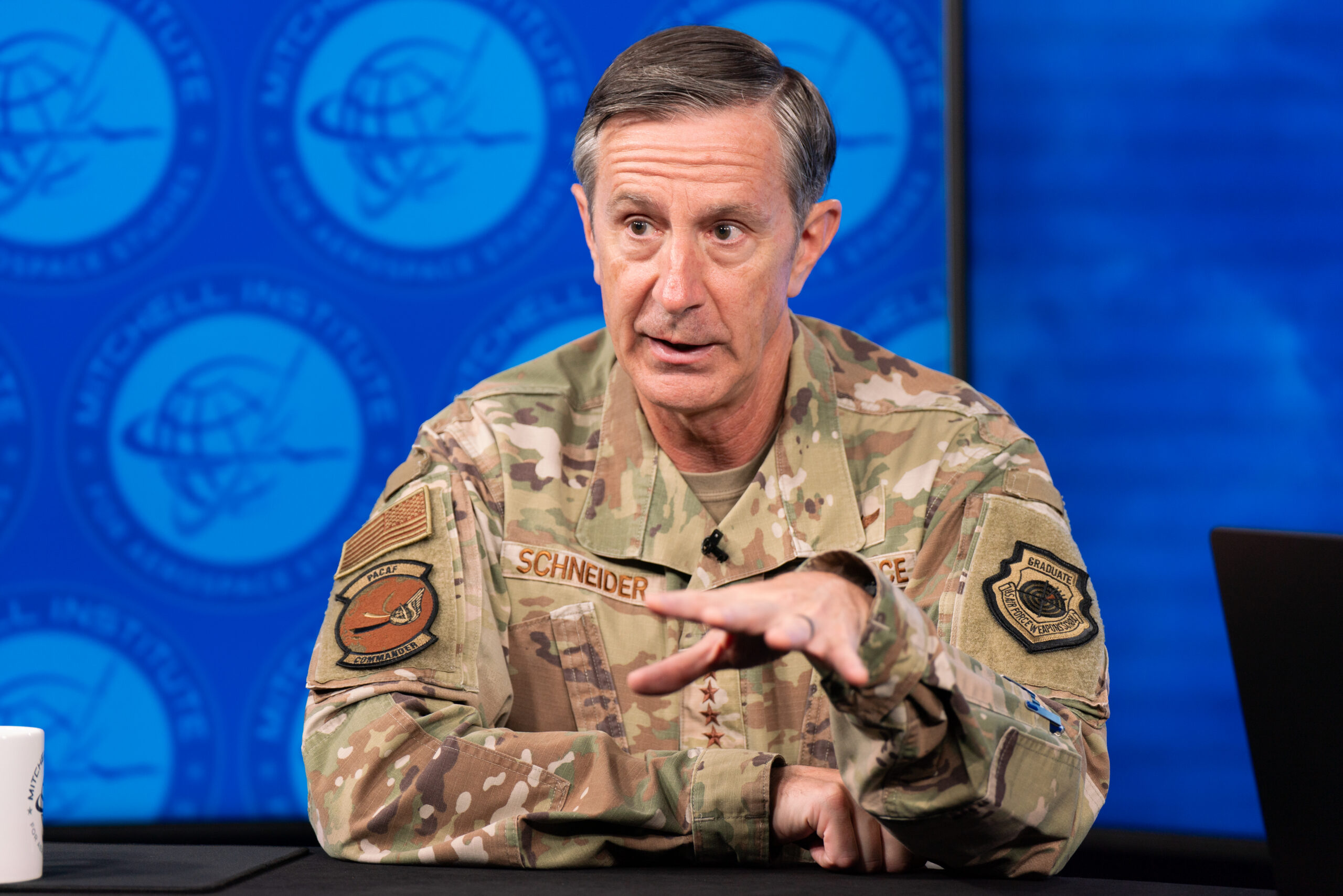
The U.S. Air Force is significantly expanding the scope of its flagship Pacific exercise, Resolute Force Pacific (REFORPAC), for its next iteration in spring 2027. This upcoming large-scale event will move beyond its initial Air Force-centric focus to incorporate other U.S. military branches and a greater number of international allies, according to Gen. Kevin B. Schneider, commander of Pacific Air Forces (PACAF).
Gen. Schneider revealed the ambitious plans on July 27, signaling a strategic shift towards more integrated and complex joint and combined operations in the Indo-Pacific region. The first edition of REFORPAC, which took place in summer 2025, served as a foundational exercise, featuring approximately 300 aircraft operating across multiple locations in Japan, Guam, and other strategic areas. Despite its massive scale, that inaugural event was primarily limited to U.S. Air Force personnel and platforms, a characteristic Gen. Schneider described as a “stepping stone” for his command.
“It was largely USAF-focused in 2025. We’re bringing more joint forces into it now that we’ve got a one rep under our belt and we know what we’re doing, and we’re bringing more allies and partners into it as well,” Schneider stated during an event hosted by the Air & Space Forces Association’s Mitchell Institute for Aerospace Studies. This expansion underscores the U.S. military’s increasing emphasis on interoperability and collective defense capabilities with partners in the face of evolving geopolitical dynamics.
Planning for REFORPAC 2027 has reportedly intensified. “REFORPAC 2027 planning probably started about the day that we finished REFORPAC 2025. It is in earnest right now. We’ll look to execute this the springtime of 2027,” Gen. Schneider confirmed, highlighting the continuous cycle of evaluation and preparation that underpins such large-scale military exercises.
The genesis of Resolute Force Pacific lies in the Department of the Air Force’s “reoptimization” initiative, launched in 2024. This effort was designed to reorient both the Air Force and Space Force towards preparing for potential “great power competition,” particularly with nations like China. Although the broader reoptimization strategy was later adjusted due to changes in departmental leadership and presidential administrations, the core concept of large-scale exercises like REFORPAC was retained. Officials recognized their critical value in providing key lessons on “large operations in contested, dynamic environments,” a point Gen. Schneider emphasized in September 2025.
Despite being described as a biennial event, specific details about the 2027 edition of REFORPAC, including its precise timing, had remained largely unannounced until now. Gen. Schneider noted the extensive coordination involved: “We have gone through a couple of the initial conferences. We have briefed it to Pacific Command, and the combatant command is fully supportive and understanding of what it is that we’re trying to do. So that is moving out, and really appreciate the team, both Air Force, joint force, and ally and partner teams, that are really going all in on this one.” This broad support from U.S. Indo-Pacific Command (INDOPACOM) and allied nations underscores the perceived importance of such complex training scenarios for regional stability and deterrence.
Refining the Exercise Strategy
While exercises like REFORPAC are indispensable for honing the skills necessary for large-scale operations against potential adversaries, they also entail significant resource expenditure and can impact military readiness. The preparation and recovery periods for airmen and aircraft can place a considerable “burn” on resources, as Gen. Schneider acknowledged at AFA’s Air, Space & Cyber Conference in 2024. “An exercise is a great way to build skill sets. We build interoperability, and there’s a lot to be gained,” he said. “There’s also a burn that’s associated with exercises.”
This cost-benefit analysis of military exercises is currently under intense scrutiny as Air Force Secretary Troy Meink and Chief of Staff Gen. Kenneth S. Wilsbach champion a service-wide drive to enhance readiness rates. In response, Gen. Schneider and his team at PACAF are meticulously reviewing the dozens of exercises PACAF participates in annually to determine their true value and impact on overall readiness. “We do 45 of those in PACAF, give or take a couple every year, and that’s a lot,” Schneider explained, highlighting the administrative and logistical burden.
The objective is to discern which exercises truly serve as “readiness gainers” versus those that may not offer a high return on investment. “They’re all valuable; they all have benefits. But we’re taking a look at, what are the ones that are readiness gainers? What are the ones that are maybe not high on that list of building readiness for our Airmen? And then making some decisions to go, we’re going to continue to do these; we’re not going to do these; or we’ll do these in reduced volume, just to make sure that we are preserving that readiness within our formations, so that we can be responsive to our commander at PACOM, as well as provide the Air Force options for other parts of the world.” This strategic prioritization aims to optimize training without compromising the ability to respond to global contingencies.
Schneider’s reference to “other parts of the world” is particularly pertinent, given the significant deployment of U.S. forces, including numerous fighters, bombers, and tankers, to the Middle East for ongoing operations, notably against Iranian-backed groups. Managing these dual demands—maintaining a robust presence in the Indo-Pacific while supporting operations in other theaters—requires careful risk assessment. “I think we’ve done a pretty good job of identifying amongst commanders where we’re going to take risk or how we manage the risks as we prioritize efforts in the CENTCOM region right now, and what are those things that we are able to absorb as commanders elsewhere in the Air Force enterprise,” Schneider remarked.
As PACAF refines its exercise prioritization, the focus will increasingly be on scenarios that address “the most critical, the most challenging, the most difficult” problems confronting the Air Force. These include advanced fifth-generation fighter tactics, the complexities of large-scale command and control in contested environments, and the development of long-range “kill chains”—the intricate process of detecting, tracking, targeting, and engaging threats from extended distances.
A recent example of such high-value training was Exercise Valiant Shield, a major multinational endeavor that involved the U.S. Navy, Japanese forces, and other partners. A notable highlight of this exercise was the participation of the Royal Australian Air Force’s (RAAF) in-development MQ-28 Ghost Bat. This semi-autonomous drone is designed to operate alongside manned platforms, extending their range, sensing capabilities, and combat effectiveness. The MQ-28 flew with multiple U.S. aircraft during Valiant Shield, demonstrating advanced concepts for future air warfare.
While Gen. Schneider largely deferred specific comments on the MQ-28’s performance to the Air Force’s dedicated test enterprise, he underscored the exercise’s utility for developing tactics, techniques, and procedures (TTPs) for advanced capabilities like the Collaborative Combat Aircraft (CCA) program. The CCA initiative aims to field a family of affordable, AI-enabled unmanned aircraft that can augment manned fighter and bomber fleets, significantly enhancing their survivability and lethality.
Conversely, training events focused on lower-end or more basic skills may face curtailment. Gen. Schneider reminisced about earlier career experiences: “I grew up in PACAF doing exercises where we’d go to a different country and we would do basic fighter maneuvers … which was a hoot. I really enjoyed it. But while that does provide some capability, those are also things that can be done at home station without the cost or expense of a deployment.” This strategic shift reflects a concerted effort to maximize the impact of every training dollar and hour, ensuring that high-stakes, complex scenarios remain the priority for deployed exercises.
Why This Matters
The U.S. Air Force’s decision to dramatically expand the scope and participation of Resolute Force Pacific 2027 holds profound implications for global security and military strategy, particularly in the Indo-Pacific. This move is not merely an incremental adjustment to a routine exercise; it signifies a heightened commitment to preparing for potential high-intensity conflicts and reinforcing alliances in a region characterized by increasing geopolitical tension.
Deterrence and Regional Stability:By integrating all U.S. military services and a wider array of international partners, REFORPAC 2027 sends a clear message of collective resolve and capability. This enhanced show of force and interoperability serves as a critical deterrent against potential adversaries, particularly China, which has been steadily expanding its military presence and influence in the Indo-Pacific. A more robust, cohesive, and agile allied military posture can help maintain the regional balance of power, discouraging aggression and promoting stability.
Enhanced Interoperability and Collective Defense:The inclusion of sister services (Army, Navy, Marine Corps) means the exercise will simulate a more realistic, multi-domain conflict scenario, reflecting modern warfare’s complexities. When combined with increased allied participation, it fosters deeper interoperability—the ability for different forces to operate together seamlessly. This is crucial for effective joint responses to crises, ensuring that diverse military assets can communicate, coordinate, and execute missions as a unified force, thereby strengthening the collective defense capabilities of the U.S. and its partners.
Adapting to Great Power Competition:The exercise’s origin in the “reoptimization” effort underscores the Pentagon’s strategic pivot towards great power competition. Training for “large operations in contested, dynamic environments” directly addresses the challenges posed by technologically advanced adversaries. This means practicing not just combat, but also resilient command and control, logistics, and sustainment in a scenario where communication and access might be denied or degraded. Such high-fidelity training is essential for maintaining a qualitative edge.
Accelerating Technological Integration:The spotlight on advanced platforms like the RAAF’s MQ-28 Ghost Bat and the broader Collaborative Combat Aircraft (CCA) program highlights the imperative of integrating cutting-edge technology into operational doctrine. Exercises like Valiant Shield and REFORPAC provide invaluable real-world testing grounds for developing the tactics, techniques, and procedures for these future systems. Successfully incorporating autonomous drones and AI-enabled platforms is vital for extending the reach, survivability, and lethality of manned aircraft, shaping the future of air warfare.
Optimizing Readiness and Resources:The Air Force’s deliberate review of its 45 annual exercises reflects a critical effort to maximize military readiness while optimizing resource allocation. In an era of competing global demands and finite budgets, prioritizing high-value, complex training scenarios over more routine ones ensures that precious time, personnel, and equipment are dedicated to developing the most essential skills for contemporary and future conflicts. This strategic efficiency is key to maintaining a global military presence without overstretching forces.
In essence, REFORPAC 2027 and the broader shift in U.S. exercise strategy are not just about training; they are about strategically positioning the U.S. and its allies to deter conflict, ensure regional security, and remain prepared for the most demanding challenges of the 21st century.