
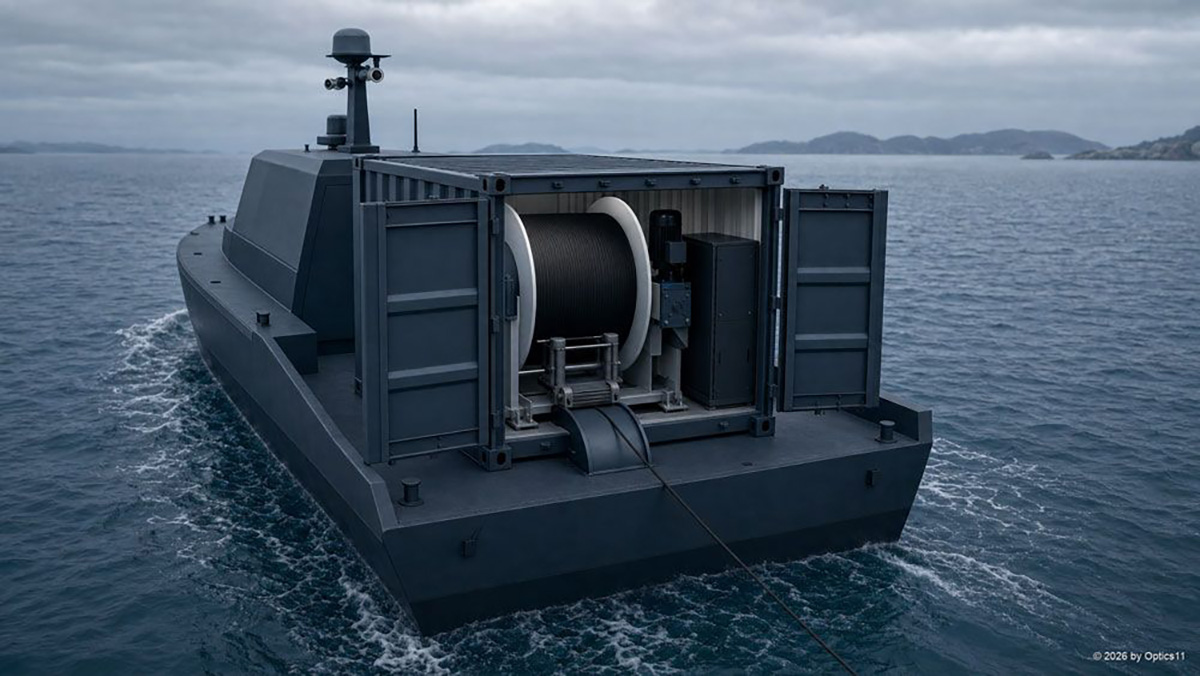
Netherlands Boosts Anti-Submarine Warfare Capabilities with Rapidly Deployable Containerized Systems
The Dutch Ministry of Defence has initiated a significant upgrade to its anti-submarine warfare (ASW) capabilities, ordering innovative containerized towed-array systems designed for rapid deployment across a wide array of surface vessels. This strategic acquisition, announced by Amsterdam-based company OPTICS11, aims to equip the Royal Netherlands Navy with enhanced anti-submarine sensing abilities for ships not originally designed for such specialized roles. The order covers the initial systems under the “Anti-Submarine Warfare In A Box,” or ASWINABO, program, expanding OPTICS11’s OptiArray product line.
The OptiArray, a fibre-optic towed array, represents a departure from traditional ASW technology. OPTICS11 emphasizes its compatibility with a broad range of existing crewed and uncrewed platforms, moving beyond the conventional reliance on a limited number of highly specialized warships. By adapting the OptiArray into a portable, containerized system, the ASWINABO program enables navies to retrofit advanced sonar sensing onto numerous “vessels of opportunity” as operational needs dictate. This flexible approach is gaining increasing relevance as the global naval landscape sees a rapid expansion in the use of maritime drones and unmanned surface vessels (USVs).
Traditionally, sophisticated towed array systems, critical for detecting stealthy submarines over long distances, have been deeply integrated into a small fleet of purpose-built frigates or destroyers. This integration is costly, time-consuming, and limits the number of platforms capable of performing ASW missions. The “in a box” concept championed by OPTICS11 seeks to overcome these limitations by providing a modular, plug-and-play solution. This not only significantly reduces the cost and complexity of integrating ASW capabilities but also allows navies to quickly adapt their fleets to emerging threats, potentially converting commercial vessels, patrol boats, or even unmanned platforms into active submarine hunters.
This strategic move by the Dutch Ministry of Defence comes amidst escalating concerns over the security of critical subsea infrastructure across the globe, particularly in European waters. Cables, pipelines, and other vital seabed assets, which are crucial for global communication, energy, and commerce, have become increasingly vulnerable targets for espionage, sabotage, and hybrid warfare tactics. The proliferation of advanced autonomous underwater vehicles (AUVs) further complicates the underwater threat environment, making detection and classification of potential aggressors more challenging. Northern Europe, in particular, has witnessed a heightened presence of vessels often referred to as “Russian shadow fleets” or intelligence-gathering ships, which have been observed testing the limits of territorial waters and mapping critical seabed infrastructure, raising alarms among NATO allies regarding potential disruption or attack on these assets.
A key differentiator of OPTICS11’s OptiArray lies in its passive, fibre-optic technology, which contrasts sharply with conventional electrical towed arrays that rely on powered electronics throughout the sensing chain. The passive nature of OptiArray allows it to remain acoustically silent, thereby avoiding self-generated noise that could mask faint target signatures or reveal its own presence. Furthermore, it boasts immunity to electromagnetic interference (EMI), a common challenge for electrical systems in complex maritime environments. OPTICS11 states these characteristics enable the system to capture richer acoustic information, translating into earlier detection of submerged threats and more accurate classification of targets, distinguishing between submarines, underwater drones, or even natural phenomena. The project also encompasses establishing robust production, integration, and validation capabilities to support future large-scale deployments, alongside investments in manufacturing readiness and supply chain resilience.
Paul Heiden, CEO of OPTICS11, underscored the urgency of this technological shift. “The underwater threat environment is evolving rapidly, but advanced threat sensing has traditionally been confined to a small number of specialist naval platforms,” he noted. “By containerizing OptiArray, we’re making world-class detection faster, more flexible and cheaper. We want to set the standard for unmanned underwater and above-water drones, as our technology is a perfect fit for doing this: light, small, highly sensitive and very accurate. As critical subsea infrastructure becomes increasingly contested, prevention starts with detection.” His comments highlight the dual benefits of enhanced capability and operational efficiency.
Echoing this sentiment, Captain Lucas Leppink, Head of the Maritime Systems Department at COMMIT within the Dutch Ministry of Defence, emphasized the transformative potential for the Royal Netherlands Navy. “With ASWINABO, the Royal Netherlands Navy will be able to equip its surface ships, unmanned surface vessels and any other vessel of opportunity with underwater surveillance capability, a game-changer for maritime security operations and undersea infrastructure protection,” Captain Leppink stated. This perspective from the Ministry of Defence highlights the strategic value of being able to rapidly adapt and expand ASW coverage.
Founded in 2011 as a spin-out from Vrije Universiteit Amsterdam, OPTICS11 has established itself as a developer of passive fibre optic sensing arrays. The company claims its technology can detect and classify underwater targets up to 100 kilometres from shore. Beyond OptiArray, the company’s portfolio includes OptiBarrier, a seabed-placed system designed for the persistent protection of sensitive maritime areas such as ports, offshore wind farms, and subsea cables, and OptiFender, a monitoring solution for high-voltage electrical infrastructure. This diverse application of its core fibre-optic sensing technology underscores its potential for various security and monitoring needs.
Why This Matters
The Royal Netherlands Navy’s adoption of the ASWINABO program represents a significant paradigm shift in naval anti-submarine warfare and maritime security strategies, with wide-ranging implications for national defense, international alliances, and the protection of global infrastructure.
1. A Revolution in ASW Flexibility and Accessibility: Traditionally, ASW capabilities have been concentrated within a small, expensive fleet of highly specialized vessels. This new “Anti-Submarine Warfare In A Box” approach democratizes ASW, making advanced sonar sensing accessible to a broader range of platforms, including non-specialist civilian vessels and increasingly prevalent unmanned surface vehicles (USVs). This flexibility allows navies to quickly re-role ships based on dynamic threat assessments, providing a cost-effective method to enhance and distribute surveillance capabilities without the prohibitive expense and lead times associated with building new dedicated ASW platforms.
2. Enhanced Protection for Critical Subsea Infrastructure: The order directly addresses the escalating threat to vital underwater cables, pipelines, and other infrastructure, which are crucial for global communication, energy, and commerce. With growing geopolitical tensions and the documented activities of state actors conducting reconnaissance or potential sabotage, the ability to rapidly deploy ASW systems on a wider variety of vessels is crucial. It creates a more robust and responsive defense network, deterring malicious actors and safeguarding the economic and security lifelines of nations.
3. Adapting to Evolving Hybrid Warfare Threats: The nature of maritime threats has expanded beyond conventional naval engagements to include hybrid warfare tactics, such as covert operations, espionage, and potential sabotage by advanced underwater vehicles. The passive, acoustically silent nature of OptiArray, combined with its immunity to electromagnetic interference, provides a crucial advantage in detecting stealthy threats that might otherwise evade traditional sensors. This technological edge is vital for countering sophisticated adversaries operating in complex underwater environments.
4. Broader Implications for NATO and Allied Navies: As a prominent member of NATO, the Netherlands’ adoption of this flexible ASW solution could influence alliance-wide strategies. The ability to rapidly augment ASW coverage across various platforms aligns with NATO’s emphasis on distributed maritime operations and enhancing collective defense against underwater threats, particularly in critical regions like the North Sea and the Baltic Sea. Other allied navies facing similar challenges and budget constraints may look to the ASWINABO model as a blueprint for modernizing their own ASW capabilities.
5. The Future of Unmanned Systems in Naval Warfare: The emphasis on compatibility with uncrewed platforms signals a clear direction for future naval operations. As unmanned surface and underwater vehicles become more sophisticated and autonomous, integrating advanced sensing “in a box” allows for their rapid transformation into powerful ASW assets. This paves the way for a more networked, resilient, and potentially less risk-prone approach to naval surveillance and defense, pushing the boundaries of what unmanned systems can achieve in critical maritime domains.
In essence, this procurement is not merely about acquiring new sonar technology; it represents a strategic embrace of modularity, adaptability, and technological innovation to meet complex and evolving underwater security challenges, setting a potential new standard for anti-submarine warfare in the 21st century.