
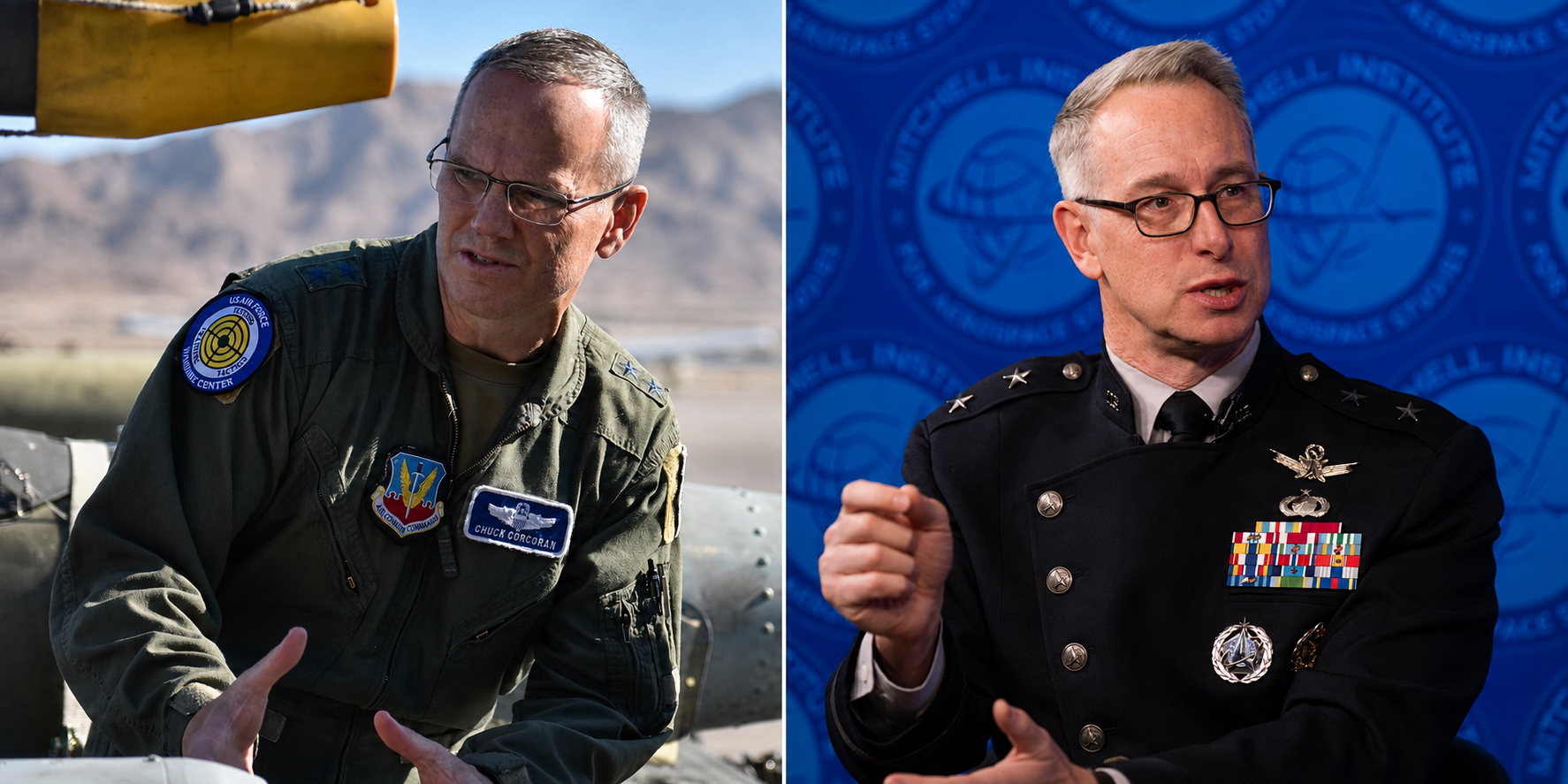
The Pentagon announced on August 3 that it has nominated three officers for significant three-star leadership roles across the Air Force and Space Force. These nominations, which include a new director of operations for the Space Staff and the rare recall of a retired general officer to lead Air University, were sent to the Senate on July 30 and have been referred to the Senate Armed Services Committee for review and confirmation.
The nominations highlight strategic appointments aimed at shaping future operations, education, and leadership within the U.S. military’s air and space domains. The slate of nominees includes:
- Space Force Maj. Gen. Christopher S. Povakhas been nominated to serve as the new Deputy Chief of Space Operations for Operations. If confirmed, he would succeed Lt. Gen. Douglas A. Schiess, who is concurrently awaiting Senate confirmation to become the third-ever Chief of Space Operations.
- Retired Maj. Gen. Charles S. Corcoranis nominated to assume the role of Commander and President of Air University, located at Maxwell Air Force Base, Alabama. He would replace Lt. Gen. Daniel H. Tulley, who is transitioning to lead Air Mobility Command. Corcoran’s nomination is notable due to his return to active duty following his retirement in 2023.
- Space Force Maj. Gen. Robert J. Huttis also nominated for a third star. He will continue in his current capacity as the Senior Military Assistant to Deputy Secretary of Defense Stephen Feinberg, a role he has held since August of the previous year.
Retired Lt. Gen. David A. Deptula, who serves as the Dean of AFA’s Mitchell Institute for Aerospace Studies, offered his perspective on these developments. “The nominations of Maj. Gen. Chris Povak and retired Maj. Gen. Chuck Corcoran are exceptionally positive developments,” Deptula stated. He emphasized the importance of these appointments, noting, “These are serious leaders being selected for serious missions at a time when both the Air Force and Space Force must sharpen their focus on operational effectiveness.”
The confirmation process for Lt. Gen. Douglas A. Schiess to become the next Chief of Space Operations (CSO) is progressing, having easily cleared the Senate Armed Services Committee. His nomination now awaits a floor vote by the full Senate. Upon confirmation, Schiess is expected to succeed Gen. B. Chance Saltzman, who is slated to retire in the fall after nearly four years in the role. Schiess’s transition would open the Deputy Chief of Space Operations for Operations position, which Povak is nominated to fill.
The role of Deputy Chief of Space Operations for Operations is a critical leadership position within the Space Force, overseeing a wide array of responsibilities. This includes the development and implementation of policy related to operations, sustainment, training, and overall readiness for the Space Force. The position has historically been held by officers who later ascended to the Chief of Space Operations role, underscoring its strategic importance. Major General Povak brings a wealth of experience to this role, having spent the preceding four years as deputy director of the National Reconnaissance Office (NRO), an agency responsible for operating U.S. intelligence satellites and maintaining close ties with the Department of Defense and the Space Force. Prior to his tenure at the NRO, Povak also served as deputy director of the Space Warfighting Analysis Center.
Deptula characterized Povak as an “outstanding choice” for the Space Force’s senior operations officer, highlighting his unique qualifications. “His experience at the National Reconnaissance Office and the Space Warfighting Analysis Center gives him an unusually valuable perspective,” Deptula commented. “He understands both the architecture that produces space capability and the operational demands that capability must satisfy.”
Major General Charles S. Corcoran’s nomination is particularly distinctive given his return to active duty. He retired from the Air Force in 2023, having last served as the Assistant Deputy Chief of Staff for Operations, a position that mirrors the operational oversight role Povak is nominated for within the Space Force. His distinguished career also includes commanding the U.S. Air Force Warfare Center at Nellis Air Force Base, Nevada, which encompasses the Air Force Weapons School and the critically important Red Flag exercises. A seasoned pilot, Corcoran is trained on both the F-15C Eagle and F-22 Raptor and has held command positions at the squadron, group, and wing levels.
Regarding Corcoran’s appointment to Air University, Deptula asserted that he is “exactly the kind of leader Air University needs.” Deptula elaborated on Corcoran’s qualifications, stating, “He is a highly respected warfighter, Weapons School graduate, combat-experienced commander, and former commander of the Air Force Warfare Center. He understands airpower not simply as an academic subject, but as a decisive instrument of national power that must be studied, taught, planned, and employed with professional competence.”
Deptula further emphasized the potential impact of Corcoran’s leadership on military education: “His nomination offers an opportunity to reconnect professional military education with the realities of modern warfare and to ensure that Airmen are being educated in Air Force history, doctrine, operational art, campaign planning, and the effective employment of aerospace power.” Air University plays a crucial role in the professional military education of Air Force and Space Force personnel, offering courses from basic officer training to advanced war studies, and shaping the intellectual foundation of future leaders.
The recall of general officers to active duty after retirement is an uncommon event, though not unprecedented in U.S. military history. For instance, Air Force Chief of Staff Gen. Kenneth S. Wilsbach was preparing for retirement after vacating his prior job when he was nominated to become the 24th Air Force Chief of Staff. Similarly, Gen. Dan Caine, the current Chairman of the Joint Chiefs of Staff, had retired when he was nominated to become Chairman in 2025. However, Corcoran’s return after a three-year hiatus is particularly rare. One notable historical parallel involves Brig. Gen. Haywood Hansell Jr., who was recalled in 1951 after a four-year break from service to lead the Air Force’s Mobilization Division during the Korean War.
Deptula weighed in on the broader implications of Corcoran’s recall, stating, “General Corcoran’s return to active service is both a strong vote of confidence in him and a warning about the condition of Air Force talent management.” He suggested that such an action should prompt a critical self-assessment within the service: “When the service must reach into its retired ranks to find the leader with the right background for a key position, that should prompt a hard examination of how it has identified, developed, assigned, and retained operationally experienced leaders over the past several years.”
Why This Matters
The nominations for these three-star leadership positions carry significant implications for the strategic direction, operational effectiveness, and long-term health of the U.S. Air Force and Space Force. These appointments are not merely administrative changes but represent critical decisions that will influence national security capabilities for years to come.
Strategic Leadership in a Contested Environment:The appointees will play pivotal roles in an increasingly complex and contested global security landscape. Major General Povak’s expected leadership as Deputy Chief of Space Operations for Operations will be crucial for guiding the Space Force’s tactical and strategic development, especially as space becomes a more vital domain for military advantage and national defense. His background in intelligence satellites (NRO) and space warfare analysis (SWAC) is directly relevant to enhancing the Space Force’s capabilities in a rapidly evolving threat environment.
Future of Professional Military Education:The appointment of a highly respected warfighter like retired Major General Charles S. Corcoran to lead Air University is a strong signal of the Pentagon’s intent to revitalize professional military education. Air University is the intellectual heart of the Air Force and Space Force, responsible for educating and developing future leaders. Corcoran’s extensive operational experience, particularly in combat and weapons training, suggests a renewed emphasis on practical, warfighter-centric education that aligns with the realities of modern conflict. This could lead to significant curriculum reforms and a shift in how officers are prepared for command and strategic roles.
Space Force Development and Maturity:The nominations, particularly for Major General Povak, come at a critical juncture for the Space Force, which is still a relatively young service branch. As Lt. Gen. Douglas A. Schiess moves towards potentially becoming the next Chief of Space Operations, the selection of a strong operational leader like Povak is essential for establishing and refining the Space Force’s doctrine, training protocols, and operational readiness. These leadership continuity and succession plans are vital for the branch’s growth and its ability to effectively deter aggression and protect U.S. interests in space.
Talent Management and Retention Challenges:The unusual recall of a retired general officer like Major General Corcoran, while potentially bringing valuable expertise, also raises questions about the broader talent management strategies within the Air Force. As highlighted by Lt. Gen. Deptula, the need to reach into retired ranks for key leadership positions could indicate underlying issues in identifying, developing, and retaining sufficiently experienced and qualified officers within the active-duty force. This situation could prompt an internal review of career progression, leadership development programs, and retention policies to ensure a robust pipeline of future leaders.
Congressional Oversight and Civilian-Military Relations:All these nominations require Senate confirmation, underscoring the vital role of civilian oversight over the military. The Senate Armed Services Committee’s review process provides an opportunity for thorough vetting of nominees’ qualifications, experience, and strategic vision. This process ensures accountability and maintains the balance of power essential to democratic governance, especially concerning top military leadership appointments that impact national defense policy and execution.