
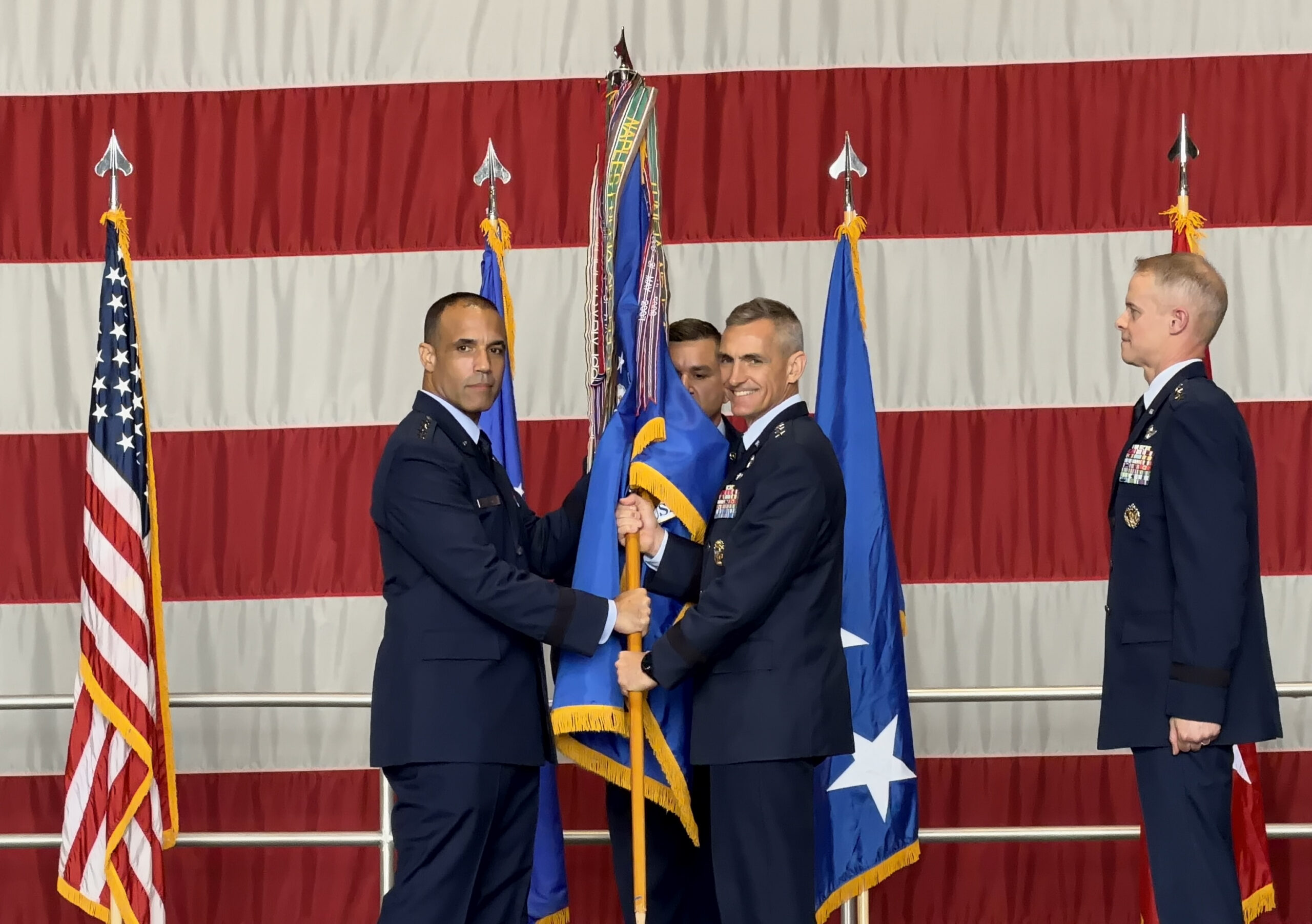
SHAW AIR FORCE BASE, S.C.—In a significant leadership transition for U.S. military operations in the Middle East, Lt. Gen. Daniel T. Lasica has assumed command of Air Forces Central (AFCENT) and taken on the role of Combined Forces Air Component Commander (CFACC) for U.S. Central Command (CENTCOM). The change of command ceremony took place on August 4, 2026, at Shaw Air Force Base, South Carolina, with Lt. Gen. Lasica succeeding Lt. Gen. Derek C. France, who is set to retire.
This command is considered one of the most critical three-star positions within the U.S. military, overseeing air operations in a region currently marked by heightened tensions and an ongoing, intermittent air campaign involving Iran. The ceremony itself garnered particular attention due to its relocation from its traditional venue in Qatar to the United States, underscoring the dynamic security landscape.
Gen. Adrian L. Spain, head of Air Combat Command, presided over the event, emphasizing the strategic importance of AFCENT. “In this command, the road you walk is a thin line between regional stability and global chaos,” Spain stated. He highlighted AFCENT’s enduring role as a “nation’s sentry,” recalling its involvement in major operations such as Desert Storm, the enforcement of no-fly zones over Iraq, and more than two decades of combat in Iraq and Afghanistan. Gen. Spain affirmed that this legacy of “generating airpower under duress continues,” particularly in the context of current engagements with Iran.
Addressing Lt. Gen. Lasica directly, Gen. Spain expressed confidence in his leadership, stating, “I know you will lead this team with the absolute focus and operational intensity that it constantly demands.” The transition occurs amidst reports of U.S. forces being prepared for renewed major combat operations against Iran, which were reportedly called off over a recent weekend by President Donald Trump at the request of allies seeking more time for peace talks.
Traditionally, AFCENT’s change of command ceremonies have been held at Al Udeid Air Base in Qatar, which serves as the forward headquarters for both CENTCOM and AFCENT and has long been the largest U.S. military installation in the Middle East. However, with Al Udeid located approximately 170 miles from Iran and having experienced persistent missile attacks, the ceremony was moved to Shaw Air Force Base in South Carolina. This relocation reflects a strategic adaptation to evolving threats in the region.
The outgoing commander, Lt. Gen. France, directed recent air campaigns against Iran from Shaw, which houses AFCENT’s U.S. headquarters. In recent years, AFCENT established a duplicate Combined Air Operations Center (CAOC) at Shaw, transferring primary operations there from the long-standing CAOC at Al Udeid prior to the outbreak of hostilities earlier in the year. Lt. Gen. France referred to the Shaw CAOC as “the machine that makes airpower happen day in and day out.”
Two of Shaw’s resident flying units, the 20th Fighter Wing, equipped with F-16C Fighting Falcons known as “Wild Weasels” for their specialized mission in suppressing enemy air defenses, and the 25th Attack Wing, operating MQ-9 Reaper drones, have been actively engaged in combat operations against Iran. Both an F-16 and an MQ-9 Reaper were prominently displayed during the ceremony, which took place in the 20th Fighter Wing’s hangar, overlooking Shaw’s active runway where F-16 flights continued throughout the day.
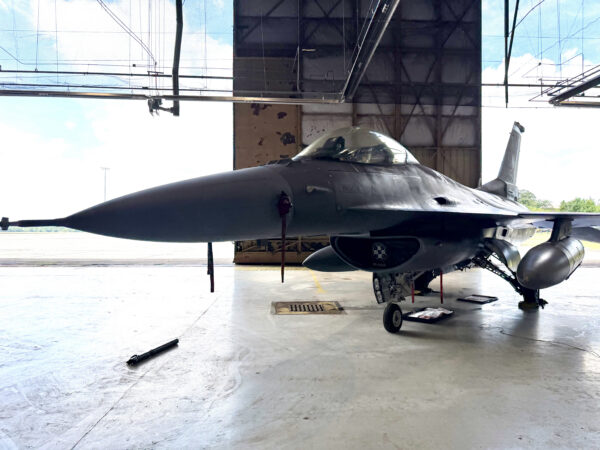
Army Lt. Gen. Patrick D. Frank, CENTCOM deputy commander, who attended in place of CENTCOM commander Navy Adm. Brad Cooper, remarked on the constant operational tempo. He recalled asking staff during previous ceremonies if flying operations should be paused. “I said, ‘Are you kidding me? That is the sound of freedom right there. We want them flying during our ceremonies,'” Lt. Gen. Frank recounted. The absence of Adm. Cooper, reportedly due to potentially looming Iran operations, and the presence of the ACC boss further underscored the high stakes and operational intensity currently defining the command. This marks the first time in eight years that AFCENT’s change of command has been held in South Carolina and at least five years since the Air Combat Command chief attended.
In his remarks, Lt. Gen. Lasica pledged his commitment to the mission. “We will continue to meet your and Adm. Cooper’s intent in service to our national strategic objectives,” he affirmed. He outlined a four-pronged approach: “We will defend our nation’s interests, our Airmen, our joint warriors, our allies, our partners, so that we can defeat adversary aggression. … We will develop our Airmen and take our lessons learned to improve the combat capabilities of our Air Force, our joint force, as well as our allies and our partners—all of this in order to win.”
An experienced F-16 pilot, Lt. Gen. Lasica previously served as director of operations for U.S. European Command (EUCOM), where he worked under former AFCENT commander Gen. Alexus G. Gynkewich. Prior to that, he was director of policy, plans, strategy, and capabilities at EUCOM. In both roles, he played a crucial part in supporting Ukraine in its conflict with Russia, including providing logistical assistance and maintaining an increased presence on Europe’s Eastern Flank to deter further Russian aggression. Notably, Lt. Gen. Lasica is also a former commander of Shaw’s 20th Fighter Wing.
Lt. Gen. France departs after a tenure marked by an exceptionally intense period of combat operations. This included Operation Epic Fury against Iran, described as the most intense air war since the 1991 Gulf War. His command also executed Operation Midnight Hammer against Iranian nuclear facilities and Operation Rough Rider against the Houthis in Yemen, both in 2025. AFCENT played a central role in the defense of Israel against Iranian drone and missile attacks during the “12-day war” in 2024, conducted strikes against ISIS in Iraq and Syria, and provided critical humanitarian aid air drops into Gaza. As Lt. Gen. Frank summarized, “For the past two years, you stood at the center of one of the most consequential periods in the history of CENTCOM.”
Why This Matters
The change of command at U.S. Air Forces Central (AFCENT) is more than a routine leadership transition; it represents a critical juncture for U.S. military strategy and regional stability in the Middle East. AFCENT serves as the air component of U.S. Central Command, responsible for all U.S. air operations across a vast and volatile area encompassing 21 nations, including Iraq, Syria, Afghanistan, and the Persian Gulf. This command is central to deterring aggression, protecting U.S. interests and personnel, and supporting allies and partners in a region that remains a flashpoint for international conflict.
The appointment of Lt. Gen. Daniel T. Lasica comes as the U.S. is engaged in what has been described as an “on-again-off-again air campaign against Iran,” underscoring the persistent and unpredictable nature of threats. The recent cancellation of planned strikes against Iran by President Trump highlights the delicate balance between military posturing and diplomatic efforts, placing significant responsibility on AFCENT’s leadership to maintain readiness while navigating complex political directives. Lt. Gen. Lasica’s prior experience in Europe, particularly in supporting Ukraine against Russia, suggests a commander adept at managing high-stakes geopolitical conflicts and coordinating multinational efforts.
The decision to hold the ceremony at Shaw Air Force Base in South Carolina, rather than the traditional forward headquarters in Qatar, is a stark indicator of the heightened threat environment in the Middle East. The relocation of the Combined Air Operations Center (CAOC) from Al Udeid Air Base, Qatar, to Shaw, due to missile attacks near Al Udeid, signifies a strategic shift by the U.S. military to enhance resilience and ensure continuity of command and control away from immediate threats. This adaptation demonstrates a proactive effort to protect critical assets and personnel while maintaining operational effectiveness.
Lt. Gen. Derek C. France’s tenure, marked by major operations like Epic Fury, Midnight Hammer, and Rough Rider, as well as the defense of Israel and humanitarian aid drops into Gaza, illustrates the breadth and intensity of AFCENT’s mandate. These operations highlight the critical role of U.S. air power in counter-terrorism, regional defense, and humanitarian efforts. The continued presence and operational capabilities of units like the 20th Fighter Wing and 25th Attack Wing are vital for projecting power, gathering intelligence, and responding rapidly to emerging crises. The transition of command ensures continuity in these essential functions, directly impacting regional security and the safety of global shipping lanes and energy supplies.
Ultimately, the leadership of AFCENT profoundly influences U.S. foreign policy and military posture in a region critical to global energy markets and international stability. The command’s ability to “defend, defeat, develop, and win,” as articulated by Lt. Gen. Lasica, is crucial not only for safeguarding U.S. interests but also for reinforcing alliances and deterring potential adversaries, thereby contributing to broader global security.
U.S. Air Force General Reflects on Demanding Tenure Overseeing Middle East Operations
Lieutenant General Derek France, outgoing commander of U.S. Air Forces Central Command (AFCENT), has concluded a period he described as “one of the most demanding” in the command’s history, highlighting the critical role of American airpower in maintaining regional stability amidst escalating tensions. Speaking as he prepared to relinquish command, General France underscored the unique capabilities and expansive reach of U.S. airpower, asserting that no other force could match its effectiveness in the complex operational environment of the Middle East.
During his tenure, General France oversaw operations throughout a region frequently challenged by geopolitical instability and direct threats. Air Force Chief of Staff General David W. Allvin, referencing this demanding period, commended General France, stating, “During Iranian missile attacks, intense air campaigns, and combat stories, your calm judgment and expertise in all things airpower allowed this command to thrive.” General Allvin’s remarks placed General France among a distinguished line of predecessors, including former Air Force Chiefs of Staff Gen. John P. Jumper, Gen. David L. Goldfein, and Gen. Charles Q. Brown Jr., as well as current combatant commanders General Alexus G. Grynkewich (now NATO Supreme Allied Commander Europe and head of U.S. European Command) and General Gregory M. Guillot (head of U.S. Northern Command).
General France assumed command from General Grynkewich in April 2024, mere days after a significant Iranian drone and missile attack targeting Israel. U.S. and allied forces played a crucial role in defending against this assault, successfully intercepting approximately 80 drones. Reflecting on his initial days in command, General France recalled, “The day I took command is the day that the [Israeli Air Force] did a response, and that was a long day because we set up defense and I got to bed about seven in the morning. I thought, ‘What in the world have I gotten myself into?’” He also referenced a separate direct attack by Iran on Israel with ballistic missiles in October 2024, further illustrating the persistent threat landscape faced by forces under his command.
The operational tempo remained high throughout his leadership. General France himself actively participated in combat missions, reportedly flying around 30 sorties, including patrols over the strategically vital Strait of Hormuz. He characterized the forces under his command as “one of the most potent joint forces that we’ve seen in a long time,” underscoring the collaborative efforts with regional and international partners.
Among his proudest moments, General France cited the operational success of “Midnight Hammer,” details of which remain largely classified, and the rescue by combat search and rescue teams of the crew of “Dude 44.” This incident involved an F-15E Strike Eagle, which General France stated was shot down by Iran in April, leading to a coordinated effort to retrieve the downed Airmen. He emphasized the scale of this rescue, noting, “an entire nation came to the aid of two downed Airmen.”
However, his tenure was not without significant challenges and losses. General France somberly reflected on such “low points,” including the tragic midair collision of two KC-135 Stratotankers while supporting Operation Epic Fury. One of these tankers, identified by its callsign Zeus 95, crashed in western Iraq, resulting in the deaths of all six Airmen aboard. “There are times of great victory, like those B-2s exiting hostile airspace after Operation Midnight Hammer or the rescue of Dude 44,” he remarked, contrasting these successes with “the tragedy of Zeus 95 and several other casualties that we’ve had across this theater.”
General France consistently emphasized airpower as the fundamental element binding all these events. He elaborated on its multifaceted role: “Airpower’s ISR [Intelligence, Surveillance, and Reconnaissance] provides an unblinking eye on the enemy. It is the power of fighter and bomber strike. It is the refueling that services both of those. It is combat search and rescue that picks up Americans out of harm’s way, and it is airlift that feeds the fight, whether it’s weapons, fuel, or aeromedical evacuation.”
Ultimately, General France concluded that while airpower serves as the common thread, the human element is the ultimate differentiator. “And if airpower is the common thread that makes a difference in the fight, our Airmen are the secret weapon,” he declared. “Our Airmen standing watch today are our nation’s sword and shield, its sentry and avenger.” His statements provide a rare glimpse into the persistent operational demands and strategic importance of U.S. air forces in a critical global theater.
Why This Matters
The reflections of Lieutenant General Derek France offer critical insights into the ongoing operational realities and strategic importance of U.S. military presence in the Middle East. His tenure at AFCENT coincided with a period of heightened regional volatility, marked by direct confrontations and proxy conflicts involving state and non-state actors.
- Regional Stability and Deterrence:General France’s emphasis on American airpower’s unique capabilities highlights its role as a primary tool for deterrence and a guarantor of regional stability. In an environment where threats can rapidly escalate, the capacity to project airpower serves to reassure allies, protect vital interests, and discourage aggression from adversaries. The U.S. and allied response to the April 2024 Iranian drone and missile attack on Israel exemplifies this immediate defensive capability and the commitment to regional security.
- Persistent Operational Demands:The characterization of his command period as “one of the most demanding” underscores the continuous pressure and high operational tempo faced by U.S. forces. This involves not only responding to immediate crises but also conducting routine surveillance, interdiction, and training missions across a vast and complex battlespace. The mention of flying 30 combat missions personally illustrates the hands-on leadership required in such an environment.
- Technological Superiority and Joint Force Integration:General France’s statements affirm the belief in the unparalleled technological advantage of American airpower. The various components he listed—ISR, strike, refueling, combat search and rescue, and airlift—demonstrate a sophisticated and integrated system. This also highlights the importance of joint force operations, where air assets work in concert with ground and naval forces to achieve objectives, a cornerstone of modern U.S. military strategy.
- Human Cost and Sacrifice:Acknowledging both “great victory” and “low points” like the Zeus 95 tragedy brings a human dimension to military operations. It serves as a stark reminder of the inherent dangers and sacrifices made by service members. These incidents underscore the high stakes involved and the personal toll on military personnel and their families, even during periods characterized by strategic successes.
- Strategic Implications for U.S. Foreign Policy:The operations described are not isolated incidents but integral components of broader U.S. foreign policy objectives in the Middle East. They reflect a commitment to counter-terrorism, safeguard global energy supplies, ensure freedom of navigation, and support key allies. General France’s insights provide context for understanding the significant resources and political capital invested in maintaining a robust military posture in the region, influencing global security dynamics.