
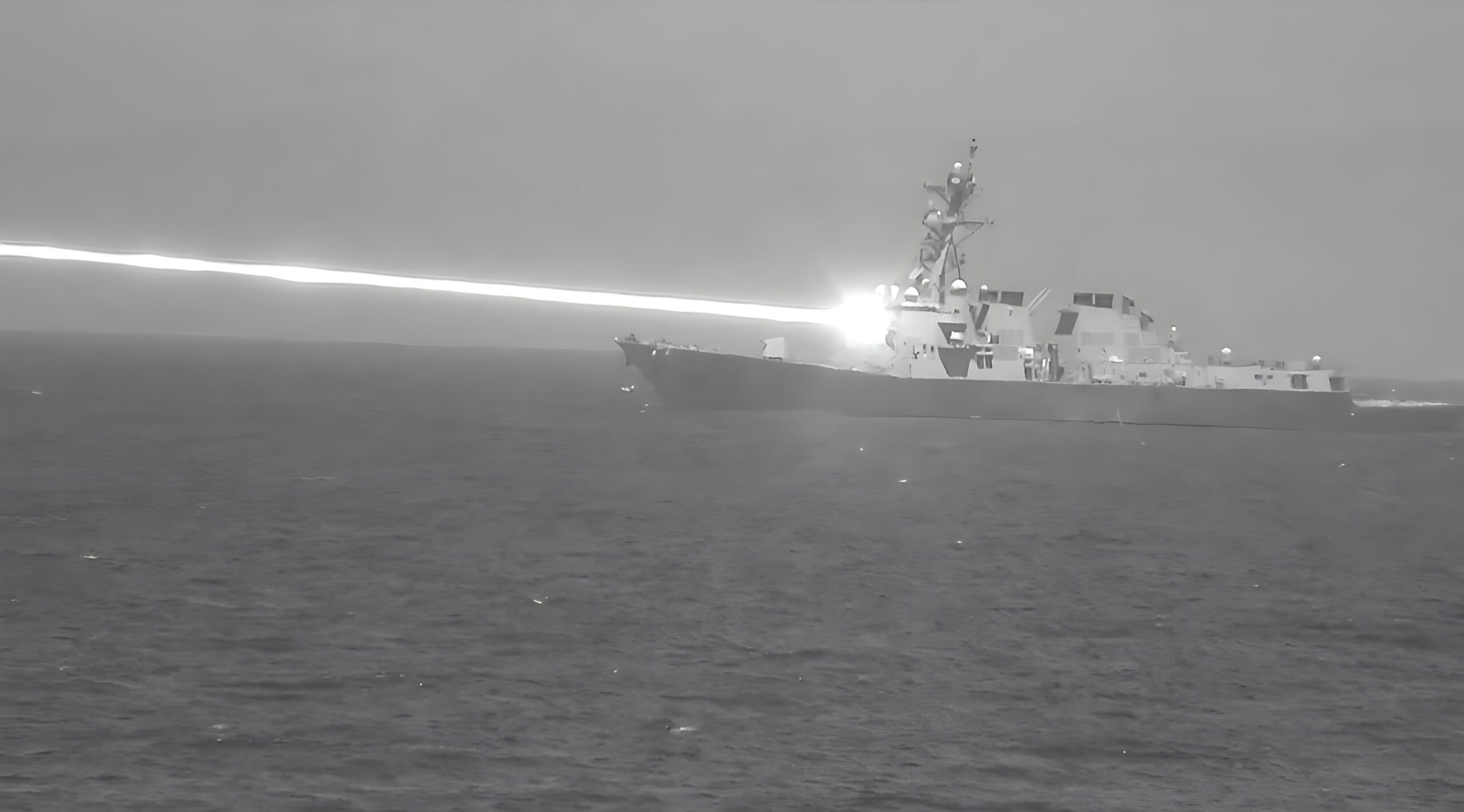
US Navy Destroyer Successfully Engages Multiple Drone Threats with Laser Weapon System
The United States Navy has confirmed a significant milestone in the development of directed energy weapons, announcing that an Arleigh Burke-class destroyer successfully used a ship-mounted laser weapon to neutralize multiple uncrewed aerial threats (UAS) during a recent at-sea demonstration. This successful engagement marks a critical step forward in integrating advanced defensive technologies into naval operations.
According to information disclosed by Lockheed Martin, the prime contractor for the system, the USS Preble, a Flight IIA Arleigh Burke-class destroyer, employed its High-Energy Laser with Integrated Optical Dazzler and Surveillance (HELIOS) system to engage and defeat four drones during a Navy-led counter-UAS exercise. While the activity took place last year, its public disclosure was made as part of Lockheed Martin’s latest financial update, underscoring its strategic importance to the company and the defense sector.
Jim Taiclet, Chief Executive of Lockheed Martin, highlighted the demonstration as proof of concept for lasers providing a viable and practical alternative to traditional missile-based defenses, particularly for close-range threats. He emphasized the system’s ability to “knock incoming uncrewed aircraft right out of the sky,” illustrating its potential to conserve the Navy’s inventory of expensive interceptor missiles for higher-priority or more advanced adversarial targets. The implications for fleet readiness and cost-effectiveness are substantial, as each missile represents a considerable financial investment and a finite resource.
Taiclet elaborated on the successful trial, stating: “The HELIOS weapon system successfully neutralised four drone threats in a US Navy-operated counter-UAS drone demonstration at sea, showcasing an opportunity to eliminate drone attacks using lasers and saving US and allied air defence missiles for more advanced threats.” He further connected this advancement to Lockheed Martin’s broader support for national defense initiatives, including what he referred to as the “Homeland Defence Mission” and “Golden Dome for America,” indicating a comprehensive approach to security. The company also noted its ongoing collaboration with government and industry partners at its Center for Innovation in Virginia, focusing on the command and control aspects integral to such advanced defense systems.
The HELIOS system, rated at approximately 60-kilowatt class, represents a significant engineering achievement. Its seamless integration into the destroyer’s existing Aegis Combat System is a key aspect of its operational viability. This integration allows HELIOS to leverage the ship’s sophisticated radar, sensors, and targeting data, enabling it to operate in conjunction with, or as an alternative to, conventional weaponry. Installed aboard the USS Preble, a vessel frequently used for testing and evaluating emergent naval technologies, HELIOS is designed for dual-purpose functionality. It can perform “soft-kill” engagements, which involve non-lethal methods such as dazzling or degrading the optical and infrared sensors of incoming threats, thereby disrupting their operational capabilities. Concurrently, it is capable of “hard-kill” engagements, delivering sufficient energy to heat and damage the structural integrity or critical components of a target, leading to its destruction.
This successful demonstration builds upon years of research and development in directed energy weapons. Laser systems offer several distinct advantages over traditional kinetic interceptors, including a virtually unlimited magazine capacity as long as power is available, a significantly lower cost per shot, and the speed-of-light engagement which minimizes reaction time for adversaries. While challenges remain, particularly concerning beam propagation through varying atmospheric conditions and power generation requirements, the HELIOS system’s performance aboard the USS Preble marks a critical validation of the technology’s readiness for naval application.
Why This Matters
The successful deployment and demonstration of the HELIOS laser weapon system on a frontline US Navy destroyer signifies a pivotal moment in naval warfare and defense technology. Its implications are multi-faceted and extend across strategic, economic, and tactical domains.
Firstly, from a **strategic perspective**, this marks a substantial shift towards incorporating directed energy weapons as a viable component of layered defense systems. For decades, missile interceptors have been the primary defense against aerial threats. The advent of operational laser weapons introduces a new paradigm, allowing navies to engage threats with unprecedented precision and at the speed of light. This capability is particularly crucial in an era defined by the proliferation of sophisticated and inexpensive drones, which pose a complex challenge to traditional defenses.
Secondly, the **economic implications** are profound. As highlighted by Lockheed Martin’s CEO, the ability to neutralize low-cost drone threats with a laser system rather than expensive interceptor missiles can lead to immense cost savings. A single high-end naval interceptor missile can cost millions of dollars, while the “cost per shot” of a laser is estimated to be in the low tens or hundreds of dollars, primarily for the electricity consumed. This dramatically alters the cost-exchange ratio in favor of the defender, potentially freeing up critical budget allocations for other defense priorities and ensuring that expensive munitions are reserved for high-value targets. Moreover, the “virtually unlimited magazine” — limited only by the ship’s power generation — removes the logistical constraints associated with carrying a finite number of physical missiles, enhancing endurance in protracted engagements.
Thirdly, **tactically**, HELIOS offers several advantages. Its precision engagement capabilities mean a reduced risk of collateral damage compared to explosive warheads. The ability to switch between “soft-kill” (dazzling sensors) and “hard-kill” (destroying the target) functions provides flexibility in responding to a range of threats, from surveillance drones to armed UAS. The speed of light engagement offers minimal warning time for targets, enhancing the weapon’s effectiveness against agile aerial threats. Furthermore, its integration into the Aegis Combat System means that existing radar, sensor, and command-and-control infrastructure can be leveraged, accelerating its adoption and ensuring seamless operation within established naval combat protocols.
Finally, this development underscores the ongoing **evolution of warfare and defense against emerging threats**. The proliferation of uncrewed systems, including swarms of drones, presents a significant challenge to modern militaries. Laser weapons offer a promising solution to counter these evolving threats effectively and economically. While challenges such as atmospheric conditions affecting beam propagation, power generation, and target acquisition at extended ranges continue to be areas of active research, the successful neutralization of four drones by USS Preble signifies that these hurdles are progressively being overcome. This milestone not only validates years of investment in directed energy research but also paves the way for wider deployment of such systems across naval fleets globally, influencing future naval doctrine and defense procurements.