
Unlock the Editor’s Digest for free
Roula Khalaf, Editor of the FT, selects her favourite stories in this weekly newsletter.
Key Takeaways
- Global warming is unlocking new Arctic shipping lanes, promising radical shifts in global supply chains, freight costs, and maritime logistics, with significant investment opportunities and risks for shipping, energy, and infrastructure sectors.
- A fierce geopolitical and economic contest is intensifying in the Arctic, with China leveraging its maritime prowess and strategic partnerships (notably with Russia) to establish dominance, challenging existing trade hegemonies and influencing future capital flows into resource exploration and infrastructure.
- The US, facing an eroding industrial base, is attempting to reassert its maritime and strategic position through legislative efforts like the “Ships Act” and capital expenditure on icebreakers, signaling a potential revival in domestic shipbuilding and defense contracting, albeit amidst lobbying pressures and high costs.
Last month, global sea temperatures reached a record high for July, a stark indicator of accelerating climate change that fuels maritime heatwaves across the Atlantic, Pacific, and Mediterranean. While an ominous environmental warning, this phenomenon simultaneously ushers in a new era of commercial opportunity and geopolitical competition, fundamentally reshaping global market dynamics and supply chain strategies.
The accelerated melting of Arctic ice sheets is not merely an environmental event; it is a seismic shift in global logistics infrastructure. New shipping lanes in the High North are becoming viable, offering a potential radical decrease in transit times and energy consumption for commercial goods moving between the Atlantic and Pacific basins. For multinational corporations heavily reliant on global supply chains, these routes promise significant operational efficiencies, reduced fuel costs, and potentially lower freight rates, impacting everything from consumer goods pricing to the profitability of shipping conglomerates. This newfound accessibility also inherently reconfigures the geostrategic map, making the Arctic a burgeoning frontier for investment and influence.
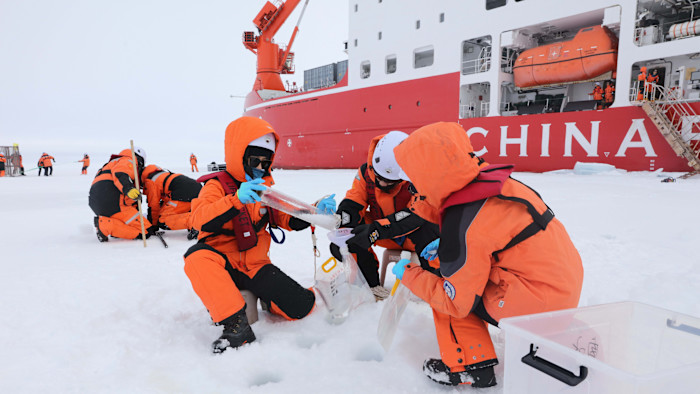
The geopolitical undercurrents are as frozen as the region once was. US President Donald Trump’s “Donroe Doctrine,” prioritizing security in the northern and western hemispheres, and his expressed interest in Greenland, underscore the strategic value now attributed to the Arctic. However, it is China, often in collaboration with Russia and its formidable icebreaker fleet, that is rapidly monetizing these emerging opportunities. This week marked a pivotal moment with a Chinese shipping line launching the first weekly container ship passage through the Arctic. Branded the “Ice Silk Road,” this route, skirting Russia on a journey between China’s east coast and the UK, represents a clear strategic investment in alternative trade pathways that could bypass traditional chokepoints and significantly reduce transit times compared to the Suez Canal route.
This initiative highlights China’s decades-long, deliberate focus on maritime dominance. Since its accession to the World Trade Organization, China has strategically poured capital into its maritime and shipping sector, systematically eroding the industrial strength of traditional naval powers, particularly the US. China’s shipbuilding industry now dwarfs that of the US, controlling an estimated 55 per cent of global production, a staggering increase from just 5 per cent in 2000. This asymmetry presents profound commercial and military concerns for the US and its allies, impacting not only defense readiness but also the economic security of nations dependent on the US for maritime protection and unfettered trade routes. The financial implications are massive: China’s strategic capital expenditure in this sector underpins its long-term economic expansion and geopolitical leverage.
In response to this growing disparity, a bipartisan push is underway in the US to pass the “Ships Act.” This legislation aims to revitalize domestic shipyards and expand the US commercial fleet, signaling a potential pivot toward industrial policy focused on strategic self-sufficiency. However, critics argue the bill has been diluted by lobbying efforts from American importers, who fear higher shipping costs if forced to utilize more expensive US-flagged vessels. This internal conflict underscores the tension between national security imperatives and immediate commercial interests, a dynamic that will shape future investment in US maritime infrastructure. Despite these challenges, Trump has been credited for securing a deal to build icebreakers with Finland, a crucial step in projecting presence and protecting commercial interests in the High North – an investment in critical capital assets that reflects long-term strategic planning, even if its foundational strategy predates his administration.
The demand for icebreakers is set to surge as Arctic commerce pathways multiply. Even without visible ice, the volatile conditions of the High North necessitate these specialized vessels to ensure safe passage, protecting valuable cargo and human lives from sudden shifts in wind and ice. China’s declaration as a “near Arctic” nation, coupled with its deepening cooperation with Russia on oil and gas transport, highlights a calculated expansion of its economic footprint. Russia, possessing a vast fleet of icebreakers, is also leveraging its sovereign control over the Northern Sea Route, effectively monetizing access through permits and escort services, thereby adding a geopolitical premium to Arctic shipping costs.
Beyond shipping, the Arctic holds immense untapped economic potential. The US, Canada, and various European and Asian nations are intensifying seabed mapping efforts, not just to identify viable shipping routes but also to explore vast mineral deposits – particularly rare earths, crucial for high-tech industries – and substantial reserves of natural gas. These efforts signal a new commodity frontier, potentially diversifying global supply chains for critical resources currently concentrated in a few nations, primarily China. Investment in exploration, extraction technologies, and supporting infrastructure will require colossal capital expenditure, driving market activity in sectors ranging from mining and energy to advanced marine engineering.
The paradox is undeniable: the very climate change that threatens global ecosystems is simultaneously unleashing new economic opportunities in the Arctic. Increased shipping through these sensitive waters will inevitably contribute to further sea ice breakdown, creating a feedback loop where more open pathways incentivize greater exploitation. This dynamic fuels a burgeoning race to secure, exploit, and potentially colonize a melting Arctic. As with so many aspects of today’s geostrategic shifts and market reconfigurations, China has secured an early, significant lead, dictating terms and shaping investment narratives.
Market Impact
The opening of Arctic shipping lanes represents a significant long-term structural shift for global markets, impacting logistics providers, commodity traders, and industrial sectors. Shipping companies like Maersk, COSCO, and CMA CGM will face strategic choices regarding fleet composition, route optimization, and investment in ice-strengthened vessels. Reduced transit times could compress global supply chain lead times, potentially lowering inventory holding costs for manufacturers and retailers. For the energy sector, new natural gas fields in the Arctic could alter global supply dynamics, affecting LNG prices and energy security. The hunt for rare earths will drive capital investment into mining and exploration firms, potentially diversifying critical mineral supply chains away from current concentrations. Furthermore, the geopolitical competition will fuel increased defense spending on icebreakers and naval capabilities, benefiting defense contractors and specialized shipbuilding firms. Investors should monitor shifts in freight derivatives, commodity futures for energy and rare earths, and the market capitalization of logistics and resource extraction companies with significant Arctic exposure, as this thawing frontier presents both substantial opportunities and heightened geopolitical risk premiums.