
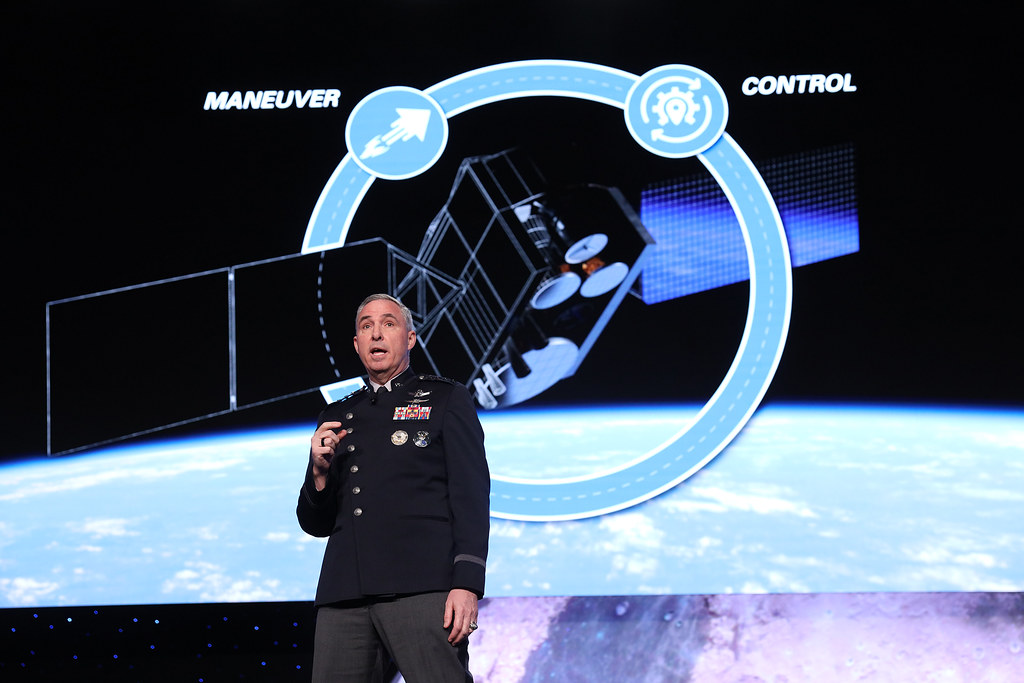
HUNTSVILLE, Ala.—The U.S. Space Command (SPACECOM) is actively preparing for a significant live-fly exercise, scheduled to occur in the coming weeks. This exercise is specifically designed to rigorously test advanced maneuver concepts, with the overarching goal of refining and informing SPACECOM’s strategic approach to dynamic operations within Earth’s orbit.
General Stephen Whiting, commander of SPACECOM, publicly announced these plans on August 12 during a briefing held at Redstone Arsenal in Huntsville, Alabama. He detailed that the forthcoming event will encompass two primary components: live operational demonstrations utilizing existing U.S. military satellites and a complementary tabletop exercise. These dual approaches will allow SPACECOM to evaluate both the practical execution of on-orbit maneuvers and the strategic decision-making processes required for such complex operations.
Explaining the core objective, General Whiting emphasized, “We will take some of our existing satellites and work with partners to demonstrate what are some of the requirements and capabilities to be able to maneuver for advantage, not just maneuver when you have to change your orbital position.” This statement underscores a critical shift in strategic thinking for space operations: moving beyond mere collision avoidance or maintaining a static orbital slot, towards an active strategy of repositioning spacecraft to gain tactical or operational superiority. Such “maneuver for advantage” could involve relocating assets to improve surveillance capabilities, evade potential threats, or position for offensive or defensive actions in a contested environment.
This upcoming exercise forms a key component of SPACECOM’s broader “Apollo Maneuvers” initiative, a series of demonstrations that General Whiting first unveiled in January. The overarching goal of Apollo Maneuvers is to systematically refine tactics and, in doing so, lay the foundational groundwork for a future maneuver warfare doctrine specifically tailored for the space domain. The command has, in recent years, increasingly highlighted the imperative for spacecraft designs that permit extensive, unrestricted movement, moving past the limitations imposed by conventional propulsion systems and finite fuel reserves. The chosen name, “Apollo Maneuvers,” is a deliberate historical allusion to the U.S. Army’s “Louisiana Maneuvers” of 1941. These were a series of extensive battle management exercises conducted during World War II, instrumental in testing and refining ground tactics for large-scale conflicts. By drawing this parallel, SPACECOM signals its intention to develop similarly comprehensive and foundational operational doctrines for space.
General Whiting further articulated the strategic rationale behind this initiative, stating, “This is to get after the requirement that we see to be able to execute a maneuver warfare strategy in space, just like we do on the land, in the air, and at sea.” This analogy highlights a fundamental shift in military thinking: applying principles of agility, surprise, and rapid repositioning, traditionally confined to terrestrial, atmospheric, and maritime theaters, to the unique challenges and opportunities of the space domain. The aim is to create a dynamic space architecture capable of adapting to evolving threats and mission requirements. “We want to be able to maneuver for advantage,” he reiterated, emphasizing the proactive rather than reactive nature of this emerging strategy.
While General Whiting did not elaborate on the specific scenarios that would be simulated during the exercise, the identities of participating partners, or the particular satellites that would be utilized, a spokesperson for SPACECOM provided additional context to Air & Space Forces Magazine. The spokesperson confirmed that the Apollo Maneuvers effort is intrinsically linked to Operation Olympic Defender, an established multinational partnership. Operation Olympic Defender involves seven allied nations working collaboratively to enhance the integration of space operations and improve data sharing capabilities among them. The spokesperson further clarified that the Apollo Maneuvers exercise will encompass “coordinated activities” spanning multiple orbital regimes. These activities are designed to address two critical areas: “executing contested logistics”—which refers to the ability to resupply or maintain space assets in a challenging or hostile environment—and “developing satellite servicing requirements,” indicating a focus on in-orbit repair, refueling, and life-extension capabilities for spacecraft.
In earlier remarks to reporters, General Whiting had indicated that SPACECOM intended to coordinate the Apollo Maneuvers events to align with separate on-orbit logistics and refueling demonstrations planned by the U.S. Space Force for the current year and the next. Addressing the potential for synergy, General Whiting stated in April, “Obviously those programs will have their own technical mission requirements that they need to test out certain things, and we don’t want to interfere with that, but we have high confidence that we’ll be able to partner with those organizations to demonstrate capability, and then to also leverage their test points as part of a broader tabletop exercise.” This suggests a strategy of integration, where SPACECOM can utilize the technical achievements and data points from Space Force’s independent demonstrations to enrich the strategic and tactical evaluations within Apollo Maneuvers, fostering a comprehensive understanding of future space operations.
Complementing the live-fly and tabletop components, U.S. Space Command has also established a dedicated team of analysts. Their mission is to construct a sophisticated digital environment, a simulated battlespace, which the command’s warfighting branch will utilize to conduct and analyze aspects of the upcoming exercise. This digital platform will likely enable the testing of a wider array of scenarios, including those too risky, costly, or complex to execute with physical assets, providing invaluable insights for doctrine development.
Speaking again on August 12 at the Space and Missile Defense Symposium in Huntsville, General Whiting explicitly linked his command’s urgent push for more maneuverable spacecraft and the corresponding tactics to advancements observed in China’s space capabilities. He highlighted that China has demonstrated significant progress in areas such as on-orbit refueling and logistics. These capabilities allow satellites to extend their operational lifespan, change orbits more frequently, and potentially perform complex rendezvous and proximity operations, reducing reliance on pre-launch fuel capacity. General Whiting underscored the strategic imperative driving SPACECOM’s efforts, stating unequivocally, “We do not want to be in a position where an opponent has a maneuver advantage over us in the space domain.” This reflects a core tenet of military strategy: preventing a potential adversary from gaining a decisive edge in any operational environment. In space, maneuver advantage could translate into superior intelligence gathering, more resilient satellite networks, or enhanced capabilities to disrupt an opponent’s space assets, making it a critical area of competition.
Reinforcing these strategic priorities, U.S. Space Command earlier this month released a pivotal document outlining its “vision for space operations in 2040.” This document is designed to serve as a guiding framework, providing planners, commanders, and operators with a conceptual lens through which to anticipate and prepare for the future operating environment in space. Central to this vision, the document unequivocally describes maneuver as a paramount enabler for maintaining U.S. advantage in space. It posits that the ability to maneuver has the potential to “unlock” a host of emerging capabilities. These include the capacity to reposition satellites that have sustained damage, thereby restoring their functionality or moving them to a safer orbit, and crucially, to extend the operational lifespan of “critical systems” through in-orbit servicing and maintenance.
The document elaborates on this transformative potential, stating, “In a future where satellites can rendezvous, refuel, repair, or replace components in space, on-orbit architectures become dynamic rather than fixed.” This vision contrasts sharply with the current paradigm where most satellites are launched with a fixed amount of fuel and limited ability to change their mission profile or repair themselves. A dynamic architecture implies a flexible, resilient, and adaptive constellation of satellites, capable of reconfiguring itself to meet evolving demands or threats. The document concludes with a powerful assertion about the strategic implications of this agility: “The side that can maneuver persistently and at scale will set the operational rhythm in orbit.” This suggests that the ability to rapidly and repeatedly shift positions, refuel, and service assets will dictate the pace and nature of operations, giving a decisive advantage to the most agile actor.
Why This Matters
The U.S. Space Command’s “Apollo Maneuvers” initiative, and specifically the upcoming live-fly exercise, represents a pivotal shift in how nations envision and prepare for operations in Earth’s orbit. Its significance extends across several critical domains:
National Security and Strategic Advantage:Space is no longer merely a support domain but an increasingly contested arena and potential theater of conflict. The ability to “maneuver for advantage” means the U.S. seeks to ensure its satellites can evade threats, reposition for optimal intelligence gathering, or maintain operational integrity even under duress. This strategic agility is crucial for deterring potential adversaries and ensuring the resilience of critical space-based assets, which are indispensable for modern military operations, from precision navigation to global communications. Without dynamic maneuver capabilities, a nation’s space assets could become static targets, vulnerable to disruption or destruction, thereby jeopardizing national security.
Technological Innovation and Economic Impact:Developing spacecraft capable of persistent, fuel-efficient maneuver requires significant advancements in propulsion systems, autonomous navigation, robotics for in-orbit servicing, and artificial intelligence for decision-making. The substantial investments and innovations spurred by these military requirements often have dual-use applications, accelerating the development of commercial space industries. Technologies for on-orbit refueling, repair, and assembly could lead to a thriving commercial space economy, reducing launch costs, extending satellite lifespans, and enabling entirely new services that benefit both governmental and private sectors, potentially including space tourism or asteroid mining in the future.
Geopolitical Competition and Stability:The explicit mention of China’s advancements in on-orbit logistics highlights the escalating strategic competition in space. As more nations and private entities achieve advanced space capabilities, the risk of miscalculation or conflict in orbit increases. By proactively developing maneuver warfare doctrine, the U.S. aims to maintain a deterrent posture and ensure stability by demonstrating its capability to protect its interests. The involvement of multinational partners through Operation Olympic Defender also underscores the importance of allied integration in navigating this complex and contested domain, promoting collective security and shared understanding of space operations, which is vital for preventing unilateral actions that could destabilize the orbital environment.
Impact on Daily Life:While often perceived as a purely military or scientific endeavor, the security and resilience of space assets directly impact countless aspects of civilian life. From the GPS signals that guide transportation and enable financial transactions, to the communication satellites that connect the globe, and the weather satellites that predict storms, modern society relies heavily on a stable and accessible space environment. Ensuring the “operational rhythm in orbit” remains in the hands of responsible actors directly translates to the continued availability and reliability of these essential services for billions worldwide. A robust maneuver capability helps safeguard these critical infrastructures against threats, both intentional and accidental, ensuring the uninterrupted flow of information and services that underpin contemporary society.