
Unlock the Editor’s Digest for free
Roula Khalaf, Editor of the FT, selects her favourite stories in this weekly newsletter.
Key Takeaways
- Elevated Geopolitical Risk Premium:Despite strategic geopolitical maneuvers positioning itself as a “hinge power,” Pakistan’s chronic domestic instability, governance issues, and security challenges significantly increase its sovereign risk, deterring foreign direct investment and elevating borrowing costs in international markets.
- Economic Vulnerability & IMF Dependency:Persistent fiscal mismanagement and reliance on IMF bailouts reflect deep structural economic weaknesses, leading to currency volatility, credit rating downgrades, and limited investor confidence in long-term growth prospects, even amid potential commercial deals.
- Paradox of Strategic Asset vs. Investment Destination:Pakistan’s ability to navigate complex regional alliances and project influence abroad contrasts sharply with its internal disarray, creating a market paradox where its strategic importance is high, but its investability remains low due to perceived high operational and political risks.
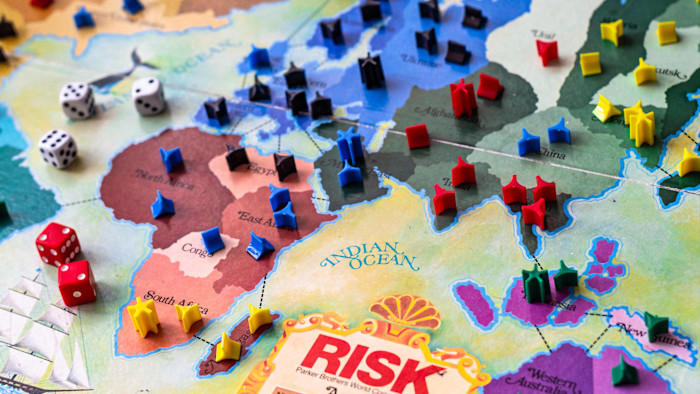
In the last few decades of the 20th century, the go-to geopolitical board game for many teenagers was Risk. The object was world domination, the secret to success simple: take over a hinge power on the map that covers the board, try to control a continent and expand from there. It is like playing the Great Game, as the 19th-century contest for Central Asia was known, around your kitchen table: you keep your armies hidden, and then you strike. In the high-stakes arena of global capital markets, however, the equivalent of a “hinge power” is a nation whose strategic geopolitical position carries a unique, often volatile, risk premium that investors must price into every asset.
Remarkably, the original Risk map with its 42 territories has stayed all but the same since it was launched in 1957. It is time for an update. Why does the game not include nuclear-armed Pakistan? Its surface area on the Risk board is split between a supersized India, Afghanistan and a vast “Middle East”. Yet in the real-life game of Risk that is geopolitics in what could be Donald Trump’s second term, Pakistan is busily projecting itself as a hinge power, attempting to leverage its strategic location for diplomatic and economic gain, despite a backdrop of profound domestic instability. This month’s defence pact with Saudi Arabia and Turkey is just the latest power play by Islamabad, signaling a proactive, if sometimes precarious, foreign policy that has significant implications for regional trade, energy security, and defense sector investments.
The most striking demonstration of this strategy was in April when it drew on its ties with America, China and regional powers, and hosted the first direct talks between Washington and Tehran since the Islamic revolution of 1979. While there was no breakthrough, and officials fretted the impasse made them look silly before Qatar assumed the mediating role, the signal was clear. Pakistan has tense relations with neighbouring India, Afghanistan and Iran, yet it senses an opportunity to play a more proactive role in the world. From a market perspective, such maneuvers, even if unsuccessful, contribute to a perception of heightened regional volatility, impacting investor sentiment towards sovereign bonds and equity markets across the broader Middle East and South Asia. The pursuit of “à la carte” alignments—with Washington and Beijing, Sunni Gulf states and Shia Iran—underscores a complex hedging strategy that, while politically astute, can create ambiguity for international investors seeking clarity on long-term policy direction.
The case for Pakistan’s elevation to the Risk board has no moral dimension, and neither does the market’s assessment. Its semi-feudal military-led political class has misruled for much of the country’s existence, leading to chronic fiscal mismanagement, frequent IMF dependency, and a ballooning debt-to-GDP ratio which erodes investor confidence and elevates sovereign risk premiums. One minister laments the early decades of independence, when at times the economy seemed in better shape than India’s; this is now a distant dream as Pakistan navigates its latest IMF bailout, a recurring event that signals deep structural economic weaknesses and places significant downward pressure on the Pakistani Rupee (PKR) and its credit ratings. The perceived inability to graduate from IMF programs suggests persistent governance issues that directly impact the country’s attractiveness as a foreign direct investment (FDI) destination.
As for democratic freedoms, the wildly popular opposition leader, Imran Khan, may have been an erratic prime minister but it is appalling that he is in prison on seemingly trumped-up charges. This month has seen a new media crackdown. This political instability, suppression of dissent, and lack of rule of law are grimly familiar to anyone who has followed the country over the years, and they translate directly into a higher country risk premium for businesses and investors. Political unpredictability deters long-term capital commitments, forcing a focus on short-term, high-return ventures that can exit quickly, or simply bypassing the market altogether.
But while a shambles at home, Pakistan is delivering a Machiavellian masterclass abroad. Values are patently irrelevant to statecraft in the age of Trump; all that matters is the deal. That clearly suits Pakistan as it pursues them, commercially with America on crypto and critical minerals, and on the world stage. While nascent, discussions around critical minerals represent a potential avenue for future economic growth and FDI, tapping into global supply chain demands, though the viability is heavily contingent on security and regulatory stability. The Mecca Joint Defence Agreement, as the new pact is known, is the latest in a diplomaticpas de deuxby Pakistan’s de facto leader, Field Marshal Asim Munir, and his civilian sidekick, Prime Minister Shehbaz Sharif, since Trump resumed office. Both intuited immediately the essential art of sycophancy in dealing with him, highlighting a transactional approach to international relations that can yield short-term geopolitical gains but does not necessarily translate into sustained economic partnerships without addressing fundamental domestic issues.
The new pact reflects how the war against Iran has shaken up the Gulf. The signatories are in effect hedging against the loss of America’s security umbrella. Their pledge of “collective deterrence against aggression” echoes the language of Nato, although it has yet to be put to the test. For Pakistan, the pact is of particular import. It represents an attempt to diversify its strategic alliances and potentially unlock new avenues for trade and investment within the bloc. Even as it fights a low-level war with Afghanistan, is ever at risk of a calamitous conflict with India, and wages a murderous counter-insurgency in two border provinces, it has bold ambitions to break free of its neighbourhood. Officials dream of a rail link connecting Central Asia to Pakistan’s ports, opening up new markets for logistics and trade. They hope international investors see this year’s Saudi bailout as a backstop, encouraging a fresh look at Pakistan’s long-term infrastructure potential and its role as a regional trade conduit, particularly for landlocked Central Asian economies seeking sea access.
In the game of Risk, the winner ultimately deploys infantry, cavalry and artillery and triumphs literally by throws of dice. Unfortunately for Munir, real life is more complicated, and the market’s dice rolls are based on cold, hard data. He has deployed forces along the border with Afghanistan, in the province of Balochistan and Pakistan-held Kashmir, and has little to show for it but body bags. At least 860 soldiers and police have been killed this year. International interest in mining deals, despite the country’s untapped reserves, is stalled over these profound security concerns. This directly impacts foreign direct investment (FDI) in key resource sectors, causing a significant opportunity cost and reflecting a tangible security-related risk discount on potential returns. The persistent internal conflicts not only divert critical national resources but also project an image of instability that negates any positive sentiment derived from diplomatic overtures.
Pakistan’s officials say the dilemma is always whether to nurture a democracy or the state. Munir believes the latter is the right course. He is said to be enjoying the accolades over his moves. They should earn Pakistan a place on the Risk board. Yet his domain is a tinderbox. Such is the paradox of Pakistan – a nation of immense strategic importance whose geopolitical dexterity is continuously undermined by its internal fragility, making it a challenging, high-risk proposition for global capital.
[email protected]
Market Impact
Pakistan’s complex geopolitical maneuvers, while strategically assertive, directly contribute to a significant risk premium for its financial assets. For sovereign bond investors, persistent IMF reliance and political instability translate into higher yield demands and frequent credit rating downgrades, limiting access to international capital markets and raising the cost of debt servicing. The Pakistani Rupee (PKR) faces continuous pressure from fiscal imbalances and geopolitical uncertainties, leading to volatility that erodes investor confidence and impacts import/export costs. Equity markets remain characterized by high volatility and low foreign participation, as security concerns and governance issues deter long-term foreign direct investment (FDI) in critical sectors like mining and infrastructure, despite significant potential. Regional defence pacts could theoretically open new trade corridors or energy security avenues, but the lack of internal stability and rule of law makes these opportunities difficult to capitalize on, leaving Pakistan primarily viewed as a high-risk frontier market where geopolitical strategy often overshadows underlying economic fundamentals.