
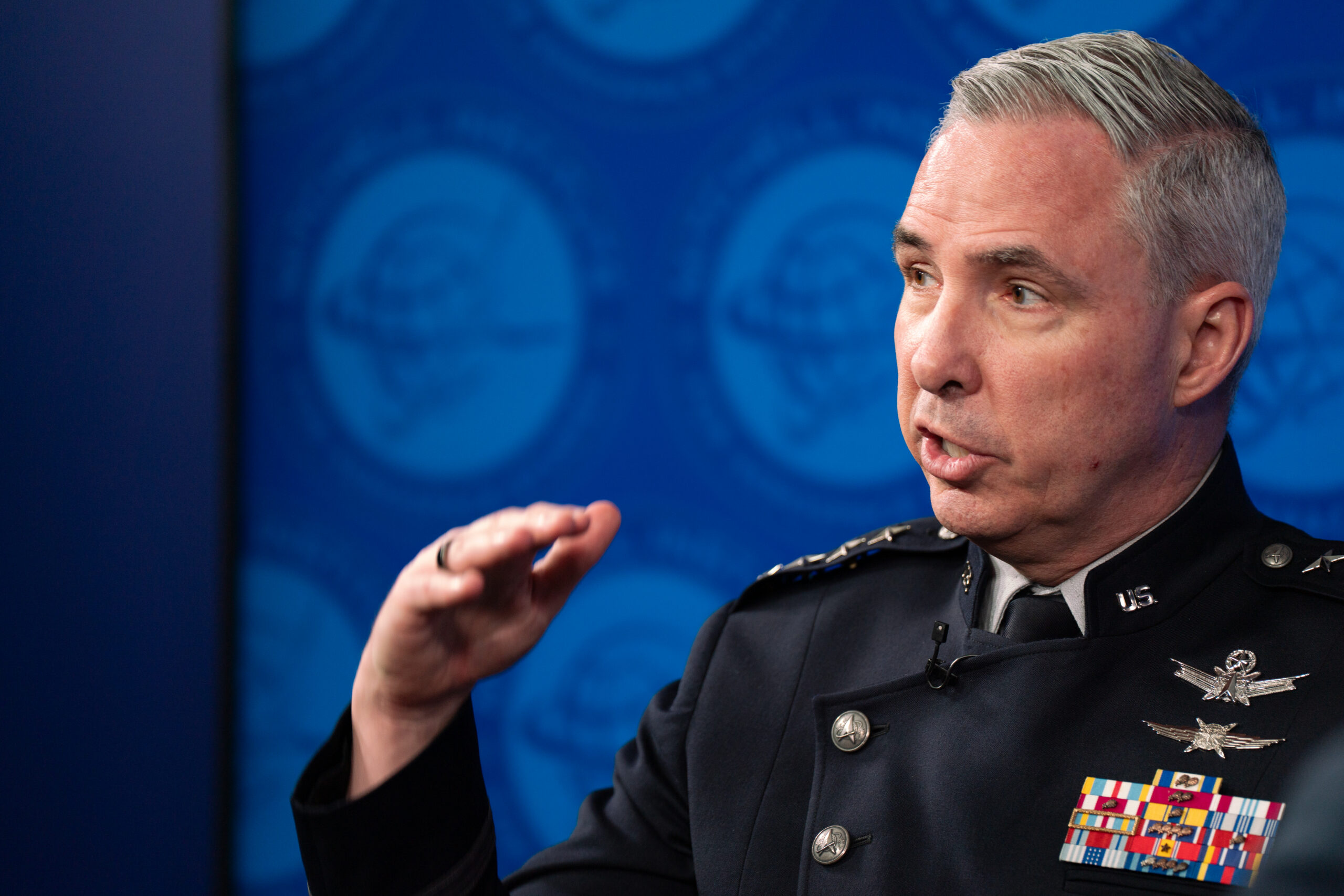
HUNTSVILLE, Ala.—Gen. Stephen Whiting, the head of U.S. Space Command, stated on August 12 that current military operations, particularly those involving Iran, have revealed significant vulnerabilities in ground-based space assets, with missile defense systems being particularly susceptible to attack. Speaking at the Space and Missile Defense Symposium, Gen. Whiting advocated for a fundamental shift towards a more resilient, mobile, and distributed architectural approach for these critical ground systems.
Gen. Whiting underscored the increasing threat posed by adversaries targeting space and missile defense assets. “If current overseas operations have taught us anything, it’s that our adversaries are targeting space and missile defense assets like never before,” he remarked. He specifically identified Iran, a medium-sized military power, as an actor actively engaging these targets. Whiting highlighted that adversaries typically dedicate expensive resources to target what they consider their opponent’s most valuable assets, indicating the high strategic importance and perceived vulnerability of current U.S. space and missile defense infrastructure.
Simultaneously, Gen. Whiting articulated a dual challenge for U.S. Space Command: while seeking to enhance the resilience of its own assets, the command also requires the ability to counter adversaries who are similarly bolstering their satellite and ground station resilience through proliferation. This necessitates a strategic focus on both defensive hardening and the development of offensive countermeasures.
Ground System Vulnerability and Resilience
Since the initiation of Operation Epic Fury in late February, multiple media reports have indicated that Iranian missiles and drones have struck and caused damage to U.S. radar sites across the Middle East. Following his speech, Gen. Whiting confirmed to reporters that despite the effective contributions of U.S. space capabilities to recent engagements, the Department of Defense must urgently improve the resilience of its ground-based infrastructure.
The U.S. Space Force has, in recent years, strategically transitioned its on-orbit architecture. This evolution involves moving away from relying on a limited number of large satellites in geosynchronous orbit (GEO) towards deploying larger constellations of smaller satellites in low Earth orbit (LEO), commonly referred to as proliferated LEO (pLEO). This architectural shift is based on the principle of “strength in numbers,” where the sheer volume and distribution of satellites provide redundancy, making it significantly harder for an adversary to incapacitate the entire constellation.
Gen. Whiting advocated for the military to apply a similar distributed and resilient approach to its ground architecture. He proposed a departure from single-node, centralized systems in favor of a more distributed, mobile, and survivable footprint. “Anywhere we are reliant on fixed, centralized nodes, we need to really think through how are we making that as resilient as a pLEO constellation is resilient compared to the traditional constellations we have,” he explained, underscoring the critical need for this architectural transformation.
A recently issued U.S. Space Command vision-casting document, which forecasts the operational landscape and challenges up to 2040, explicitly identifies ground systems as “the physical anchor of spacepower.” This designation highlights their indispensable role while also making them attractive targets for adversaries aiming to disrupt U.S. space capabilities through kinetic or cyber attacks. The document warns that without resilient ground capabilities, the strategic advantages of a proliferated satellite constellation—such as redundancy and global reach—could be rapidly negated if an enemy successfully targets the terrestrial operational hubs that control them.
The report’s assessment is unequivocal: “Static ground nodes, once the norm, will become liabilities. They represent single points of failure that adversaries can attack through cyber intrusion, directed energy, precision fires, or sabotage. In a future where space effects must persist through the first strike, fixed infrastructure will be targeted early and often.”
To counteract these vulnerabilities and maintain strategic advantage, the vision document proposes that ground infrastructure must evolve into a resilient, mobile, and extensively distributed network. This future network should seamlessly integrate military, commercial, and coalition capabilities, shifting command and control (C2) from static, predictable points to adaptive, dynamic systems. The overarching objective, as outlined in the report, is to enable warfighters to concentrate on mission objectives rather than on defending a fragile and vulnerable network.
Countering Adversary Proliferation
While emphasizing the need to protect U.S. on-orbit assets through hardened and distributed ground architectures, Gen. Whiting and other officials at the symposium also stressed the necessity for the U.S. to enhance its own offensive capabilities. These capabilities would be designed to neutralize an adversary’s proliferated constellations, particularly by developing methods to target single nodes in a way that affects multiple satellites—a concept referred to as “one-to-many” effects.
Gen. Whiting identified the ability to effectively counter an enemy’s proliferated LEO (pLEO) systems as one of the most pressing capability gaps for U.S. Space Command in the coming years. This capability holds the top position on his “integrated priority list” for fiscal years 2029 through 2031. This list serves as a crucial signal to the Department of Defense, industry partners, and academic research institutions regarding the specific technologies and capabilities U.S. Space Command requires to successfully execute its mission in a contested space environment.
Whiting clarified that Space Command seeks options that can disable large segments of satellite constellations rather than requiring individual targeting of each spacecraft. Army Lt. Gen. Richard Zellman, Deputy Commander of SPACECOM, further discussed this concept during an August 11 panel, suggesting that both cyber and directed energy weapons could be employed to achieve these “one-to-many” effects.
“We are asking industry, we are asking research and development firms, the government labs, to please put their time, effort, attention this problem area so that we can develop some solutions,” Whiting urged. He added that a key objective is to ensure that no U.S. force is exposed to risk due to an adversary’s proliferated LEO constellation that could potentially “find, fix, track, and target them.”
Beyond the development of counter-pLEO capabilities, other critical items on Gen. Whiting’s priority list include:
- Kinetic and Non-Kinetic Fires:These capabilities must be both credible and publicly acknowledged to serve as an effective deterrent against adversarial actions in space.
- Joint, Integrated Command and Control (C2):Enhancing the ability to seamlessly coordinate and control space operations across various military branches and allied forces for unified action.
- Dedicated Space Domain Awareness (SDA):Developing and maintaining advanced capabilities to monitor, understand, and predict activities within the space environment, which is essential for supporting advanced targeting and defense operations.
- Sustained Space Maneuver:The capability for U.S. space assets to move strategically in orbit, both to gain positional advantage and to actively avoid on-orbit threats, thereby ensuring survivability and operational flexibility.
Why This Matters
Gen. Stephen Whiting’s statements represent a critical juncture in the evolution of military strategy regarding space. The demonstrated vulnerability of ground-based space assets, highlighted by recent operations involving Iran, confirms that modern warfare extends significantly beyond traditional land, sea, and air domains to encompass the vital infrastructure that supports space-based capabilities. This realization necessitates a fundamental re-evaluation of how nations protect essential satellite communication, navigation, intelligence, and missile defense systems. The call for a distributed, mobile, and resilient ground architecture mirrors the ongoing strategic shift in on-orbit satellite constellations, signaling a comprehensive and integrated approach to safeguarding national spacepower.
This strategic emphasis carries profound implications for global security and military doctrine. In an increasingly contested space domain, the capacity to withstand a “first strike” on critical ground infrastructure is paramount for maintaining operational continuity, deterrence, and strategic stability. Nations that continue to rely on static, centralized ground nodes face an escalating risk, driving an urgent demand for innovation in cyber defense, physical security, advanced networking solutions, and the integration of artificial intelligence for rapid response. Furthermore, the explicit inclusion of commercial and coalition capabilities in this new architecture suggests a future where international partnerships play a crucial role in enhancing resilience, potentially fostering greater collaboration among allies, but also defining new lines of strategic competition.
The pursuit of “one-to-many” counter-proliferation capabilities against adversary proliferated LEO (pLEO) systems marks another significant development. If successfully developed, such capabilities could fundamentally redefine the dynamics of space-based conflict, allowing a single action to neutralize a substantial portion of an adversary’s space assets. This strategic imperative, while intended to protect U.S. forces and interests, could also accelerate an arms race in space, challenging existing international norms and treaties regarding space militarization and potentially increasing the risk of miscalculation. The development of advanced kinetic and non-kinetic fires, coupled with enhanced space domain awareness and maneuverability, indicates a future where space operations are highly dynamic, increasingly contested, and integral to all facets of military power. For the global populace, the reliability of services such as GPS, weather forecasting, and global communications—all fundamentally dependent on space assets and their terrestrial controls—is directly tied to the success of these defensive and offensive strategies, making the future of space a matter of immediate and pervasive relevance.