
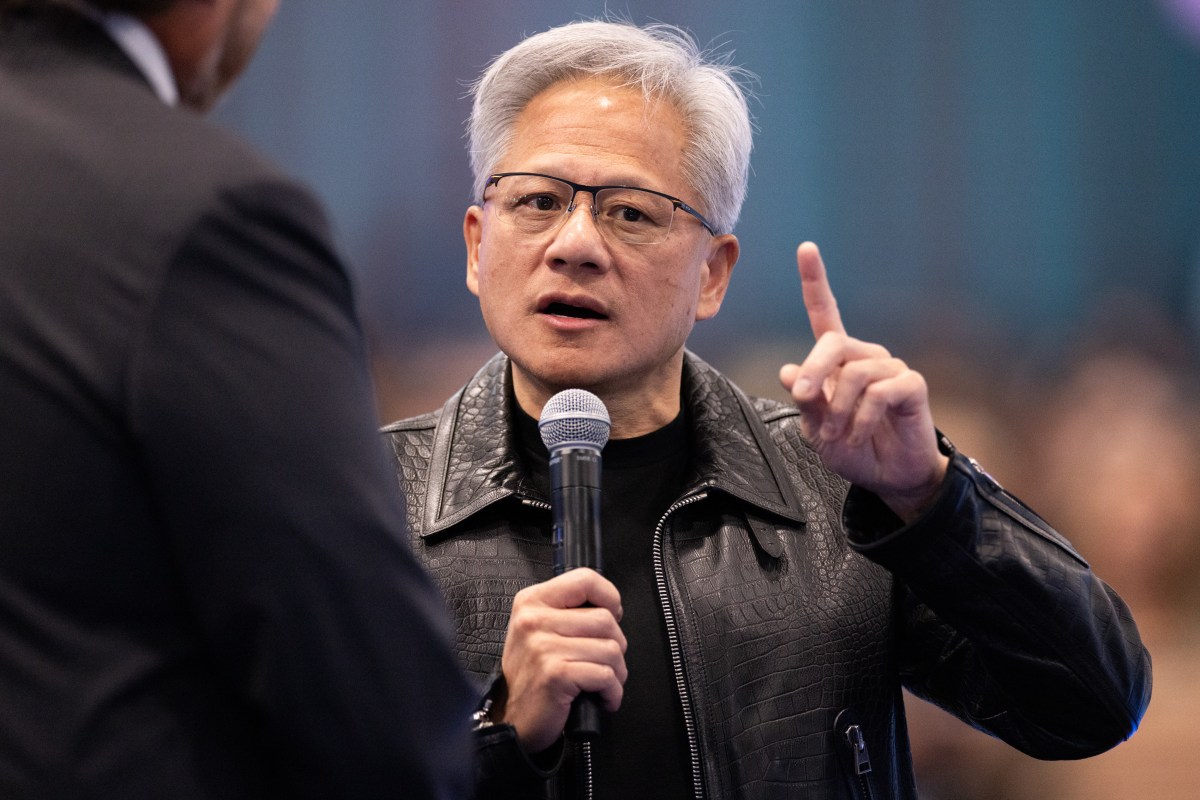
A memo circulated earlier this year claimed that technology executive Alice Huang was recruited by China’s Ministry of State Security to spy on Nvidia CEO Jensen Huang, according to multiple media reports.
The New York Times, which had previously said Nvidia’s chief executive had been the target of Chinese intelligence, was the first to report on the memo, which was reportedly based on U.S. intelligence. The Financial Times subsequently reported that the memo also claimed Jensen Huang had a romantic relationship with Alice Huang, an executive at a Singapore-based company called Megaspeed.
An Nvidia spokesperson told the NYT that Jensen Huang’s interactions with Alice Huang were “not unusual,” and that the company does not share classified information with its customers.
A separate NYT report examined New Matrix, a Chinese company authorized by the U.S. Commerce Department to buy advanced Nvidia chips. But at the office address listed by New Matrix, reporters only found “a hollow gray shell,” raising concerns that it could be a front for a blacklisted private equity firm.
The Nvidia spokesperson said the company sells “the first, best and most of our technology in America.”
{content}
Key Takeaways
- Allegations of Chinese state-sponsored espionage targeting Nvidia’s CEO highlight the escalating geopolitical stakes in the global tech race, particularly concerning advanced AI chip technology.
- A reported memo, based on U.S. intelligence, claimed a tech executive was recruited by China’s Ministry of State Security to spy on Jensen Huang, underscoring the sophisticated methods employed in industrial espionage.
- Separate concerns about a suspicious Chinese firm authorized to buy advanced Nvidia chips reveal critical vulnerabilities in supply chain oversight and export control enforcement, blurring lines between legitimate trade and potential illicit activity.
Nvidia in the Crosshairs: Espionage, AI, and the Geopolitical Gambit
The world’s leading chipmaker, Nvidia, finds itself at the epicenter of a geopolitical storm, grappling with allegations of state-sponsored espionage and questions surrounding its intricate supply chain to China. These aren’t merely corporate security issues; they represent a stark illustration of the intense U.S.-China technology rivalry, where innovation and market dominance are intrinsically linked to national security. Recent reports have pulled back the curtain on a landscape far more complex and perilous than typically understood for even the most formidable tech giants.
The Allegations Unpacked: A Web of Intrigue
At the heart of the latest controversy is a memo, reportedly based on U.S. intelligence, circulating earlier this year. This document, first detailed by The New York Times, claims that a technology executive, Alice Huang, was recruited by China’s Ministry of State Security (MSS) to spy on Nvidia CEO Jensen Huang. The target? Likely Nvidia’s closely guarded intellectual property, strategic insights, and future roadmaps – critical assets in the burgeoning AI era. The Financial Times added another layer to the narrative, reporting that the memo also alleged a romantic relationship between Jensen Huang and Alice Huang, an executive at Singapore-based Megaspeed. Such an addition, if true, would suggest a classic intelligence playbook: using personal relationships as a vector for influence or information gathering.
Nvidia, through a spokesperson, addressed these claims to the NYT, stating that Jensen Huang’s interactions with Alice Huang were “not unusual” and asserting that the company “does not share classified information with its customers.” This response, while expected, underlines the delicate position in which Nvidia finds itself, having to navigate public scrutiny while defending its integrity in a highly sensitive domain. The implications of such allegations reach far beyond the individuals involved, touching upon the very fabric of corporate security and international relations.
Beyond Individuals: The Geopolitical Chessboard
Why would Nvidia, a private enterprise, become such a high-value target for state-sponsored espionage? The answer lies in its unparalleled position in the artificial intelligence revolution. Nvidia’s GPUs are the foundational technology for AI development, powering everything from advanced data centers to autonomous vehicles and supercomputing. Dominance in AI is widely seen as crucial for future economic and military power, making companies like Nvidia strategic national assets. China’s stated goal of achieving self-sufficiency and leadership in advanced technologies, particularly semiconductors and AI, means that obtaining critical foreign technology and intelligence – by any means necessary – is a core objective.
This context transforms alleged corporate espionage into a geopolitical chess match. The U.S. has increasingly implemented export controls to restrict China’s access to advanced chip technology, aiming to slow Beijing’s military modernization and AI ambitions. Such measures, while intended to protect U.S. interests, inevitably intensify efforts by targeted nations to circumvent restrictions or acquire technology through alternative, often illicit, channels. The alleged MSS recruitment scheme, if substantiated, would be a stark reminder of the sophisticated and persistent nature of state-level intelligence operations against critical infrastructure and high-tech industries.
The “Hollow Shell” Anomaly: Supply Chain Vulnerabilities Exposed
Further compounding Nvidia’s challenges and underscoring systemic vulnerabilities is another New York Times report, which investigated New Matrix, a Chinese company authorized by the U.S. Commerce Department to purchase advanced Nvidia chips. The investigation revealed a troubling discrepancy: at the office address listed by New Matrix, reporters found only “a hollow gray shell.” This empty façade immediately raises red flags, suggesting that New Matrix might not be a legitimate operational entity but rather a front for a blacklisted private equity firm or another sanctioned organization.
This finding is deeply concerning. It implies that despite stringent export controls and licensing requirements, loopholes and deceptive practices may allow restricted technology to reach unintended recipients. Such “shell companies” are a common tactic used to bypass sanctions and regulations, making it incredibly difficult for regulatory bodies and even the companies themselves to perform adequate due diligence. For Nvidia, this situation points to the immense pressure on its compliance mechanisms, highlighting the challenge of ensuring its cutting-edge technology doesn’t inadvertently aid entities designated as threats to national security.
Nvidia’s Strategic Defense: A Global Tech Giant on a Tightrope
Nvidia’s public statements reflect the tightrope walk of a global tech giant caught between competing national interests. Their assertion that they sell “the first, best and most of our technology in America” is a strategic reassurance, aimed at signaling commitment to U.S. national security priorities and bolstering trust with domestic stakeholders. Yet, as a multinational corporation, Nvidia also operates extensively in China, a critical market for its products and a significant part of its global revenue strategy. Balancing these commercial imperatives with geopolitical demands is a monumental task.
The company’s position requires not only robust internal security protocols to protect its intellectual property but also sophisticated compliance frameworks to navigate the labyrinthine world of export controls and international sanctions. The alleged espionage and the New Matrix anomaly underscore that even with the best intentions, vigilance must be constant and adaptable to evolving threats.
An Industry-Wide Wake-Up Call
These revelations about Nvidia are not isolated incidents but a microcosm of the challenges facing the entire global technology sector. They serve as a powerful wake-up call for every company involved in critical technology development, from AI to quantum computing and advanced materials. The lines between commercial competition and national security are increasingly blurred, demanding heightened awareness, enhanced cybersecurity, and rigorous due diligence across all aspects of operations – from hiring practices to supply chain management. The era of “business as usual” for global tech companies is definitively over; geopolitical considerations are now an inextricable part of strategic planning.
Bottom Line
The converging narratives of alleged espionage targeting Nvidia’s leadership and the suspicious activities within its authorized supply chain paint a stark picture of the new geopolitical battleground. As AI chips become the new oil of the information age, the struggle for technological supremacy intensifies, transforming leading tech companies into unwitting protagonists in a high-stakes global power play. For Nvidia, and indeed for the entire tech industry, these incidents underscore an urgent need for unparalleled vigilance, robust security, and a proactive approach to managing the complex interplay of innovation, commerce, and national security in an increasingly fragmented world.
Source:{feed_title}