
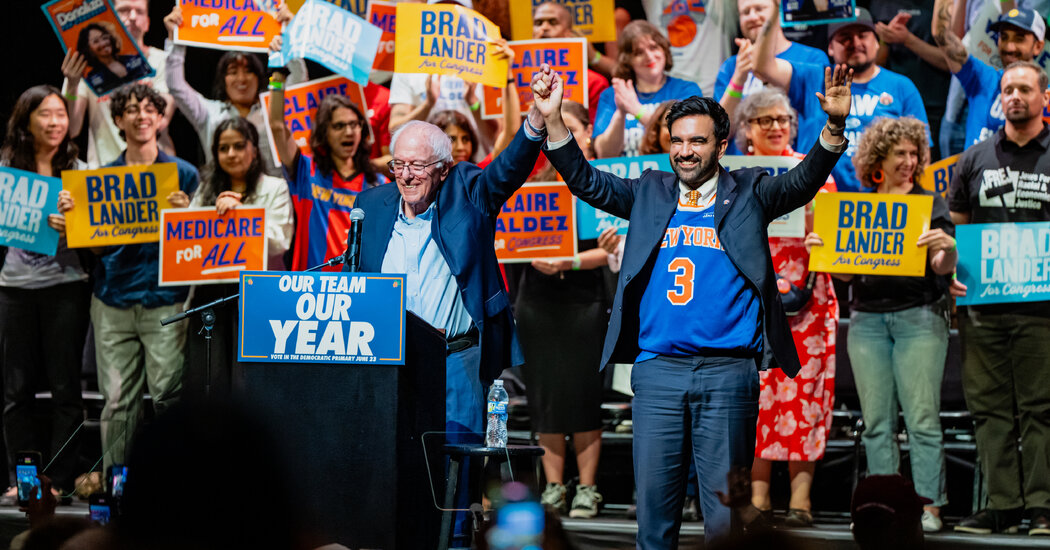
Across the United States, a discernible shift is underway within the Democratic Party, as a growing movement of younger, progressive candidates increasingly challenges established figures and conventional political approaches. This trend has ignited numerous primary contests nationwide, prompting an internal debate over the ideological direction and future identity of the party.
As the primary election season concludes, the outcomes provide insights into both the momentum and the inherent challenges facing this progressive insurgent movement.
Recent weeks have showcased mixed results for these candidates. In Minnesota, Lieutenant Governor Peggy Flanagan secured a Senate primary victory by a double-digit margin, campaigning on a resolutely progressive platform against a more moderate opponent. Similarly, in Michigan, Dr. Abdul El-Sayed, a left-leaning Democrat, won a Senate primary despite being significantly outspent. In Wisconsin, Francesca Hong, a member affiliated with the Democratic Socialists of America (DSA), narrowly missed a primary victory for governor, falling short by less than one percentage point. These results signal a heightened level of political competitiveness for candidates aligned with the revitalized progressive left, demonstrating their capacity to contend in statewide primaries, extending beyond traditionally liberal House districts.
However, while these candidacies have garnered enthusiasm among certain segments of the electorate, including strategists, activists, and college-educated voters, some demographic groups historically vital to the Democratic Party’s success have shown greater reservations. In Michigan and Wisconsin, both critical battleground states, progressive candidates reportedly faced difficulties in mobilizing support among traditional Democratic constituencies. This includes Black voters, more moderate segments of the party, and older Americans who consistently participate in elections.
The successes of left-wing candidates in various primaries have led many progressives to anticipate a significant ideological shift within the Democratic Party, envisioning a trajectory similar to how the Tea Party movement influenced the Republican Party nearly two decades ago, pushing it further to the right. Yet, the primary results also raise questions about whether these candidates can assemble a sufficiently broad coalition of Democrats, independents, and moderate voters to win general elections in swing states. The ability to do so is crucial for Democrats seeking to regain control of Congress and ultimately the White House.
Chris Walton, former chairman of the Democratic Party of Milwaukee County, articulated this concern: “Would I put a D.S.A. member up for governor in New York or Massachusetts? Sure, we can take a chance. But it makes it harder in a state like Wisconsin, where you’re starting out at the 48-yard line and have to figure out how to get to 50.” This statement underscores the strategic calculation facing the party in electorally competitive states.
The upcoming general elections will present further tests for these progressive candidates, particularly in key battleground House districts. Additionally, Dr. El-Sayed in Michigan and Troy Jackson, a progressive former state senator in Maine, are poised to contest Senate seats deemed essential for Democrats to achieve a majority in the upper chamber. The primary outcomes suggest that successful general election campaigns for some of these nominees will necessitate not only persuading independent voters but also consolidating support within their own base.
Detailed analysis of primary results reveals specific demographic challenges. In Michigan, Dr. El-Sayed recorded lower support in majority-Black townships across the state. While popular among younger voters, data indicated he performed less strongly than his Democratic primary opponent, Representative Haley Stevens, among older voters, a demographic known for higher turnout rates. In Wisconsin, Ms. Hong, who had been favored in pre-election polling, unexpectedly lost her primary bid to David Crowley, the Milwaukee County executive. Crowley, who would become the state’s first Black governor if elected, demonstrated strength in metro Milwaukee and rural counties, whereas Hong’s support concentrated in smaller cities and suburbs, including areas with college populations.
Senator Bernie Sanders, the independent from Vermont who has championed progressive candidates nationally, including Dr. El-Sayed and Ms. Flanagan, expressed confidence in the ability of Democrats and independents to unite behind the nominees in the general election. “If our candidates keep talking about the issues that are relevant to ordinary people — the issues of affordability, the issues of health care, the issues of education, housing, basic necessities of life, protecting Social Security — against Republicans who want to cut Social Security, you know what? Our guys are gonna win, and they’ll win big,” Senator Sanders stated.
However, signs of internal dissent are also apparent, even in historically Democratic strongholds. In New York, Black and Latino community leaders have voiced concerns regarding progressive victories in rapidly gentrifying neighborhoods. These leaders worry that the daily challenges and priorities of long-term residents, such as housing affordability and public safety, may be overshadowed by new political agendas. This sentiment was echoed by Representative Adriano Espaillat, a New York Democrat and chair of the Congressional Hispanic Caucus. Earlier this summer, Espaillat lost his primary to Darializa Avila Chevalier, a democratic socialist challenger who had advocated for policies such as the abolition of police, borders, and prisons, and the seizure of property from landlords.
In an interview, Representative Espaillat pointed to precinct-level data indicating that while his opponent performed better in whiter, younger, and higher-income areas, he maintained strong support across many older and majority-Hispanic communities. “They claim to have the agenda of the working class, but that’s not what the people in those communities feel,” Mr. Espaillat asserted. “Those neighborhoods, I believe, are concerned about affordability, but they’re also concerned about public safety. You know, they’re also concerned about the types of issues that D.S.A. may have a different position on than they do.”
The emergence of this new progressive movement gained significant traction following the Democratic Party’s loss in the 2016 presidential election, which created an opportunity for politicians advocating for a departure from what they perceived as a stagnant party establishment. A year later, Zohran Mamdani, driven by an activist, progressive base animated by issues such as the Palestinian cause and critiques of economic inequality, secured a notable victory in a New York State Assembly race, inspiring other Democratic candidates to adopt similarly bold political visions.
Common policy positions among these progressive candidates include advocacy for “Medicare for All,” a single-payer healthcare system, and varying degrees of opposition to certain existing institutions and economic structures.
Why This Matters
The internal dynamics currently unfolding within the Democratic Party carry significant implications for the future of American politics and policy. The rise of a robust progressive wing challenges the party’s traditional centrist inclinations, potentially redefining its platform, messaging, and candidate selection for years to come. This ideological contest is not merely an academic debate; it directly influences the party’s ability to win elections and govern effectively.
Firstly, the ongoing struggle shapes the Democratic Party’s electoral strategy. The question of whether to prioritize mobilizing an energized progressive base or to build broad coalitions that include moderate and independent voters is central to achieving success in general elections, particularly in swing states. The outcomes of these internal contests will dictate the types of candidates presented to the broader electorate, influencing the national political landscape, including control of Congress and the presidency. A party perceived as too far left could struggle to attract the independent and moderate voters essential for statewide and national victories, while a party that ignores its progressive base risks alienating a passionate and increasingly influential segment of its support.
Secondly, this ideological evolution has direct consequences for national policy. Should the progressive wing consolidate its influence, it could lead to a more aggressive pursuit of policies such as universal healthcare, significant climate action, expanded social programs, and reforms to criminal justice and economic systems. These shifts would represent a substantial departure from more incremental approaches, potentially leading to more polarized legislative battles and a reorientation of government priorities. Conversely, if more moderate voices retain their hold, the party’s policy agenda may remain closer to the established center, focusing on incremental changes rather than transformative reforms.
Finally, the debate over progressive candidates highlights fundamental questions about representation and voter engagement. The data suggesting progressive candidates struggle with older, Black, and more moderate voters indicates a potential fissure within the Democratic base. Addressing these concerns is crucial for party unity and effectiveness. Furthermore, the concerns voiced by Black and Latino leaders in New York underscore the importance of ensuring that the party’s evolving platform genuinely addresses the diverse priorities of its long-standing constituents, particularly in communities facing complex challenges related to gentrification, public safety, and economic stability. How the Democratic Party navigates these internal divisions will determine its capacity to present a united front and effectively address the nation’s challenges, impacting voter turnout, party cohesion, and ultimately, its political power in the American system.
Washington D.C., USA– Recent Democratic primary elections across the United States have provided a nuanced look into the ongoing ideological shifts within one of the nation’s two major political parties. While progressive and populist candidates continue to challenge established norms and incumbents, recent results suggest both the expanding reach of this movement and the inherent limits to its appeal, particularly when candidates face scrutiny over past statements or perceived radicalism.
The outcomes in key races in Michigan, Minnesota, and Wisconsin underscore a complex internal struggle within the Democratic Party. On one hand, voters in some areas are demonstrating a willingness to reject arguments from party leadership favoring more moderate candidates for perceived “electability.” On the other, the Wisconsin primary highlighted that there are boundaries to how far voters are willing to embrace unconventional candidates, even within a progressive framework.
In Michigan’s 12th Congressional District, Congresswoman Rashida Tlaib, a prominent figure in the progressive wing of the Democratic Party and a member of “The Squad” in the House of Representatives, secured a decisive victory against her challenger, Adam Hollier. Tlaib’s campaign emphasized a platform that aligns with core progressive tenets: advocating for an end to corporate money in politics, pushing for robust climate action, and expressing strong opposition to American support for Israel, particularly in light of the conflict in Gaza, which she and her supporters have characterized as a genocide. Her commanding win, with over 78% of the vote, illustrates the continued strength of the progressive movement in diverse, urban districts where such platforms resonate strongly with the electorate.
Similarly, in Minnesota, Jessica Flanagan achieved a significant upset, defeating incumbent Representative Angie Craig by a substantial margin of 20 percentage points. Flanagan, who eagerly embraced progressive policies and garnered support from allies like Senator Bernie Sanders, presented herself as a champion for issues such as access to affordable childcare and housing, alongside broader social justice initiatives. A lifetime member of the Democratic-Farmer-Labor Party (DFL), Minnesota’s affiliate of the national Democratic Party, Flanagan successfully built a broad coalition, drawing support from diverse groups including faith communities, labor unions, young people, and rural farmers across her home state. Her victory challenged the conventional wisdom often espoused by Democratic leaders that more moderate candidates are better positioned to win statewide or broader elections.
However, the landscape proved more challenging for progressive candidates in Wisconsin. State lawmaker Danielle Hong, a member of the Democratic Socialists of America (DSA), failed in her bid, losing despite endorsements from influential progressive figures. Her defeat is attributed largely to past controversial statements that she struggled to adequately explain to voters. These included a suggestion to cancel Thanksgiving during the pandemic and another describing her young biracial son as offering her “proximity to whiteness.” Such remarks appeared to be too much for the Wisconsin electorate, indicating that while voters may be open to non-traditional candidates, they also have limits regarding perceived eccentricity or an inability to articulate positions clearly and sensitively.
The varied outcomes underscore a common thread: many progressive candidates share a broad platform. This often includes commitments to combating climate change, opposing the influence of corporate money in politics, and advocating for social justice. There is also a notable shift in discourse regarding US foreign policy, particularly concerning Israel, with a growing segment of the progressive base viewing opposition to American support for Israel as a moral litmus test, particularly in the context of the Gaza conflict.
Despite these commonalities, there are also significant ideological differences within what is broadly termed the “progressive” or “populist” camp. Matt Barreto, a Democratic pollster, noted that the ideological spectrum is “way looser than people think,” encompassing candidates who identify as progressive, populist, or even align with the DSA, which is not officially part of the Democratic Party structure. For example, while Ms. Hong is a DSA member, Dr. El-Sayed, another candidate mentioned in broader discussions about this trend, identifies as a “capitalist” despite his long-standing relationship and appearances at DSA events. Ms. Flanagan, while embracing Sanders’ policies, is deeply rooted in the mainstream Democratic Party through the DFL.
The primary results collectively challenge the long-held belief among some Democratic strategists that only centrist or moderate candidates can secure victories in competitive races. Lauren Hitt, a Democratic strategist, observed that “people are less willing to trust the political class and what we think is electable.” Voters, she suggests, are “looking for people who break the mold.” However, the Wisconsin outcome adds a critical caveat: “if you break the mold so much that you’re eccentric, that’s not the solution either.” Charles Franklin, director of the Marquette Law School poll, noted that while successes of democratic socialists like Representative Summer Lee and others have been significant in district-level races, statewide contests with a more heterogeneous electorate present different challenges, revealing “some limits on that, even within Democratic primaries.”
Why This Matters
The internal dynamics of the Democratic Party in the United States hold significant implications both domestically and internationally. These primary results are not merely snapshots of local political contests but rather indicators of deeper ideological currents that will shape the party’s future, its policy agenda, and potentially, the direction of the nation.
Domestically, the ongoing tension between the progressive and moderate wings will influence the Democratic Party’s platform on critical issues such as economic inequality, climate change, healthcare, and social justice. As younger, more ideologically driven candidates gain traction, they push the party to the left, potentially leading to more ambitious legislative proposals and a different approach to governance. This internal debate is crucial for defining the party’s identity in an era of increasing political polarization and will directly impact its ability to mobilize voters in general elections and govern effectively.
Internationally, the shifts within the Democratic Party could have profound consequences for US foreign policy. The growing skepticism and outright opposition among some progressives regarding unconditional US support for Israel, particularly in the context of the Gaza conflict, represents a significant departure from long-standing bipartisan consensus. Should this view gain further prominence, it could lead to substantial changes in US diplomatic postures, aid packages, and strategic alliances in the Middle East. Furthermore, a stronger emphasis on climate action, human rights, and multilateralism by an increasingly progressive Democratic Party could reshape America’s role on the global stage, influencing international agreements and global governance efforts.
Moreover, these trends in the US Democratic Party reflect broader global phenomena. Similar internal struggles between established party structures and insurgent progressive or populist movements are observed in many democracies worldwide. The rise of social media, the questioning of traditional media, and a general distrust of political establishments are common threads. Understanding how a major party in a globally influential nation navigates these internal challenges offers insights into the evolving nature of political representation and the demands of modern electorates. The outcomes of these primary races therefore serve as a bellwether for the future trajectory of one of the world’s most powerful political forces, with ripple effects far beyond American borders.