
PMG managing partner Ryan Shear and Naftali Group EVP Danielle Naftali speak to Fox News Digital about why South Florida real estate outperforms NYC, accelerating corporate relocations, and how zero state income tax fuels long-term growth.
Key Takeaways:
- **South Florida’s Maturing Market:** Despite a recent surge in the cost of living and real estate, top developers argue South Florida is experiencing a long-overdue market correction, transitioning from an underpriced vacation spot to a world-class global city with significant long-term value.
- **Strategic Economic Drivers:** Florida’s zero state income tax remains a powerful magnet for corporate relocations and high-net-worth individuals, while comparatively lower construction costs and accessible debt continue to fuel robust development activity, reinforcing the region’s competitive edge over high-tax states like New York.
- **Beyond Price Per Square Foot:** The investment thesis for South Florida’s luxury real estate is increasingly driven by a holistic lifestyle proposition – including cultural institutions, world-class amenities, and an improved quality of life – making buyers less price-sensitive and more focused on the enduring appreciation potential of a dynamic, growing market.
While recent economic data suggests South Florida has, on paper, lost its cost advantage over New York, top real estate developers argue these aggregated numbers fail to tell the full story of a maturing market and a fundamental economic shift. Instead, they posit that the region is simply playing long-overdue catch-up after decades of underpriced real estate, still offering sophisticated buyers significantly more long-term value and an unparalleled quality of life.
“Miami has earned a seat as one of the greatest cities in the world,” Naftali Group EVP of marketing, sales and design Danielle Naftali told Fox News Digital. “As people have migrated down here, [and] made it a location that people are living permanently, obviously, things have become a bit more expensive… world-class restaurants opening here, the most amazing cultural institutions, entertainment, hospitality groups — everything that people really experience in major cities around the world. And, you know, those truly go hand in hand.” This sentiment underscores a broader market narrative: Miami’s ascendance isn’t just about affordability arbitrage; it’s about its evolution into a premier global destination, driving a natural price appreciation.
“Globally, Miami was playing catch-up to New York for long periods of time, and you can do this by price per square foot, you can do it by total dollars, what they sell for, but Miami used to trade at — as a local myself — I almost thought it was weird how inexpensive the real estate was here comparatively to cities like New York or London or LA,” PMG managing director Ryan Shear also told Fox Digital.
“A lot of people have moved down here, not just people, but companies and a lot of high-profile people, and you’re seeing big headlines about big trades and big sales and that’s true and that is great for the city. I don’t think it tells the whole story. I think Miami is still a value city,” he added, emphasizing that for strategic investors and permanent residents, South Florida remains a compelling bargain. “I still think it’s a bargain play down here.”
FLORIDA NAMES N.Y.C. MAYOR ZOHRAN MAMDANI ‘ECONOMIC DEVELOPER OF THE YEAR’ IN TIMES SQUARE CAMPAIGN
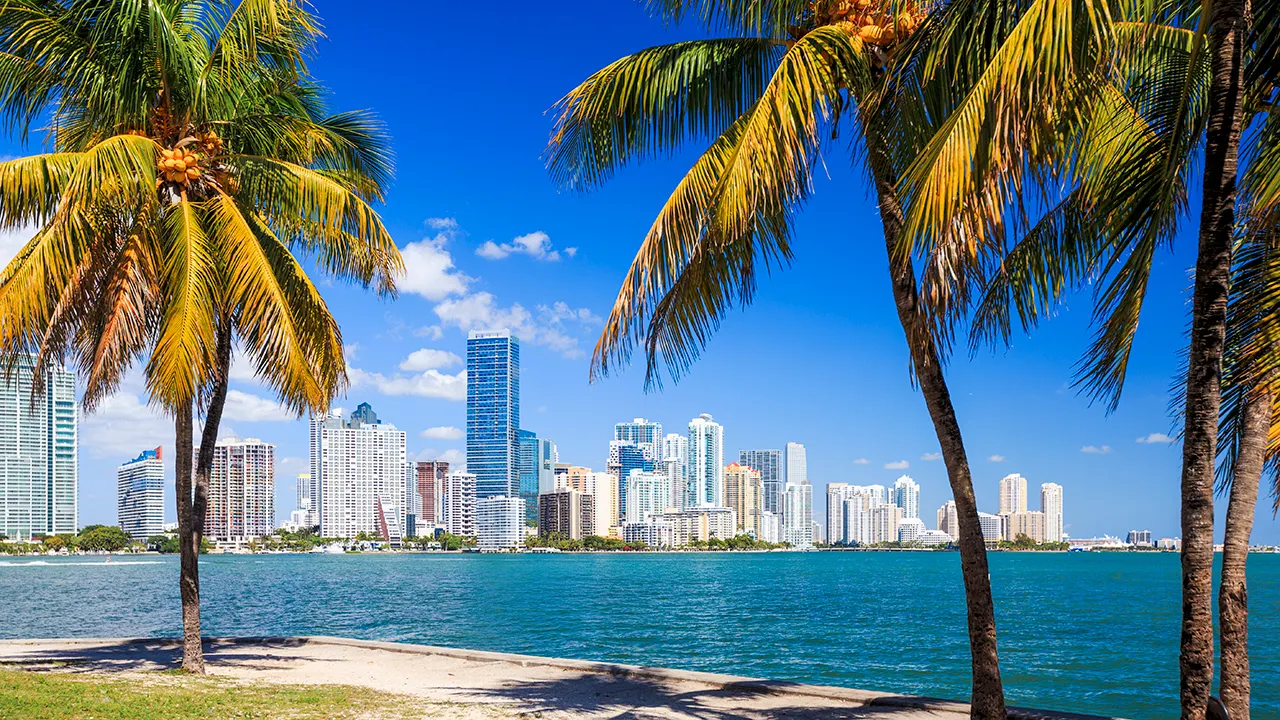
A view of Miami’s skyline and Biscayne Bay.(Getty Images)
Arecent Bloomberg analysisof U.S. Bureau of Economic Analysis data found that the overall cost of living in the Miami-Fort Lauderdale-West Palm Beach metropolitan area has surpassed that of greater New York. The analysis separately found that housing costs in South Florida are roughly 5% higher than in New York and its suburbs. Additionally, consumer prices in South Florida have risen 36% since 2019, according to the U.S. Bureau of Labor Statistics, representing the second-highest inflation surge among major American markets, trailing only Tampa. This significant inflationary pressure reflects intense demand, supply chain constraints, and rapid population expansion, impacting everything from groceries to services.
South Florida home prices have jumped 79% since the pandemic, according to S&P CoreLogic Case-Shiller data, illustrating the extraordinary demand-side pressure. Concurrently, Florida’s average annual homeowners insurance premium stands at $8,292, roughly four times the average in New York state, according to Insurify. These rising operational costs, particularly insurance, pose a unique challenge for homeowners and investors, often attributed to increasing climate risks and a complex regulatory environment.
“There’s definitely a price gap that has changed. But what we see ultimately is that buyers are less sensitive to the price per square foot as the buyers have become more sophisticated,” Naftali countered. “We see our buyers thinking about everything from lifestyle, services and amenities, finished pallets, and really the best quality. So this is something that people are really willing to pay that premium.” For the high-end luxury market, this signifies a shift from purely transactional value to experiential value, where quality of life and premium amenities justify higher price points.
Former Miami Mayor Francis Suarez discusses Miami’s 36% consumer price index hike since 2019, making it pricier than NYC. He addresses housing affordability for the middle class and Cuba’s impending collapse.
“Anyone that’s buying in our development today will be able to see their appreciation over the next five to ten years,” she said, reflecting confidence in the sustained growth trajectory and long-term investment returns in the South Florida market.
Beyond homebuyer costs, developers also face nationwide borrowing and insurance pressures, particularly in a volatile interest rate environment. However, Shear emphasized that constructing a high-rise in Florida remains vastly more accessible and cost-effective than doing so in New York, a crucial factor influencing new supply and market equilibrium.
“It is still less expensive to build in Florida than New York. And not by a little, by like a decent, significant amount,” Shear said. “Debt in Florida is the same as debt in Texas… Banks lend nationally and globally. So it’s still affordable to build in Florida.” This comparative advantage in development costs allows for more aggressive project pipelines and potentially better margins for developers, which ultimately influences the type and volume of new inventory coming online.
“Everything’s relative. You know, we’re relative to the world we live in. So, relative is South Florida trading at faster paces, absorption greater than what we see in a lot of markets… It’s not a Miami thing. I think Florida in general is having a very good moment. And it’s been going on for a while, and I don’t think it’s stopping,” Shear said, pointing to a broader statewide phenomenon of economic dynamism and population inflow.
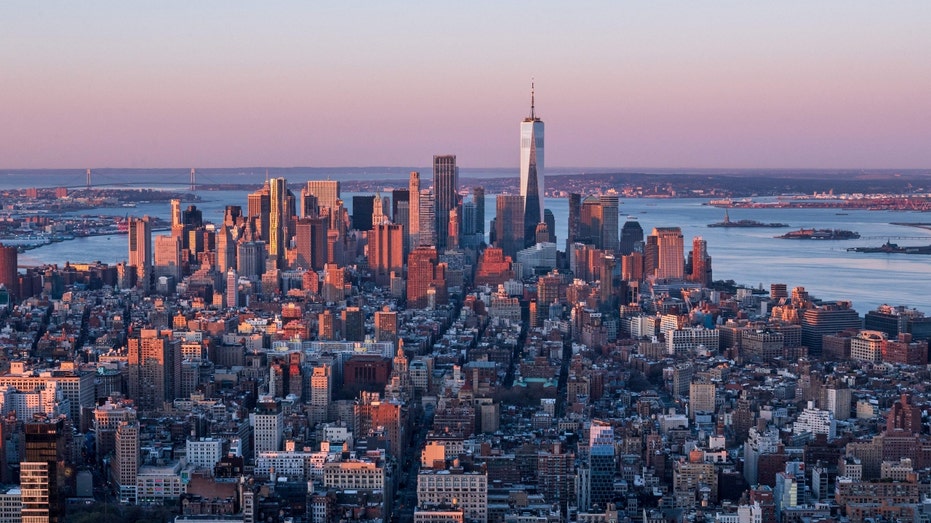
The Manhattan skyline is seen at sunrise from the 86th floor observatory of the Empire State Building on April 3, 2021, in New York City.(Getty Images)
Florida remains one of nine U.S. states with no individual income tax, whereas top earners in New York City face combined state and local income tax rates of nearly 14.8%. This stark tax differential continues to be a primary driver for the relocation of high-net-worth individuals and corporations seeking to optimize their financial liabilities. ATTOM data show Miami-area property taxes have jumped 62% since 2019, a considerable increase that offsets some of the income tax benefits, although the base property values have also surged. Florida voters, meanwhile, will consider a constitutional amendment in November that would exempt the first $250,000 of a homestead’s value from property taxes other than school district levies, a potential legislative move aimed at mitigating rising costs for primary residents.
“There is definitely still tax incentive to Florida. That’s very obvious. What we see, though, especially in the luxury sector, is that global luxury buyers, it’s not that they’re either going to New York or either going to Florida. Most of those buyers have a home in both locations. So there’s definitely a tax benefit to being in Florida, without a doubt,” Naftali said, highlighting a sophisticated buyer demographic that leverages both markets strategically.
“It’s just math. The effective tax rate, I believe, in New York, if you’re in the top tax bracket, is somewhere between 50 and 55%, depending on what borough and so forth. There’s no state income tax and there’s no city tax here. So the top tax bracket is set by the federal government, that’s it. That’s the math. If anybody would tell you different, it’s not an opinion, that just factually is the truth,” Shear argued, underscoring the undeniable financial arbitrage that attracts a significant cohort of professionals and businesses.
“I think people have finally figured out that like living in Florida may just be a better life that they want, and that’s invaluable.”
“I’ve read countless articles saying how real estate taxes are going through the roof. Well, it’s not the real estate tax going through the roof. There’s just more expensive real estate. It’s not that the tax rate is changing,” he continued, clarifying that the increase in property tax bills primarily stems from skyrocketing valuations rather than a hike in the millage rate. “But if you want to go to city that’s checking all these boxes that somebody’s looking for — massive growth, massive job[s], large population, high rises and so forth — I think it’s impossible to find one. So again, to the point of relativity, it’s all relative to the next option. I think as an option, it does not get better than South Florida.”
U.S. Census Bureau figures show the Miami-Fort Lauderdale-West Palm Beach metro area’s median household income was $80,625 in 2024, about $1,000 below the national median of $81,604. This income disparity, coupled with rising costs, presents ongoing affordability challenges for the region’s middle and working classes, a critical consideration for sustainable long-term growth. The developers also pointed to infrastructure, permitting and school expansion as efforts to accommodate future population growth across South Florida, indicating an awareness of the need for sustained public investment to support private sector expansion.
While local median incomes may lag national benchmarks, Shear noted the region’s economic engine is fundamentally changing as major employers relocate their corporate headquarters, rather than just opening small satellite branches. This shift represents a deeper commitment and a more substantial economic impact, bringing high-paying jobs and fostering new business ecosystems.
Florida Chamber of Commerce CEO Mark Wilson speaks with Fox News Digital about the intention behind a new Times Square ad targeting Zohran Mamdani as businesses and wealth flee New York for Florida.
“It’s not just the people that are moving down here. People are moving their companies down here,” Shear explained, noting that PMG shifted its primary headquarters from New York to Miami. “We’ve reached a tipping point where you’re seeing companies… that are planting their flag in Miami and building companies or taking their existing company and moving them to Miami.” This trend reflects a broader macroeconomic reassessment by corporations in the post-pandemic era, prioritizing favorable tax environments, talent pools, and quality of life for employees.
GET FOX BUSINESS ON THE GO BY CLICKING HERE
“I think specifically in Miami, people will continue to move down here. As we said, this is no longer a seasonal location, right? You have everything here,” Naftali said. “It’s a continuous progression. So when you talk about the next five years, it’s only going to continue to get better. So if you’re able to get in now and invest in a new development down here, I think it’s a great investment opportunity.”
“Ask people, where do you want to spend the rest of your life?” Shear said. “Not everything’s about price per square foot, and I still think it’s a value play down here, but I think it is about a lot more down in Florida… Work hours, quality of life, weather, state income tax, restaurants, who’s down here. I mean, Miami’s culture now is incredible… how lucky are we to experience the world’s cultures in one city? Fundamentally, people are moving down here and still are continuing to, not just because you save on taxes or there’s good sun. I think people have finally figured out that living in Florida may just be a better life that they want, and that’s invaluable.” This perspective frames quality of life not just as a perk, but as a critical, undervalued component of market competitiveness and long-term capital appreciation.
READ MORE FROM FOX BUSINESS
Market Impact:
The ongoing economic dynamic between South Florida and New York signifies a pivotal shift in U.S. urban market leadership, driven by complex interplay of fiscal policy, demographic trends, and evolving lifestyle preferences. For investors, South Florida represents a market with strong fundamentals, fueled by corporate migration, continued population growth, and a robust luxury segment less susceptible to general economic headwinds. Developers will continue to favor Florida due to relatively lower construction costs and a more favorable regulatory environment compared to legacy markets. However, the rapidly escalating cost of living, particularly housing and insurance, poses significant challenges for broader affordability and could strain local infrastructure and public services if not adequately addressed. This competitive environment forces both states to reassess their value propositions, with New York potentially facing continued outflows of wealth and businesses, while Florida must balance its growth ambitions with the need for sustainable, inclusive development. The long-term market impact points to a continued rebalancing of economic power, where “quality of life” becomes as significant a driver of capital and talent as traditional financial metrics.