
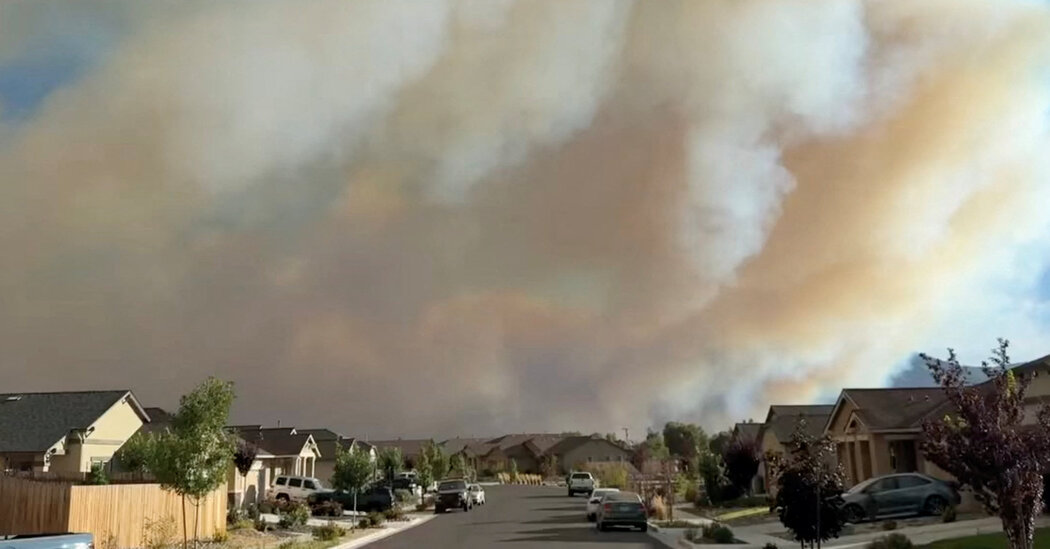
Nevada Wildfire Forces Mass Evacuations, Threatens Reno Amid Widespread Western Blazes
Reno, Nevada – [Date of Publication]
A rapidly expanding wildfire in the foothills of the Sierra Nevada, designated as the Hawk fire, has prompted widespread evacuations, necessitated the closure of medical facilities, and triggered emergency declarations from state officials as it advances towards the populous city of Reno, Nevada. The blaze, which originated on Saturday, has escalated to encompass over 13,000 acres with no reported containment, directly encroaching upon the outskirts of Reno, a metropolitan area home to nearly 300,000 residents situated close to the California border.
Extensive Evacuations and State-Level Response
As of Sunday morning, local authorities recommended evacuation for approximately 90,000 individuals located in areas vulnerable to the fire’s progression. From this number, around 42,000 residents, primarily situated northwest of downtown Reno within Washoe County, have been placed under mandatory evacuation orders. An additional 45,000 people received “prepare-to-leave” warnings, a less urgent but serious advisory that encourages residents to be ready for immediate departure, with officials urging voluntary early evacuation if feasible for those affected.
In response to the deteriorating situation, Nevada Governor Joe Lombardo issued a state of emergency for Washoe County, which encompasses Reno and parts of Lake Tahoe. Governor Lombardo also activated the Nevada National Guard, emphasizing in a Sunday social media statement that the situation remained “rapidly evolving.” The incident has resulted in six reported injuries, including three firefighters, highlighting the inherent dangers faced by emergency personnel.
Washoe County Sheriff Darin Balaam confirmed on Sunday that contingency plans have been established for the potential evacuation of the county jail, underscoring the comprehensive nature of the emergency preparedness. The fire’s impact on infrastructure has been immediate and significant, with more than a dozen roadways closed, disrupting local traffic and critical evacuation routes.
Impact on Critical Infrastructure and Emergency Operations
The Hawk fire has caused substantial disruption to essential services and infrastructure. Two medical centers affiliated with the Northern Nevada Health System have urgently evacuated their patients and suspended operations due to the fire’s proximity and the associated hazards, as stated by Jamii Uboldi, the system’s public information officer. Furthermore, the Reno-Stead Airport has been closed to general air traffic by the Reno-Tahoe Airport Authority, though the primary Reno-Tahoe International Airport remains open for commercial flights.
A concerted multi-agency effort is actively engaged in combating the wildfire. Approximately 800 emergency responders from various local, state, and federal agencies are on the ground, supported by an additional 300 law enforcement officers tasked with maintaining public order and securing evacuated neighborhoods. The Nevada National Guard has deployed Chinook and Black Hawk helicopters to provide crucial aerial support for firefighting efforts, and 60 National Guard Response Force personnel are assisting law enforcement in safeguarding residential areas that have been cleared.
Both ground and aerial crews worked continuously through the night to stem the fire’s advance. Authorities have confirmed that the fire was human-caused, though specific details regarding whether arson is suspected have not been publicly disclosed. NV Energy, the local utility provider, reported that approximately 10,000 customers were still without power on Sunday, a reduction from the peak of 60,000 outages recorded on Saturday.
Environmental Factors and Broader Regional Context
The rapid escalation and intensity of the Hawk fire are primarily attributed to a confluence of adverse environmental conditions: extreme heat, profoundly dry vegetation, and persistent strong winds across the region. This particular blaze marks the second major wildfire to affect this specific area within the past three weeks. To the north of the Hawk fire, the Bug fire, which originated in California and subsequently crossed the state line into Nevada, had consumed an estimated 94,000 acres, though it is now reported to be 95 percent contained by California and Nevada authorities.
The crisis extends beyond Nevada, with the entire American West grappling with a particularly severe wildfire season. California Governor Gavin Newsom has extended an offer of both air and ground resources to assist Nevada in monitoring and combating the Hawk fire. Across the Western United States, arid and semi-arid landscapes are being ravaged by fires propelled by sustained high temperatures and widespread drought conditions. Washington State has witnessed over 400,000 acres burn this wildfire season, with hundreds of homes destroyed in Spokane County. In Oregon, a recent wildfire season recorded a staggering 2.4 million acres consumed. Nevada itself is currently contending with 44 active fires burning nearly 250,000 acres, while Utah’s ongoing fires have consumed more than 350,000 acres.
Richard Edwards, Fire Chief at Truckee Meadows Fire and Rescue, one of the key agencies involved in the response, characterized the Hawk fire as “a very dynamic incident for us, as it’s being driven by the winds.” He further elaborated, “The wind-driven fires move very rapidly into our residential areas, creating a lot of challenges for our firefighters to save homes and protect lives.” While winds had temporarily subsided, Chief Edwards cautioned on Sunday that conditions favorable to renewed fire growth, including stronger winds, were anticipated to return later in the afternoon.
Why This Matters
The Hawk fire is more than a localized emergency; it represents a critical incident with significant and far-reaching implications that underscore the increasing challenges posed by wildfires across the Western United States. Firstly, the immediate threat to Reno’s substantial population highlights the profound human impact of these events, forcing tens of thousands from their homes and profoundly disrupting daily life on a large scale. The urgent evacuation of hospitals and the closure of key transportation infrastructure like the Reno-Stead Airport demonstrate the immense strain placed on public services and critical infrastructure, demanding swift and highly coordinated responses from multiple governmental and civilian agencies.
Economically, the fire poses substantial risks. Beyond the direct costs associated with firefighting efforts and property damage, there are broader implications for local businesses, tourism—a vital sector for Nevada—and the long-term economic recovery of the region. The extensive power outages affecting thousands of homes and businesses further illustrate the pervasive economic disruption that major wildfires can inflict. The necessity for comprehensive emergency strategies, such as contingency plans for evacuating the county jail, points to the profound societal disruption these events can cause, testing the resilience and emergency preparedness of entire communities.
Environmentally, large-scale wildfires like the Hawk fire contribute significantly to poor air quality, impacting public health across vast geographic regions. They cause widespread devastation to ecosystems, leading to long-term alterations in landscapes, increased soil erosion, and adverse effects on wildlife populations. The fact that this is the second major blaze in the area within three weeks, following the Bug fire, signals a concerning trend of increased frequency and intensity of such events.
From a global perspective, the situation in Nevada serves as a stark illustration of the escalating consequences of climate change, particularly in arid and semi-arid regions. The “cocktail of extreme heat, dry conditions and strong winds” cited by officials perfectly describes the environmental conditions exacerbated by a warming planet, which contribute to longer, more severe, and more destructive wildfire seasons across the American West, as evidenced by record-breaking fires in states like Washington, Oregon, and Utah. This necessitates ongoing investment in wildfire prevention, suppression technologies, and adaptation strategies, along with a deeper understanding of human roles in ignition and the broader policy implications for land management and climate action. Ultimately, the Hawk fire serves as a potent illustration of the complex interplay between environmental conditions, human activity, and the capacity of communities to respond to and recover from natural disasters, making it a matter of profound importance for public policy, emergency management, and environmental sustainability.