
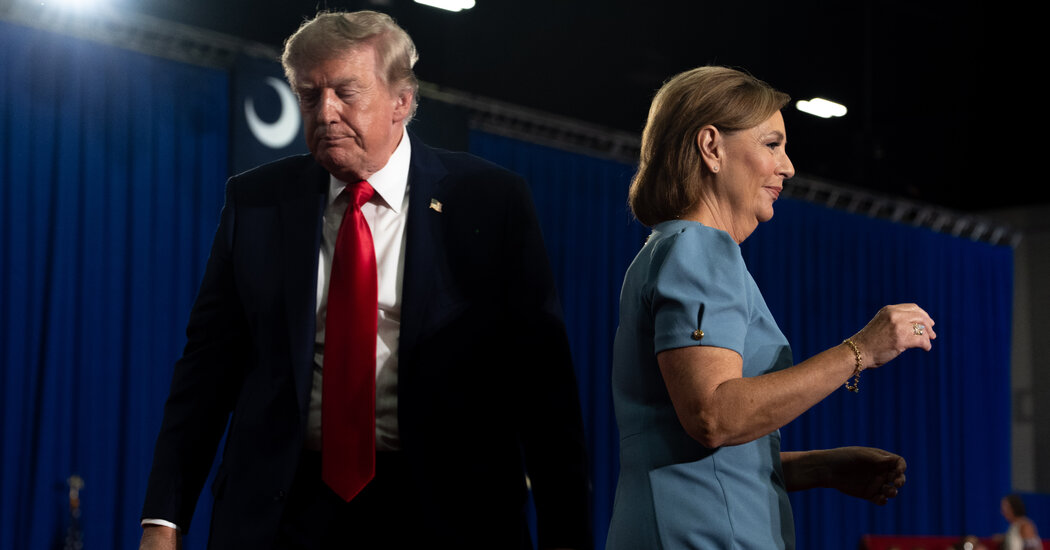
Former President Donald Trump has undertaken extensive efforts to support Senator Darline Graham in South Carolina’s upcoming primary election runoff for a U.S. Senate seat. The runoff, scheduled for Tuesday, will determine the Republican nominee for a critical special election.
In the final weeks leading up to the election, Mr. Trump traveled to Myrtle Beach to host a rally for Ms. Graham, personally contacted high-level state officials to encourage their endorsements, and deployed his political action committee, MAGA Inc. Campaign finance filings released on Monday revealed that MAGA Inc., a super PAC generally cautious with its spending this cycle, invested nearly $800,000 on phone calls on Ms. Graham’s behalf. This sum represents almost a third of the committee’s total expenditures for the year, underscoring the former president’s significant commitment to her candidacy.
The outcome of this race carries considerable implications for Mr. Trump’s political influence, particularly in a state that has previously demonstrated a willingness to diverge from his preferences. Within the last six months, South Carolina voters have twice rejected candidates favored by Mr. Trump. In June, voters dismissed his initial choice for governor, prompting him to issue a second endorsement in the final stages of that contest. Earlier this year, the Republican-controlled State Senate opted not to advance a new congressional map supported by Mr. Trump and other national Republicans. This proposed map would have eliminated South Carolina’s sole majority-Black congressional district, currently held by a Democrat.
Beyond South Carolina, Mr. Trump’s national endorsement record faces scrutiny due to several high-profile losses in other states. Given his enthusiastic promotion of Ms. Graham, a defeat for her would represent a notable setback for his perceived ability to sway Republican primary voters nationwide.
“What I really want you to do is pretend, please, that I’m on the ballot,” Mr. Trump urged attendees at the Myrtle Beach rally on Friday, emphasizing the personal stake he had in the election. “Just come and vote. It’s so important.”
Ms. Graham is competing against Representative Ralph Norman, a hard-line conservative known for occasionally challenging party leadership, including the former president. The winner of this Republican runoff in the reliably conservative state will advance to the general election in November to face Dr. Annie Andrews, the Democratic nominee, for a full six-year term in the Senate. The special election was necessitated by the passing of Senator Lindsey Graham in July.
Senator Darline Graham, who previously served as a longtime administrator of disability services, had not held public office until her appointment by the state’s governor to fill the remainder of her late brother’s Senate term. Weeks later, on August 11, she secured the top position in a crowded special primary election. Her initial success was significantly bolstered by Mr. Trump’s endorsement and her campaign’s pledge to voters that she would continue the most popular aspects of her brother’s tenure, including retaining his well-regarded staff and aligning with the former president’s agenda. However, in the final week of what has been a rapidly unfolding election cycle, political momentum appears to have shifted against her.
Last week, during the only televised debate of the runoff, Ms. Graham encountered difficulties when questioned about the strategic importance of Taiwan to U.S. interests, acknowledging, “I am not that informed on national security.” The day prior, the Republican Party chapter in her home county notably endorsed her opponent, Representative Norman. Furthermore, observers noted visible empty sections at Mr. Trump’s rally in Myrtle Beach on Friday, and some attendees expressed reservations about Ms. Graham’s readiness for the office.
Some individuals present at the rally indicated they were there primarily to gather more information about Ms. Graham. Many acknowledged her recent comment regarding foreign policy knowledge but offered cautious defenses, suggesting that she could acquire the necessary experience while serving in office.
Addressing such concerns at the rally, Mr. Trump stated, “You know, she’s never done it before, but she knows politics well. But she loves our military; she loves things that have to do with greatness for America.”
Over the past week, interviews with voters across the state revealed a prevalent skepticism regarding what many perceived as an attempt by Washington political insiders, including the former president, to influence their choice for senator. “This is just inside establishment B.S.,” remarked Curtis Loftis, the state treasurer who has endorsed Mr. Norman, referring to Ms. Graham’s candidacy. “She’s been asked by the president and then asked by the governor, and this has all just been foisted on her.”
Neither Ms. Graham’s campaign nor officials with MAGA Inc. responded to requests for comments regarding the current state of the race. Brittany Yanick, a spokeswoman for Mr. Norman, issued a statement indicating that the campaign was “feeling great” as Election Day approached.
South Carolina has a documented history of voter resistance to perceived top-down political directives. A notable example occurred in 2018 when then-Lieutenant Governor Henry McMaster, despite having the endorsement of Mr. Trump, was compelled into a runoff election for governor against a relatively unknown 39-year-old political newcomer.
With considerable assistance from Mr. Trump, Ms. Graham has accumulated endorsements from several influential South Carolina officials. Senator Tim Scott, who chairs the Senate Republicans’ campaign arm, has been a vocal proponent of her candidacy. Representative Russell Fry, a former primary opponent of Ms. Graham in July, publicly backed her after a request from the former president. Governor Henry McMaster, who initially remained neutral in the primary contest, endorsed Ms. Graham on the day Mr. Trump arrived in the state for his rally. Two individuals familiar with the conversation confirmed that Mr. Trump had personally called Mr. McMaster earlier that week.
Conversely, Mark Sanford, a former South Carolina governor and congressman known for his criticisms of Mr. Trump, received a call from the former president urging him to endorse Ms. Graham. However, on the day of Mr. Trump’s visit, Mr. Sanford issued a lengthy statement endorsing Mr. Norman, asserting that “as much as I would like to honor tradition and old friendships, the stakes are simply too high as our nation really is at a financial tipping point.”
On the campaign trail, Mr. Norman frequently highlights his endorsements from Senators Rick Scott of Florida and Mike Lee of Utah. Both are Republicans who have garnered support from the party’s conservative base for their willingness to challenge party leadership.
Rob Godfrey, a seasoned Republican political strategist in South Carolina, commented that primary voters in the state are typically highly informed and intent on making their own decisions at the ballot box. “Our voters don’t always take advice from other politicians, no matter what office they hold, about who to support,” Mr. Godfrey stated. “While both of these candidates have their fair share of endorsements, our voters are hyper-informed, thanks to the number of candidates they meet face-to-face, take their own agency seriously at the ballot box, have an independent streak and expect they’ll know the person they end up supporting personally.”
Throughout the weekend, both candidates engaged in last-minute campaigning, visiting local restaurants and holding town halls in an effort to personally greet as many South Carolinians as possible. On Monday night, just hours before Election Day, Ms. Graham was scheduled to participate in a virtual rally alongside one of her most ardent supporters, Mr. Trump, an opportunity her opponent did not share.
Shawn McCreesh and Theodore Schleifer contributed reporting.
Why This Matters
The South Carolina Senate primary runoff holds significant implications for several key political actors and dynamics:
For Former President Donald Trump:This race serves as a crucial test of Mr. Trump’s enduring influence within the Republican Party. His extensive and personal involvement in supporting Darline Graham, including significant financial backing from his PAC and direct appeals to state officials and voters, elevates the stakes. A victory for Ms. Graham would reinforce his status as a powerful kingmaker and validate the continued strength of his endorsement, particularly as he considers future political endeavors. Conversely, a loss would represent another high-profile setback in a state that has previously resisted his preferences, potentially raising questions about the diminishing power of his endorsements and his ability to sway primary voters in competitive races. This outcome could impact his broader influence in Republican primaries nationwide ahead of future election cycles.
For South Carolina Politics:The election underscores South Carolina’s distinct political character, characterized by an independent streak and a history of voters resisting perceived outside interference. The outcome will signal whether national endorsements, even from a figure as prominent as Mr. Trump, can overcome local sentiment and voter skepticism about “establishment” choices. It will also shape the future direction of the Republican Party within the state, determining whether a candidate strongly backed by national figures or one appealing more to local conservative grassroots will prevail. This could influence future candidate selections and campaign strategies in the state.
For the Republican Party Nationally:The South Carolina runoff is being closely watched by Republican strategists and potential candidates across the country. The result will provide insights into the current ideological balance and power dynamics within the party – specifically, the interplay between the populist wing aligned with Mr. Trump and more traditional conservative factions. A victory for Mr. Norman, a hard-line conservative who has occasionally bucked leadership, could signal a continued appetite for independent, non-establishment figures within the conservative base. The way this race concludes will offer a barometer for the efficacy of top-down political endorsements versus grassroots or anti-establishment appeals in shaping the party’s future.
For the U.S. Senate:The winner of this runoff will proceed to the general election in a reliably Republican state, making them the likely next U.S. Senator from South Carolina. The ideological leanings and priorities of the new senator will have a direct impact on legislative debates, committee assignments, and the overall balance of power in the Senate. The differences between Ms. Graham, initially appointed and aligned with the former president, and Mr. Norman, a more established conservative with a record of independent action, could influence the tenor and direction of the Republican caucus in Congress, particularly on issues ranging from national security to fiscal policy.