
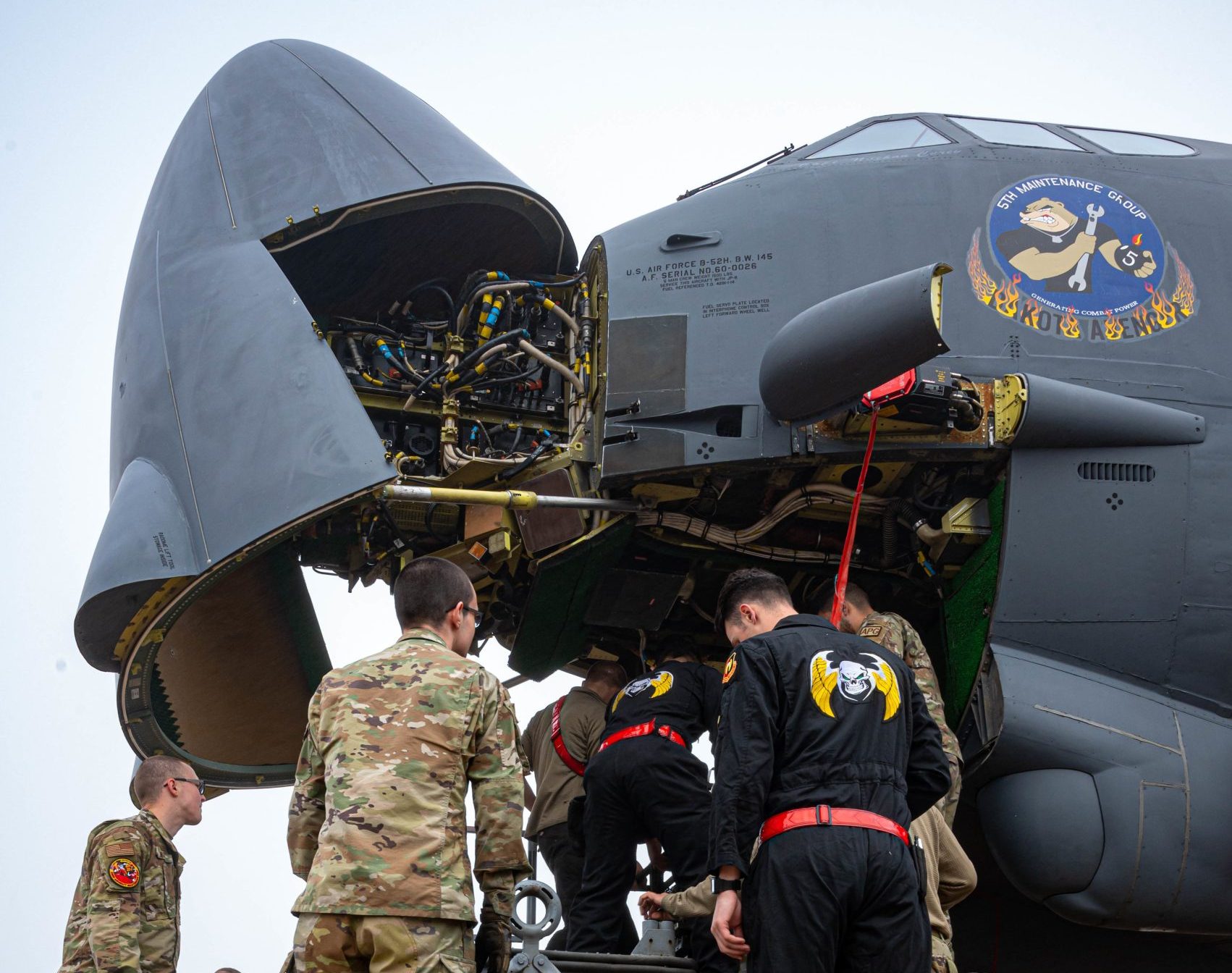
The United States Department of Defense announced on August 25 a significant investment in the future capabilities of the Air Force’s B-52H Stratofortress bomber fleet, awarding two contracts totaling over $766 million to Raytheon Technologies and Boeing. These contracts are pivotal to the ongoing Radar Modernization Program (RMP) for the venerable Cold War-era aircraft, which aims to extend its operational life and enhance its combat effectiveness for decades to come.
The larger of the two awards, an indefinite-delivery, indefinite-quantity (IDIQ) contract valued at up to $603 million, was granted to Raytheon Technologies. This contract tasks Raytheon with equipping B-52s with the new AN/APQ-188 radar system. The AN/APQ-188 is a state-of-the-art active electronically scanned array (AESA) radar, derived from the advanced systems currently deployed on modern fighter aircraft such as the F-15 and F/A-18. The integration of AESA technology is expected to provide the B-52 with vastly improved navigation, targeting, and all-weather operational capabilities, a critical upgrade for an aircraft designed in the 1950s.
Boeing received the second contract, valued at $163 million. This agreement is a cost-plus-incentive fee, cost-plus-fixed fee cost-reimbursement, and firm-fixed-price delivery order under an existing IDIQ contract for B-52 production and sustainment. Boeing’s role will involve manufacturing and delivering bomb rack modernization system kits. These kits are essential to support the Radar Modernization Program, ensuring that the B-52’s weapon systems are fully compatible and optimized to leverage the enhanced targeting data provided by the new AN/APQ-188 radar.
The Radar Modernization Program is a cornerstone of a comprehensive overhaul for the B-52H fleet. The program’s primary objective is to replace the legacy mechanical AN/APQ-166 radar, which has served the B-52 for decades, with a modern AESA radar. AESA radars offer several advantages over their mechanical counterparts, including enhanced reliability due to fewer moving parts, the ability to perform multiple functions simultaneously (such as air-to-air and air-to-ground scanning), and a reduced radar cross-section, making them more difficult for adversaries to detect. These technological leaps are crucial for the B-52 to remain relevant in contested airspace environments of the 21st century.
Beyond the radar upgrade, the overall modernization effort for the B-52H is so extensive that aircraft undergoing these modifications will be redesignated as B-52J models. This broader transformation includes the integration of new, more fuel-efficient engines under the Commercial Engine Re-engining Program (CERP), which will replace the current eight Pratt & Whitney TF33 engines with new Rolls-Royce F130 engines. This re-engining is projected to significantly improve fuel efficiency, increase range, and reduce maintenance costs. Additionally, the B-52J will feature upgraded avionics, modernized cockpit displays, advanced communications systems, and enhanced weapons capabilities, allowing it to carry a broader array of precision-guided munitions and standoff weapons. These cumulative upgrades are intended to ensure the B-52 remains a formidable strategic asset through at least 2050, extending its service life to nearly 100 years.
Raytheon’s work on the AN/APQ-188 radar is slated to be performed at various facilities across the United States, including Forrest, Mississippi; El Segundo, California; McKinney, Texas; and Warner Robins, Georgia. This extensive geographical distribution of work underscores the complexity and scale of the program, with an expected completion date for Raytheon’s contract set for August 2031. Boeing’s contract work for the bomb rack modernization system kits will be conducted in San Antonio, Texas, with a projected completion date of December 2028.
The Radar Modernization Program has, however, faced recent challenges. In December 2022, a B-52 outfitted with the new AN/APQ-188 radar flew from Boeing’s San Antonio facility to Edwards Air Force Base, California, to commence crucial flight testing. Tragically, in June 2023, this test aircraft crashed shortly after takeoff from Edwards Air Force Base during a test sortie, resulting in the loss of all eight crew members aboard. This incident marked a somber moment for the program and the Air Force.
In the aftermath of the crash, Air Force officials informed reporters in July that a second B-52 was being modified with another AN/APQ-188 radar to continue the essential testing. This modification work was anticipated to be completed by the end of 2023. However, the loss of the initial test aircraft has inevitably placed the radar’s testing schedule on hold, likely for several months, while the newly upgraded bomber is prepared for flight. Officials speaking at the Life Cycle Industry Days conference in Dayton, Ohio, indicated that the Air Force’s B-52 modernization team would likely need to adjust its strategy and schedule as a direct consequence of the June accident. The pause in testing emphasizes the meticulous and often challenging nature of integrating advanced systems into complex platforms, especially when dealing with unforeseen setbacks.
Why This Matters
The contracts awarded for the B-52’s Radar Modernization Program and the broader fleet upgrade represent a critical juncture for U.S. national security, the defense industry, and the future of strategic airpower. Here’s why this initiative holds significant importance:
- Extending Strategic Deterrence:The B-52 Stratofortress has been a cornerstone of American strategic deterrence and power projection for over six decades. Its ability to carry large payloads, including nuclear and conventional weapons, over vast distances makes it a unique asset. Modernizing its radar and other systems ensures this aging but vital platform remains effective and relevant in a rapidly evolving global threat landscape, maintaining U.S. advantage against near-peer adversaries.
- Technological Superiority:The transition from a mechanical radar to an Active Electronically Scanned Array (AESA) radar is a leap in technological capability. AESA radars offer superior resolution, increased resistance to electronic countermeasures, the ability to track multiple targets simultaneously, and enhanced navigation precision in all weather conditions. This upgrade is essential for the B-52 to operate effectively in modern, contested airspace and deliver precision strikes.
- Economic Impact and Innovation:These multi-million-dollar contracts translate into significant economic activity, supporting jobs in the defense sector across multiple states. Furthermore, they drive innovation in aerospace technology, fostering advancements that can have broader applications beyond military platforms.
- Prudent Resource Management:Investing in the modernization of an existing, proven platform like the B-52 can be a more cost-effective strategy than developing an entirely new bomber fleet from scratch. By extending the life and enhancing the capabilities of the B-52, the U.S. Air Force maximizes its return on investment in a platform that has consistently demonstrated its reliability and adaptability.
- Program Resilience and Safety:The tragic crash of the test aircraft highlights the inherent risks in military aviation development and testing. How the Air Force and its industry partners adapt their testing strategy and ensure safety moving forward will be crucial. The continuation of the program, even with delays, demonstrates a commitment to achieving these critical upgrades while prioritizing rigorous safety protocols. The lessons learned from this incident will undoubtedly influence future test programs.
- Long-Term Airpower Strategy:The B-52J designation signifies more than just a radar upgrade; it represents a commitment to maintaining a robust and diverse bomber fleet. Alongside newer platforms like the B-2 Spirit and the forthcoming B-21 Raider, the modernized B-52 will continue to provide critical long-range strike capabilities, contributing to a layered and flexible airpower strategy well into the middle of the 21st century.