
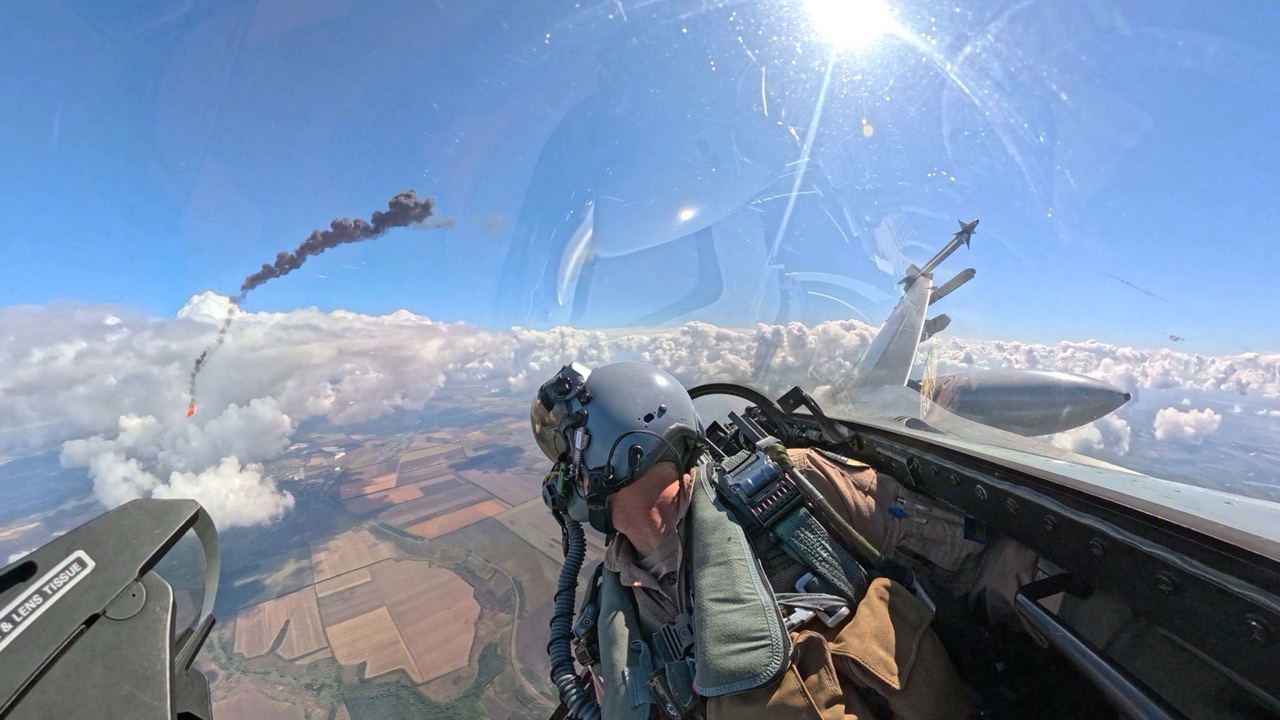
**Kyiv, Ukraine** – Ukraine’s fleet of F-16 fighter jets has emerged as a crucial component in its defense against Russia’s persistent aerial assaults, particularly in countering the diverse range of drones and missiles employed by Moscow. While demonstrating significant effectiveness in safeguarding Ukrainian airspace, their operational readiness and long-term viability are increasingly challenged by a chronic shortage of spare parts, intensive maintenance requirements, and the inherent technological limitations of their older variants. Ukrainian officials are actively seeking both urgent logistical support to sustain their current fleet and international approval to acquire more advanced F-16 models.
Denys Sienik, Ukraine’s Chargé d’Affaires to the United States, underscored the strategic importance of these aircraft during a briefing with the Defense Writers Group on November 5. “F-16s are super effective on the front line, super effective for the defense of Ukraine,” Sienik stated, highlighting their pivotal role in safeguarding Ukrainian airspace and infrastructure from relentless Russian attacks. This assessment emphasizes the aircraft’s critical function in a conflict characterized by extensive use of airborne weaponry.
The F-16s currently operated by Ukraine are primarily older F-16AM/BM Mid-Life Update aircraft, units that were originally manufactured several decades ago and subsequently donated by European allies. While these jets have undergone some upgrades to extend their service life, they generally lack the sophisticated avionics and sensor suites characteristic of newer generations. Notably, they are not equipped with modern APG-83 active electronically scanned array (AESA) radars. These advanced radars offer significantly enhanced detection capabilities, particularly against low-observable threats like one-way attack drones and cruise missiles, and provide superior situational awareness for pilots compared to older mechanically scanned radar systems. Furthermore, the Ukrainian F-16s often lack advanced datalinks for seamless, secure communication and more modern electronic warfare equipment, which is crucial for operating effectively in a highly contested electromagnetic environment.
Despite these technological disparities, the Ukrainian F-16s have demonstrated remarkable success in intercepting Russian aerial threats. A Ukrainian government spokesperson reported at a separate event on November 5 that the F-16 fleet has been credited with approximately 4,700 shoot-downs of Russian one-way attack drones. A significant portion of these interceptions, specifically 1,100, occurred in October alone, underscoring both the escalating intensity of Russia’s drone campaigns and Ukraine’s persistent defensive efforts. In these engagements, Ukrainian pilots have predominantly relied on the F-16’s internal 20mm Vulcan cannon. This reliance on a close-range weapon system, rather than more sophisticated air-to-air missiles, is a testament to the pilots’ skill and adaptability under challenging circumstances, but also indicates tactical limitations.
Sienik further elaborated on the efficacy of even the older models, stating, “Even those F-16s older versions, Block 30s, that we have are super effective at intercepting jet-powered drones, in particular, that are flying 400 kilometers, that are basically cruise missiles.” This observation highlights the inherent design capabilities of the F-16 platform, enabling it to adapt to diverse roles, even in configurations considered less advanced by contemporary standards, in countering a specific type of airborne threat that poses a significant danger to Ukrainian targets.
However, the sustained operation of these complex aircraft presents considerable logistical hurdles. Ukrainian President Volodymyr Zelenskyy has indicated that roughly half of the country’s F-16 fleet is typically undergoing maintenance and repairs in Europe at any given time. This high attrition rate, resulting from both operational wear and tear in an active combat zone and potential combat damage, places immense strain on maintenance crews and supply chains. The Ukrainian government is consequently engaged in an ongoing and urgent effort to acquire essential spare parts to keep its warplanes operational and available for missions.
“We have grounded aircraft. They need to be repaired, and the answer is that—everyone knows this—we are looking for spare parts now,” Sienik affirmed, noting that he has engaged in discussions with Lockheed Martin, the manufacturer of the F-16. He emphasized that securing these parts is currently a paramount priority. “That’s the priority for us. Not only to find new F-16s, but actually the spare parts for them,” he stressed, underscoring the immediate need to maintain the existing operational fleet as a foundational step for any future expansion.
Looking ahead, Ukraine harbors ambitions to acquire newer variants of the F-16, such as the Block 70/72, which represent the most advanced production models currently rolling off the factory line. These modern jets incorporate significant technological advancements, including improved AESA radars, enhanced electronic warfare capabilities, and longer operational lifespans, offering a substantial leap in combat effectiveness. Sienik acknowledged that such an acquisition would necessitate approval from the United States government, specifically from the administration of President Donald Trump, should he be in office. The F-16, being an American-made aircraft, requires U.S. government authorization for transfer and use by third-party nations due to export control regulations.
The U.S. government’s stance on providing F-16s to Ukraine evolved significantly since Russia’s full-scale invasion in February 2022. Initially, the administration of former President Joe Biden resisted direct transfers of F-16s due to concerns about escalation. However, a policy shift in mid-2023 allowed allied nations to transfer F-16s from their existing inventories to Ukraine and also facilitated pilot training programs in the U.S. and Europe. The first F-16s are reported to have arrived in Ukraine in 2024, and Ukrainian officials consistently stress the ongoing need for more of these aircraft to bolster their air defense capabilities against a numerically superior Russian air force.
“Newer versions, definitely yes,” Sienik stated, expressing confidence that the primary barrier is political rather than financial. “All that is missing is the political decision. I will tell you even more. It’s not even more about money. We will find money. Not us, our partners.” This suggests a belief within Kyiv that international partners are willing to fund such acquisitions if the necessary political clearances are granted by the United States.
The integration of F-16s is part of a broader, ambitious strategy by Ukraine to transition its air force from its Soviet-era legacy systems to a modern, Western-aligned force. This comprehensive transformation also includes plans to field French Mirage 2000s and Swedish Gripens, alongside the F-16s, creating a more diverse, capable, and interoperable multi-role fighter fleet compatible with NATO standards.
Beyond the aircraft themselves, Ukraine is also grappling with a critical shortage of air-to-air missiles, particularly more advanced and longer-range variants. These sophisticated munitions are expensive to procure in large quantities, and their limited availability has forced Ukrainian pilots to frequently rely on the F-16’s 20mm Vulcan cannon for engagements, a tactic typically reserved for very close-range combat scenarios. This operational constraint also applies to other fighter types within the Ukrainian air force, which are reportedly resorting to similar risky gun-kill attempts against incoming threats. Denmark recently provided more than 50,000 rounds of 20mm F-16 ammunition to Ukraine, a donation that, while helpful in the short term, is acknowledged as a stopgap measure, especially with the anticipated increase in Russian drone and missile attacks during the upcoming winter months.
Airpower experts emphasize that a truly effective national air defense system requires more than just fighter jets. Retired Lt. Gen. David A. Deptula, Dean of the Air & Space Forces Association’s Mitchell Institute for Aerospace Studies, highlighted the multifaceted nature of the threat in a September article for Air & Space Forces Magazine. “The Ukrainian Air Force is not confronting a single threat,” Deptula wrote. “Its pilots face an extraordinarily complicated mixture of slow propeller-driven drones, faster jet-powered Gerans, cruise missiles, Russian fighters, long-range surface-to-air missile systems, electronic warfare, and dense ground-based air defenses.”
Deptula further articulated the long-term vision required for Ukraine’s airpower: “The next chapter is about whether Ukraine’s wartime collection of fighters evolves into the sustainable, technologically modern, and fully integrated air force it needs, with the capacity to defend its airspace for decades—and carry the fight to the aggressor if required.” This comprehensive perspective underscores the necessity of key enabling equipment such as airborne early warning (AEW) aircraft for enhanced surveillance, robust and numerous ground-based air defenses, cost-effective interceptors, protected infrastructure, and advanced command and control systems to build a resilient and effective national air defense capability.
Why This Matters
The operational status and future trajectory of Ukraine’s F-16 fleet carry significant weight for several reasons, extending beyond the immediate conflict:
- **Impact on the War’s Progression and Civilian Protection:** The F-16s are critical for Ukraine’s ability to defend its skies, protect its population centers, and maintain some level of air superiority or parity against Russian aerial threats. Their effectiveness directly influences the human cost of the conflict and the ability of Ukrainian ground forces to operate with reduced risk from overhead attacks. A robust air defense is essential to prevent Russia from achieving overwhelming air dominance, which could drastically alter the war’s dynamics and lead to increased casualties and infrastructure damage.
- **Sustainability of Western Military Aid and Alliances:** Ukraine’s struggles with F-16 maintenance and the chronic shortage of spare parts highlight a broader challenge inherent in providing complex Western military hardware to a high-intensity conflict zone. It demonstrates that simply delivering advanced equipment is insufficient; sustained logistical support, ongoing training, and a robust, resilient supply chain are equally vital for long-term operational effectiveness. This continuous need for comprehensive support places enduring demands on donor nations, testing the long-term commitment and cohesion of international alliances.
- **Evolution of Air Warfare and Technological Imperatives:** The conflict in Ukraine serves as a real-world proving ground for military technologies and doctrines against modern threats. The F-16s’ performance against drones and cruise missiles, particularly older variants relying on gun engagements, offers invaluable lessons for air forces worldwide regarding the efficacy of different platforms and tactics. It underscores the rapid evolution of air threats and the critical importance of modern radar, electronic warfare, and missile technologies in contemporary warfare. The desire for Block 70/72 F-16s reflects a clear recognition that technological superiority is key to survival and effectiveness in current and future conflicts.
- **Geopolitical Implications and Regional Deterrence:** Ukraine’s ambitious transition to a Western-standard air force, including the integration of F-16s, French Mirage 2000s, and Swedish Gripens, represents a significant strategic shift for the nation. This not only enhances Ukraine’s long-term security posture but also strengthens its integration with NATO standards and interoperability. A stronger, Western-equipped Ukrainian military contributes directly to regional stability and acts as a more credible deterrent against future Russian aggression, reinforcing the broader security architecture of Eastern Europe.
- **Economic Burden and Strategic Resource Allocation:** The immense cost of modern fighter jets, advanced munitions, and their ongoing maintenance places a substantial economic burden on Ukraine and its international partners. The scarcity of expensive air-to-air missiles, which forces reliance on less capable cannon fire, illustrates the stark economic realities of high-intensity conflict. Decisions about supplying new aircraft versus spare parts, and advanced missiles versus basic ammunition, reflect complex choices in strategic resource allocation that directly impact battlefield outcomes and national budgets for all involved parties.