
Rep. Michael Rulli, R-Ohio, discusses data center concerns as OpenAI and NVIDIA back a massive $500B data center in Ohio, his expectations for the legislative agenda and addresses Stock Act violation allegations on ‘Mornings with Maria.’
Key Takeaways
- Geopolitical AI Race Intensifies:The exposure of Chinese influence operations targeting U.S. AI and energy policy underscores the escalating global competition for technological supremacy, impacting investment flows and national security strategies in the tech sector.
- Data Centers: Critical but Contentious Infrastructure:As the backbone of AI, data centers represent massive capital expenditure and energy demand, creating both significant opportunities for utility providers and infrastructure developers, and growing regulatory and public backlash due to environmental and cost concerns.
- Regulatory Headwinds and Market Uncertainty:Increasing scrutiny from local governments (e.g., New York’s freeze) and political figures, coupled with escalating energy costs, introduces regulatory risk and potential market volatility for companies heavily invested in AI infrastructure development.
The burgeoning artificial intelligence (AI) sector, while promising unprecedented technological advancement and economic growth, is increasingly finding itself at the nexus of geopolitical competition, energy policy, and public scrutiny. A recent probe by the social media platform X, detailing a sophisticated Chinese bot farm aiming to manipulate public discourse on U.S. AI and energy policy, casts a stark light on the non-market forces shaping this critical industry.
X’s investigation uncovered approximately 200,000 “suspected Chinese inauthentic accounts,” with a targeted subset of 200 actively disseminating disinformation designed to “distort true debate regarding U.S. artificial intelligence and energy policy.” These accounts pushed narratives claiming that AI data centers are inflating household electricity prices and overstraining energy grids, often employing AI-generated cartoons to depict data center operators as profiteering at public expense.
“The X Safety team conducted an investigation into suspected Chinese inauthentic accounts involved in influence operations: We identified a bot farm of approximately 200,000 accounts. Within this farm, we found 200 accounts posting in a manner that could manipulate a legitimate debate about American AI and energy policy,” the post on the X Global Government Affairs account noted. “These posts contained claims that AI data centers are driving up household electricity prices and straining the grid. Others included AI-generated cartoons that depicted data-center operators enriching themselves at the public’s expense.”
The popular social media platform X announced that it conducted a probe regarding “suspected Chinese inauthentic accounts” participating in influence efforts.(Getty Images / Getty Images)
This incident is not merely an issue of social media integrity; it’s a window into the high-stakes geopolitical contest for AI dominance. China’s efforts to undermine the U.S.’s AI infrastructure development speak to the strategic importance of this technology, not just for economic leadership but for national security. For investors, this translates into increased emphasis on cybersecurity resilience, supply chain integrity, and careful assessment of geopolitical risk when evaluating AI-related investments.
The bot farm’s specific targeting of data centers’ energy consumption taps into a genuine and growing concern within the U.S. Data centers are the physical infrastructure of the digital age, housing the servers, storage systems, and networking equipment essential for AI model training and deployment. Their proliferation, driven by demand from tech giants like OpenAI and NVIDIA, translates into immense energy requirements. For instance, the proposed $500 billion data center project in Ohio, backed by OpenAI and NVIDIA, exemplifies the scale of investment and, consequently, the demand for power.
The energy demands of these facilities are staggering. A single hyperscale data center can consume as much electricity as a small city. This escalating demand places significant strain on existing power grids, necessitating substantial investment in new generation capacity, transmission infrastructure, and often, a shift towards more renewable energy sources to meet corporate ESG (Environmental, Social, Governance) targets. Utility companies, particularly those operating in regions targeted for data center development, face both the opportunity of increased revenue and the challenge of managing grid stability and capacity expansion. Investors in utilities must now factor in the pace of data center growth and associated regulatory responses when assessing long-term value.
Local communities and governments are increasingly vocal about the environmental and economic impacts. New York recently became the first state to freeze new AI data centers, a move that critics warn could stifle innovation and drive away jobs. This regulatory action highlights a growing “Not In My Backyard” (NIMBY) sentiment, as local residents and politicians grapple with concerns over increased electricity rates, water usage, and the carbon footprint of these facilities.
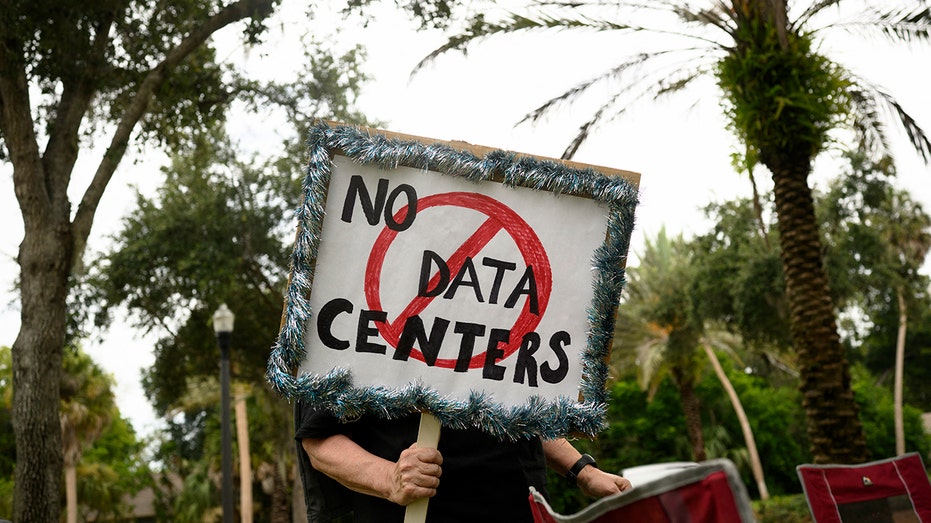
A person holds signs during a nationwide protest against AI data center expansion outside Peace Hall in New Port Richey, Fla., on July 18, 2026. (Thomas Simonetti / AFP via Getty Images / Getty Images)
Florida Gov. Ron DeSantis articulated this distrust, stating that “The concerns by citizens from across the political spectrum re: hyperscale data centers are rooted in distrust of these Big Tech titans and their designs on expanding tech power over the citizenry. It’s not just — or even mainly — about concerns about water and power usage.” This sentiment, bridging across political divides, signals a growing political risk for companies planning large-scale AI infrastructure projects.
President Donald Trump urged governors and mayors to welcome AI plants and data centers into their communities, saying he would “absolutely want” such projects because of the jobs and tax revenue they bring.
Conversely, former President Donald Trump has urged governors and mayors to embrace AI plants and data centers, emphasizing the economic benefits of job creation and tax revenue. His position underscores the national imperative to maintain a competitive edge in AI against rivals like China. “The Radical Left Dumocrats must not be allowed to cause us to lose Data Centers, AI, and all of this incredible new Technology, to China, and other countries!” he asserted. This divergence in political views underscores the complex landscape companies must navigate, balancing national strategic goals with local community concerns and regulatory hurdles.
The broader AI ecosystem also faces emerging threats, as OpenAI and over 100 companies have warned of a coming surge in AI-powered cyberattacks. This elevates cybersecurity from a compliance issue to a critical strategic investment, creating new market opportunities for firms specializing in AI security and threat detection. The integrity of the data centers themselves, and the data they house, becomes paramount in this environment.
Market Impact
The confluence of geopolitical maneuverings, escalating energy demands, and increasing regulatory scrutiny presents a complex landscape for investors in the AI and associated energy sectors. Utility companies with exposure to regions experiencing rapid data center development may see increased investment in grid infrastructure but also face regulatory pressure on pricing and environmental mandates. Data center REITs and construction firms could encounter project delays or increased compliance costs due to local opposition and state-level moratoriums. Semiconductor manufacturers and AI software developers, while benefiting from surging demand, must contend with potential bottlenecks in compute infrastructure and the overarching geopolitical competition for technological leadership. Furthermore, the rising threat of AI-powered cyberattacks will drive significant capital expenditure into cybersecurity solutions, creating a growth catalyst for that specific segment. Companies must adapt to a market where technological innovation is inextricably linked to energy policy, public sentiment, and global power dynamics, requiring robust ESG strategies and astute geopolitical risk management.