
**Washington’s European Military Posture Under Review Amid Access Tensions**
The United States military’s ability to swiftly access air bases across Europe is a pivotal factor in the Trump administration’s ongoing evaluation of its future military footprint on the continent, according to the top Pentagon policy official at the time.
Undersecretary of Defense Elbridge Colby, who addressed NATO allies in Brussels on August 27, was spearheading this comprehensive Pentagon review. He was working in conjunction with military leadership, including Air Force Gen. Alexus G. Grynkewich, who served concurrently as the head of U.S. European Command (EUCOM) and NATO’s top military commander.
A central and potentially contentious aspect of this review revolves around the concept of Access, Basing, and Overflight, commonly known as “ABO.” This framework dictates the conditions under which U.S. forces can utilize allied territory, facilities, and airspace, and its predictability is a key concern for Washington.
The Trump administration had previously voiced dissatisfaction with what it perceived as a lack of immediate access from certain European nations for U.S. aircraft during a period of heightened tensions, specifically referencing the U.S.’s involvement alongside Israel in a conflict against Iran, which was internally referred to as “Operation Epic Fury.” However, some European officials countered this stance, arguing that it was unrealistic to expect their swift consent for U.S. warplanes in a conflict for which they had not been consulted in advance and which did not directly engage the NATO alliance’s collective defense mandate.
Compounding these tensions, European allies expressed apprehension that a failure to reach common ground on the ABO issue could lead to further reductions in U.S. military presence on the continent. The Pentagon had already initiated such shifts, having previously withdrawn two Army combat brigades. This move aligned with a broader U.S. strategy to empower European nations to take a leading role in their conventional defense, thereby allowing the U.S. to reallocate military resources and focus more intently on strategic priorities in the Western Hemisphere and the Pacific region.
“We’re not looking in every context for a complete carte blanche, but we’re saying we need to be able to have the ability to operate effectively. We need predictability,” Undersecretary Colby conveyed to reporters at NATO’s headquarters. He explicitly cited “Operation Epic Fury” as an instance where this desired predictability was not consistently evident.
Colby’s diplomatic engagements in Europe included meetings with NATO ambassadors in Brussels. Prior to this, he had held discussions with General Grynkewich at U.S. European Command headquarters in Stuttgart, Germany, and consulted with the alliance’s military staff at Supreme Headquarters Allied Powers Europe (SHAPE) in Mons, Belgium. Earlier in the day, Colby had also met with Mark Rutte, who then served as NATO’s Secretary General.
As part of the review process, the Pentagon had furnished its allies with a document termed the “Terms of Reference.” This document outlined the guidelines and criteria governing the comprehensive assessment of the U.S. military posture. According to Reuters, these criteria encompassed several key areas:
- The extent to which European nations were meeting agreed-upon higher defense spending targets.
- The concrete steps allies were taking to mitigate and fill capability gaps as the U.S. began shifting military resources away from the continent.
- Allies’ demonstrated willingness and practical ability to support U.S. power projection operations outside of the immediate NATO mandate, particularly through contributions of space, cyber, and intelligence assets, as well as critical base access.
Colby underscored that this was not merely a narrow evaluation focused solely on specific locations and bases, despite their intrinsic importance. Instead, he framed it as a broader examination of the U.S.’s strategic posture in Europe, fundamentally designed to ensure the Joint Force’s capacity to fulfill the overarching priorities articulated in the National Security Strategy and the National Defense Strategy.
The aforementioned conflict with Iran served as a stark illustration of both the strategic importance of basing access and the political complexities surrounding it. For instance, Britain initially hesitated to grant the Trump administration’s request for B-52 and B-1 bombers to utilize its RAF Fairford base. Following a legal assessment and extensive consultations with American officials, Britain ultimately relented, but with the specific stipulation that any bomber missions launched from its territory would be strictly for “defensive purposes.” This term was broadly interpreted, allowing for attacks on Iranian missile and drone facilities, for which the U.S. bombers were particularly well-suited.
Conversely, Spain, which had publicly opposed the conflict, chose not to permit the U.S. to use its bases at Rota and Moron for operations related to the Iran conflict.
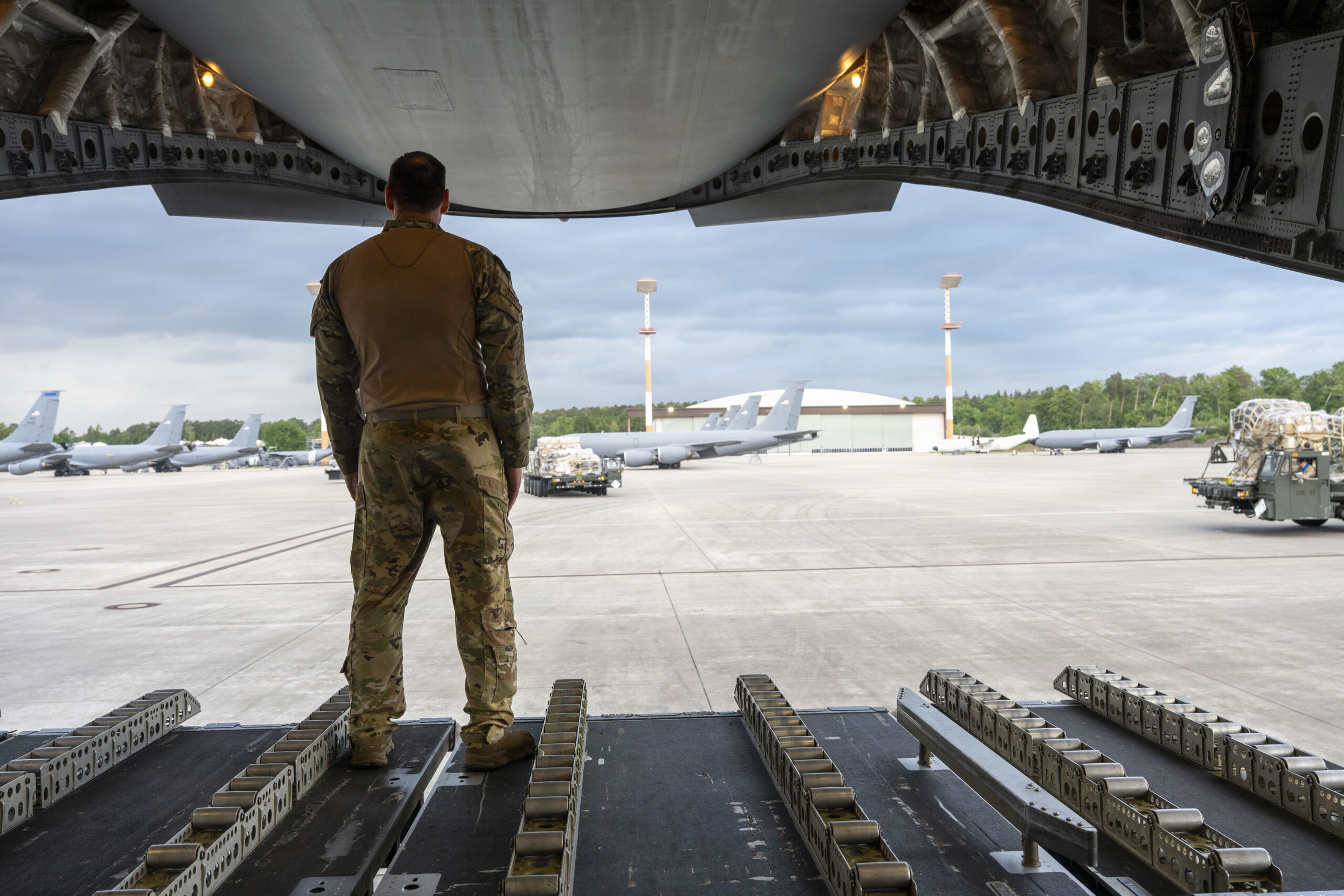
Throughout the conflict, Europe also functioned as a crucial logistical hub and stopover point for U.S. cargo aircraft. Ramstein Air Base in Germany, a primary U.S. logistical center, played a particularly vital role. Its proximity to Landstuhl Regional Medical Center, the largest American military hospital outside the U.S., meant that the facility received numerous U.S. service members wounded in the conflict. Furthermore, American fighter aircraft permanently stationed in Europe, including F-35A and F-15E fighters from RAF Lakenheath, U.K., and F-16s from Spangdahlem Air Base, Germany, and Aviano Air Base, Italy, were deployed in the conflict. Additionally, U.S.-based fighters transited through various European bases, predominantly via the U.K., en route to the theater of operations.
These ongoing discussions surrounding the Pentagon’s posture review and Colby’s engagements with NATO officials took place against a backdrop of escalating Russian aggression in Eastern Europe, fueling anxieties that regional instability could intensify further. During this period, CIA Director John Ratcliffe traveled to Moscow to consult with his Russian counterparts, reportedly to reaffirm the U.S. commitment to defend NATO, according to reports from POLITICO and The Wall Street Journal. Western officials had also reported that Russia was actively engaged in a series of “hybrid attacks” against European nations, encompassing various sabotage operations. Flights by Russian drones had previously prompted NATO to establish the “Eastern Sentry” mission, specifically designed to bolster the protection of the alliance’s eastern flank.
**Why This Matters**
The Trump administration’s review of U.S. military posture in Europe, centered on the critical issue of Access, Basing, and Overflight (ABO), represents a fundamental re-evaluation of transatlantic security arrangements. The outcomes of these discussions directly impact the future operational flexibility of U.S. forces, influencing their ability to project power and respond to crises not only within Europe but also in adjacent regions like the Middle East and Africa. A lack of predictable access could hinder rapid deployment capabilities, potentially compromising U.S. and NATO responsiveness to emerging threats.
For European allies, the review carries significant implications for their sovereign decision-making and their military burden-sharing responsibilities. The U.S. emphasis on European nations taking a greater lead in conventional defense, coupled with potential U.S. force realignments towards the Pacific, signals a shift that requires Europe to enhance its own defense capabilities and coordination. Failure to address U.S. concerns about access could precipitate further reductions in U.S. military presence, potentially creating security vacuums or perceived weaknesses at a time of heightened Russian aggression. This ongoing re-evaluation thus shapes the very nature of the NATO alliance, testing its cohesion and adaptability in a complex geopolitical landscape where traditional security challenges are intertwined with new forms of hybrid warfare.