
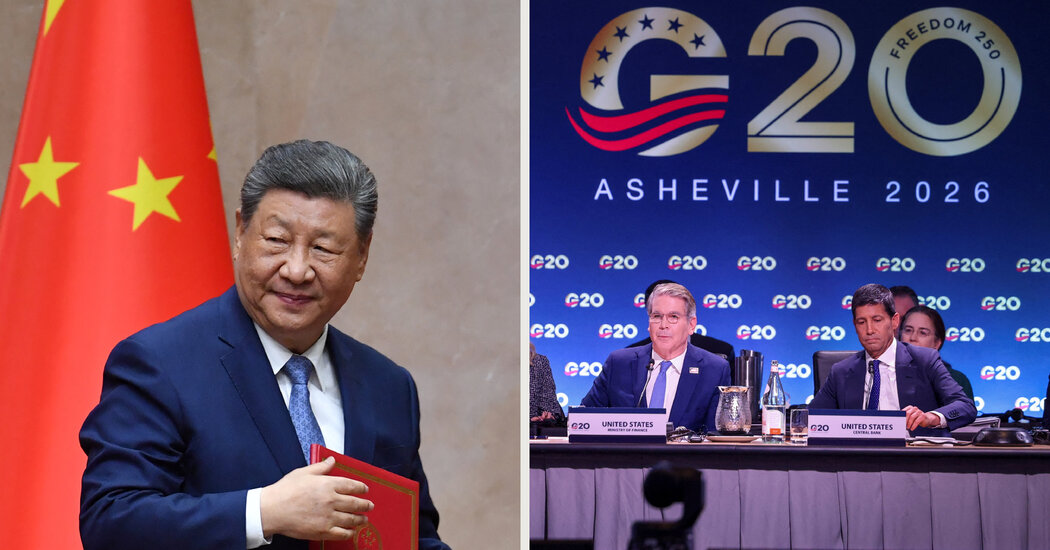
This week, two distinct international gatherings underscored a widening divergence in global diplomatic priorities and the ongoing contest to shape the future international order. Chinese leader Xi Jinping arrived in Central Asia, positioning Beijing as a central actor prepared to influence global developments. Concurrently, a meeting of finance ministers from the Group of 20 (G20) nations in the United States highlighted divisions among traditional Western allies.
In Bishkek, the capital of Kyrgyzstan, Mr. Xi participated in a security summit alongside leaders from Russia and Iran. At the Shanghai Cooperation Organization (SCO) summit, he presented China as a source of stability and advocated for an “orderly multipolar world,” contrasting with the prevailing U.S.-dominated international system. This gathering appeared designed to project solidarity among participating nations.
Simultaneously, in Asheville, North Carolina, the G20 finance ministers and central bankers meeting revealed significant fractures among major economies. European officials expressed strong disapproval of the Trump administration’s decision to invite Russia, despite its ongoing conflict with Ukraine. Treasury Secretary Scott Bessent reportedly stated that Canada’s economy was too small to withstand a trade dispute with the United States. Attendees also confronted the economic ramifications of the U.S.-Israeli conflict with Iran, which had disrupted global oil flows, pushed energy prices upward, and threatened to impede global economic growth.
These parallel events reflect a broader competition over the trajectory of the global order. China is leveraging its relationships with nations such as Russia and Iran, both of which are currently in contention with Western powers, to expand its influence. This strategy may provide Mr. Xi with increased diplomatic weight in his upcoming summit with President Trump. Conversely, the United States, under the current administration, has faced observations that its actions are straining long-standing alliances and economic relationships that have historically underpinned its global leadership role.
Ryan Hass, a former diplomat and White House national security official now with the Brookings Institution, observed, “China’s theory of the case for bending the international political order in its preferred direction is to amass support from the ‘global majority.'” He added that Mr. Xi’s participation in these groupings is “important to Beijing” because “it builds a narrative around China gaining momentum in building support for playing a more central role on the world stage.”
At the SCO summit in Bishkek, Mr. Xi met with leaders including those from Kyrgyzstan, Mongolia, and Uzbekistan. His discussions with Russian President Vladimir V. Putin held particular significance. This meeting occurred days after John Ratcliffe, the C.I.A. director, reportedly undertook a secret visit to Moscow to urge an end to the conflict in Ukraine. During their public remarks, Mr. Xi conveyed to Mr. Putin that “The foundation of China-Russia relations will become ever stronger.”
Iranian President Masoud Pezeshkian also attended the Bishkek summit. While Iranian media reported a sideline meeting between him and Mr. Xi, no scheduled formal talks were publicized. However, Mr. Putin held a meeting with President Pezeshkian, where he commended the “courage and resilience” of the Iranian people in pursuing their national interests. The Russian leader emphasized Moscow’s support for Tehran amid its conflict with the United States, stating, “During this difficult time, we are trying to provide you with the assistance you need. We have discussed this with you and are supplying you with the necessary goods.”
Earlier in the day, Mr. Putin praised the emergence of a new power center within the SCO, describing the organization as “one of the independent and influential centers of the emerging multipolar world.” He highlighted that SCO member countries collectively represent nearly half of the global population and more than a third of its gross domestic product.
In contrast, the United States has been perceived by some analysts as distancing itself from historical allies, potentially impacting its global influence. The Trump administration has initiated trade disputes with Canada and scaled back joint military exercises with South Korea. Additionally, concerns have been raised regarding the depletion of U.S. munitions in the conflict with Iran, prompting questions about its capacity to meet defense commitments internationally.
At the G20 meeting, Lars Klingbeil, the German Vice Chancellor and Finance Minister, informed reporters that the invitation extended to Russia’s Finance Minister, Anton Siluanov, by the Trump administration was “troubling.” Mr. Klingbeil stated he directly admonished Mr. Siluanov during a session concerning Russia’s actions in Ukraine. Furthermore, several European representatives expressed dissatisfaction that the U.S. Treasury Department did not invite representatives from South Africa, a long-standing G20 member and Africa’s largest economy.
An Opportunity for China
Analysts suggest that Beijing is prepared to capitalize on any perceived weakening of traditional Western alliances. Wu Xinbo, an American studies scholar at Fudan University in Shanghai who advises China’s Foreign Ministry, indicated that Beijing harbors two primary objectives: to foster a global consensus that prevents any single nation from dictating the international agenda, and to assume a more significant role in driving the global economy. China also participated in the G20 meeting.
“Now that the American engine is losing steam — or even generating negative side effects — China, as an economic engine, must step up and play a greater role in driving and leading global growth,” Mr. Wu remarked.
The Bishkek summit is part of a broader diplomatic initiative by Mr. Xi, aimed at engaging with various international factions. This year, he has hosted numerous Western leaders, including those from Germany, Britain, and Canada. He is scheduled to travel to Cairo next and is anticipated to attend a summit of BRICS nations—a group of emerging economies primarily led by China and India—in New Delhi.
Despite Mr. Xi’s efforts to present such groupings as unified counterbalances to Western influence, underlying disagreements and tensions persist. Historically, Beijing and New Delhi have held divergent views within BRICS regarding the appropriate level of confrontation with the United States, with India often exhibiting reluctance for overtly confrontational postures. In another indication of internal differences, during sideline talks at the Kyrgyzstan summit, Indian Prime Minister Narendra Modi urged Mr. Putin to conclude the conflict in Ukraine for humanitarian reasons. Russian state media reported that Mr. Putin responded by saying Russia was “moving in this direction.”
The Bishkek summit also highlighted the limitations of the SCO’s solidarity. The organization is fundamentally not a military alliance. While Beijing can offer diplomatic backing to its partners, it has not committed military forces to defend Russia or Iran in their respective conflicts. For China, this characteristic is seen as a deliberate design of the arrangement.
Why This Matters
The simultaneous diplomatic activities observed this week underscore a significant period of realignment in global power dynamics. The contrasting approaches of the United States and China, as demonstrated by the G20 and SCO summits, signal a potential shift away from a solely U.S.-centric international system towards a more multipolar world. This evolution carries profound implications for global stability, economic interconnectedness, and the future of international cooperation.
For traditional U.S. allies, perceived strains on alliances could prompt a reassessment of their own foreign policy priorities and economic partnerships. This could lead to a diversification of diplomatic engagement and a search for new anchors of stability, potentially strengthening regional blocs or fostering new bilateral relationships outside established frameworks. The economic ramifications, particularly from ongoing conflicts like the U.S.-Israeli conflict with Iran and Russia’s war in Ukraine, directly impact global supply chains, energy markets, and inflation, affecting citizens and industries worldwide.
China’s assertive diplomacy, aimed at forging new alliances and advocating for an alternative global order, presents a challenge to the existing international norms and institutions. Its efforts to garner support from the “global majority” could reshape voting blocs in international organizations and influence future multilateral initiatives. While China seeks to project unity, the internal tensions within groupings like the SCO and BRICS indicate that a truly unified counterbalance to existing powers is not a foregone conclusion. Nevertheless, these developments necessitate close observation by policymakers, economists, and citizens globally, as they will define the geopolitical landscape for decades to come, impacting trade, security, and human rights.
Beijing Navigates Complex Geopolitical Landscape Ahead of Key Summit
Beijing is currently engaged in a robust diplomatic push, strategically leveraging multilateral forums like the Shanghai Cooperation Organization (SCO) to bolster its international standing amidst growing global competition and domestic challenges. This diplomatic offensive comes as China prepares for a highly anticipated summit between its leader, Mr. Xi Jinping, and US President Donald Trump, where a range of contentious issues are expected to be discussed.
Observers note that China’s approach to international engagement, particularly through organizations like the SCO, is characterized by a deliberate avoidance of traditional alliance structures. This strategy is seen as a key differentiator from Western-led blocs and is intended to appeal to a broader spectrum of nations seeking more flexible and less binding partnerships.
Zhou Bo, a retired People’s Liberation Army senior colonel now affiliated with Tsinghua University in Beijing, articulated this perspective. “It is not based on alliance relationships, so it is not provocative,” he stated. “That’s why people have no problem accepting it or engaging with it.” This sentiment underscores China’s desire to be perceived as a partner rather than a hegemon, offering an alternative model for international cooperation in a world increasingly moving away from unipolar dominance.
Mr. Zhou further suggested that as Washington potentially retreats from certain global commitments and the international system becomes more multipolar, countries will naturally gravitate towards more pragmatic forums that come with fewer geopolitical obligations. “Naturally everyone is hedging their bets,” he remarked, indicating a trend where nations seek to diversify their diplomatic and security alignments to maximize their strategic autonomy in a fluid global environment.
Building Leverage Before Trump Summit
China’s intensified diplomatic activities and the showcasing of its influence are widely interpreted as an effort by Mr. Xi to strengthen his negotiating position and widen his strategic options before his scheduled meeting with Mr. Trump in Washington later this month. The bilateral relationship between the United States and China remains complex and fraught with tension, despite a previously announced economic truce. The Trump administration has continued to exert pressure on Beijing across multiple fronts.
Economically, beyond the ongoing trade disputes, the US has implemented measures such as banning imports of certain Chinese robots, citing national security concerns and intellectual property theft. Furthermore, the administration has expanded sanctions targeting Chinese companies found to be importing Iranian oil, a move that aligns with broader US foreign policy objectives to curb Iran’s oil exports but also impacts China’s energy supply chains and its economic ties with Tehran.
The technological rivalry, particularly in the realm of artificial intelligence (AI), has also become a critical flashpoint. Trump officials have signaled intentions to slow China’s rapid advancements in AI by threatening to restrict Chinese AI models that collect data from American counterparts. This potential restriction aims to safeguard sensitive data and maintain US technological superiority.
Adding to this pressure, the Trump administration is reportedly preparing to issue warnings to dozens of countries, advising them against participating in a Chinese AI initiative. These countries are being cautioned that involvement with China’s AI efforts could potentially lead to their exclusion from an American-led AI coalition, tentatively named Pax Silica, according to a letter drafted by the State Department and observed by The New York Times. While it remains unclear if these letters have been officially dispatched, and the State Department has not responded to requests for comment, the mere preparation of such a warning highlights the escalating competition for global dominance in critical future technologies.
China is also confronting potential trade barriers from Europe. Lawmakers in Brussels are increasingly concerned about a surge of Chinese products, including electric vehicles, solar panels, and industrial chemicals, inundating the European Union market. This influx is perceived as accelerating job losses within European industries, prompting discussions about implementing protective measures to ensure fair competition and safeguard domestic employment.
Domestically, Mr. Xi faces several significant vulnerabilities that could impact his leverage on the international stage. A recent and immediate concern is a devastating flood along the border with Nepal, which has resulted in thousands of fatalities and missing persons. This natural disaster raises questions about China’s disaster preparedness and response capabilities, potentially generating domestic criticism.
Another persistent challenge is the years-long property crisis, which has severely suppressed the Chinese economy. This crisis has reduced consumer confidence, strained local government finances, and forced Beijing to rely increasingly on exports as a primary driver for economic growth. However, this export-oriented strategy has, in turn, exacerbated trade tensions and frayed relations with key trading partners in both the US and Europe, creating a delicate balancing act for China’s economic policymakers.
Yun Sun, director of the China program at the Stimson Center in Washington, summarized China’s current predicament. “China is facing headwinds, so is the United States,” she noted. She emphasized the strategic imperative for Beijing: “The right balance is between getting enough support and endorsement at the S.C.O. without poking Trump directly in the eye.” This indicates China’s cautious approach to assert its influence without provoking an overly aggressive response from Washington, particularly prior to the critical summit.
Paul Sonne contributed reporting from Berlin, and Siyi Zhao contributed research from Beijing.
Why This Matters
The ongoing diplomatic maneuvers by China, coupled with the multifaceted pressures from the United States and Europe, signify a pivotal moment in global geopolitics and economics. These developments have far-reaching implications across several critical areas:
Shifting Global Order:China’s emphasis on non-alliance-based forums like the SCO reflects a conscious effort to reshape the international system towards a multipolar order. This challenges the post-Cold War unipolarity, potentially leading to new regional power blocs and diversified international partnerships. For countries globally, this means more options beyond traditional Western alliances, but also a more complex and potentially less predictable international landscape.
Intensifying US-China Rivalry:The escalating pressure from the Trump administration on trade, technology, and AI underscores a deepening strategic competition that extends far beyond economic tariffs. The “Pax Silica” initiative, if implemented, represents an attempt by the US to create a technological cordon around China, potentially fragmenting global tech ecosystems and forcing countries to choose sides in the race for technological supremacy. This rivalry will shape future innovation, supply chains, and national security strategies worldwide.
Global Economic Stability:China’s domestic vulnerabilities, particularly its property crisis and reliance on exports, are not merely internal issues. Its economic health significantly impacts global trade, supply chains, and financial markets. If China’s economy falters, or if its export strategy continues to provoke protectionist measures from major trading partners like Europe, it could trigger broader economic instability and contribute to a global slowdown. The EU’s potential trade restrictions highlight a growing global trend of nations re-evaluating unfettered globalization.
Future of International Cooperation:China’s pragmatic approach to international forums, offering “less strings attached” partnerships, could appeal to developing nations and those wary of traditional Western conditionalities. This could foster new models of international cooperation and development, but also raises questions about the efficacy and consensus-building capacity of such less formal structures on critical global issues like climate change, security, and human rights.
In essence, the ongoing dynamics between Beijing, Washington, and Brussels are not just about bilateral relations; they are shaping the architecture of the 21st-century world, influencing geopolitical alignments, economic pathways, and technological futures for all nations.