
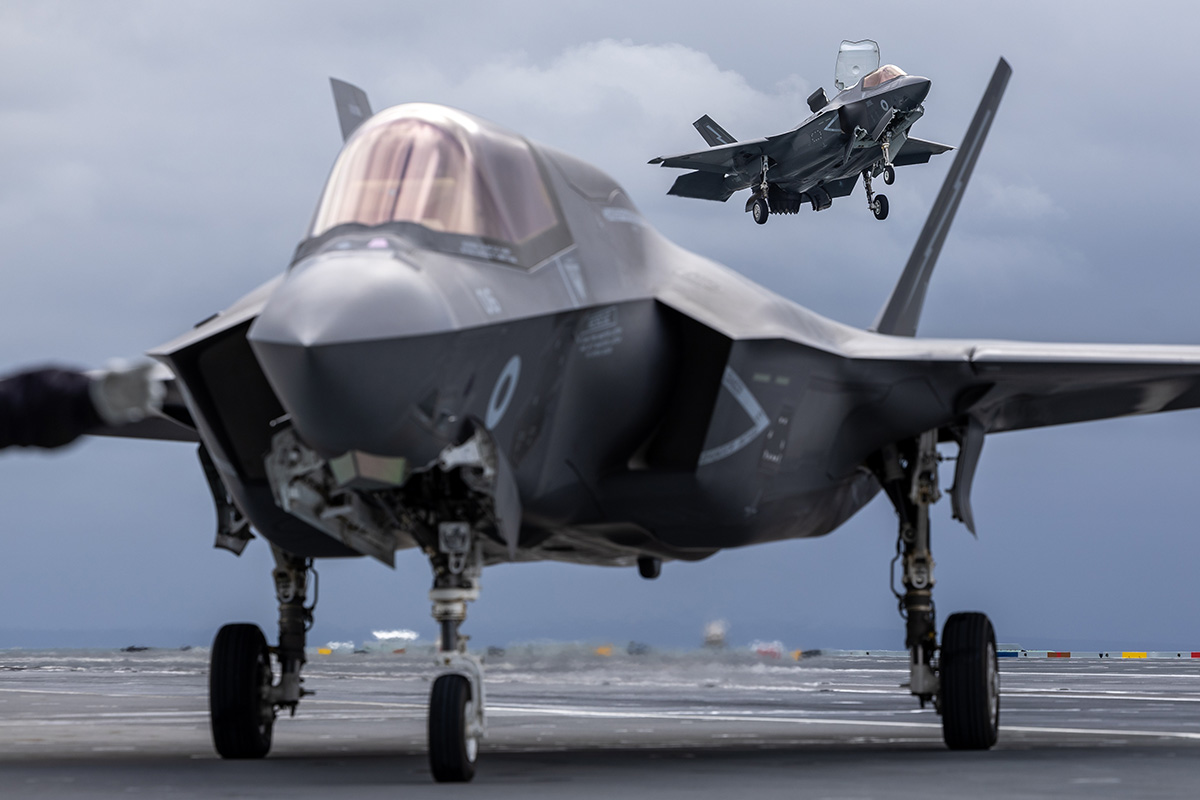
UK Parliament Addresses F-35 Support System and Operational Sovereignty Concerns
Recent discussions within the UK Parliament have brought into focus the intricacies of the nation’s participation in the F-35 Lightning II program, particularly regarding its reliance on a US-managed support system and the contentious issue of operational sovereignty. Defence Minister Luke Pollard, addressing Members of Parliament, reiterated that a Memorandum of Understanding (MoU) governs the F-35 program, ensuring all participants, including the UK, have assured access to the US-managed support infrastructure. He emphasized the UK’s successful operation and support of its F-35 aircraft within this framework since 2012.
The reassurances came in response to specific questions raised by Richard Holden, the Conservative MP for Basildon and Billericay, who sought an assessment of the potential challenges arising from reliance on a support system managed by the United States. Pollard’s response underscored the foundational agreement, stating: “The F-35 programme is governed by a Memorandum of Understanding that assures access to the US managed support system for all F-35 participants. The UK has been operating and supporting its F-35 aircraft successfully within the F-35 programme since 2012.”
These parliamentary exchanges highlight an ongoing debate about the balance between international defense cooperation and national strategic autonomy. The F-35 Lightning II, a fifth-generation multirole stealth fighter, represents one of the most advanced and complex military aircraft programs globally. It is a multinational endeavor, primarily led by the United States, with several partner nations, including the United Kingdom, playing crucial roles in its development, procurement, and ongoing support.
A key aspect of the debate revolves around the concept of operational sovereignty. In February, Lord Coaker, speaking in the House of Lords, affirmed that the UK maintains “Operational Sovereignty/Freedom of Action” over its F-35 operations. He clarified that no permission is required from any third party for the deployment or use of these aircraft by UK personnel, directly addressing concerns that had been circulating about potential external controls.
These assurances from both houses of Parliament were prompted by persistent questions, particularly in the Lords, concerning the existence of a so-called “kill switch” – a hypothetical mechanism that could allow a third party, presumably the United States, to remotely disable or impede the UK’s F-35 fleet. The Ministry of Defence has consistently rejected such claims, categorizing them as unfounded speculation.
Expert testimony has further informed the parliamentary discussions. Dr. Justin Bronk, a Senior Research Fellow for Airpower and Technology at the Royal United Services Institute (RUSI), told a Lords committee last year that his research had found no evidence of a “hard kill switch” in the F-35. While dispelling fears of a direct remote disablement feature, experts have pointed to other, more nuanced complexities that could impact operational independence.
Dr. Sophy Antrobus, a Research Fellow at King’s College London, speaking at the same committee session, identified the aircraft’s immense digital complexity as a more significant concern than a physical kill switch. She highlighted that the F-35’s systems comprise approximately nine million lines of code. This extensive software reliance, she argued, means that “no single nation can operate the aircraft independently given its structure and supply network.” This perspective points to a fundamental interdependence woven into the very design and sustainment of the F-35 platform, where continuous software updates, maintenance, and logistical support are inherently tied to a multinational, US-led ecosystem.
The “US-managed support system” encompasses a vast network of logistics, maintenance, software development, and supply chain management. This system ensures the global F-35 fleet remains operational, receives necessary upgrades, and has access to spare parts. While this integrated approach offers significant benefits in terms of cost-sharing, interoperability with allies, and access to cutting-edge technology, it also inherently creates a degree of reliance on the lead nation. The UK’s successful operation of its F-35s from its Queen Elizabeth-class aircraft carriers underscores its deep integration into this program, with these aircraft forming a cornerstone of the Royal Air Force and Royal Navy’s future air combat capabilities.
The parliamentary discussions reflect a broader tension in modern defense procurement: how to acquire state-of-the-art military technology, often developed through international collaboration, while safeguarding national strategic interests and maintaining absolute control over sovereign assets. For the UK, as a key partner in the F-35 program and a nation committed to projecting global influence, these questions are central to its long-term defense planning and alliance strategies.
Why This Matters
The ongoing parliamentary scrutiny of the F-35 program’s support systems and operational sovereignty is of significant importance for several reasons, touching upon national security, technological independence, and the future of international defense alliances.
National Security and Strategic Autonomy:For any nation, the ability to deploy and operate its military assets without external interference is fundamental to its national security and strategic autonomy. While the F-35 program is built on international cooperation, concerns about a “kill switch” or excessive reliance on a foreign-managed support system directly challenge the perception of unfettered control. Assurances from the UK government about “Operational Sovereignty/Freedom of Action” are crucial for public confidence and for ensuring that the UK can act decisively in its own defense or in support of allies, particularly during crises where geopolitical alignments might shift.
Technological Interdependence and Cyber Vulnerabilities:Dr. Antrobus’s emphasis on the F-35’s vast digital complexity (nine million lines of code) highlights a growing reality in modern warfare: military platforms are increasingly software-defined. This creates a deep technological interdependence, where ongoing access to software updates, maintenance, and potentially proprietary diagnostic tools is essential. This reliance, while fostering interoperability, also introduces potential vulnerabilities, including cybersecurity risks, the possibility of software bugs affecting operational readiness, and the need for continuous access to a foreign-controlled development pipeline. Understanding and mitigating these dependencies is critical for long-term operational resilience.
Cost-Benefit Analysis of International Defense Programs:The F-35 represents an enormous financial investment for the UK and other partner nations. The integrated, US-managed support system is designed to streamline logistics, reduce individual national development costs, and ensure commonality across the global fleet. However, it also means that partner nations have less direct control over the system’s evolution and potential future costs. The discussions in Parliament force a critical examination of the trade-offs between the benefits of shared development and support (e.g., lower individual R&D costs, enhanced interoperability) versus the perceived loss of complete national control and potential long-term dependencies.
Future of Defense Alliances and Procurement:The F-35 program serves as a template for future high-tech defense procurement, showcasing both the strengths and weaknesses of deep international collaboration. It demonstrates how modern military capabilities are often too complex and expensive for a single nation to develop independently. However, it also underscores the political and strategic challenges inherent in such ventures. The UK’s experience with the F-35 highlights the need for robust legal frameworks (like the MoU), clear communication, and ongoing political dialogue to ensure that alliances remain strong while each participant’s sovereign interests are adequately protected. This debate will likely influence how future multinational defense projects are structured and managed.