
Key Takeaways:
- Customer-Centric Launch:Maven Robotics secured its first major deal with “a cartoon of a robot” by deeply understanding a large consumer goods company’s logistics needs and focusing on end-to-end workflow automation rather than just a single robot.
- Proven Industrial Performance:Two years later, Maven boasts robots with 99%+ uptime, working 16 hours daily on complex “mixed palletizing” tasks, demonstrating a practical, ROI-driven approach to industrial automation and emerging from stealth with $100 million.
- Strategic Differentiation:Leveraging expertise from self-driving car veterans, Maven prioritizes robust, wheeled robot designs over more complex, less practical bipedal alternatives for industrial settings, committing to a task-by-task expansion grounded in solving specific, multi-billion dollar customer problems.
In 2024, Maven Robotics was less a startup and more a bold ambition. With literally “a cartoon of a robot and a team of people,” as CEO and co-founder Hamza Derbas recounted to TechCrunch, they had virtually nothing tangible to show. Yet, in the cutthroat world of industrial automation, this nascent company managed to secure a monumental deal with a major consumer goods company, outmaneuvering four established rivals with existing hardware. Two years on, Maven is not just delivering on its promise but emerging from stealth with a staggering $100 million in funding, poised to redefine industrial robotics.
The Maven Robotics Story: From Concept to Conviction
The journey began with an audacious move. Hearing that a major consumer goods company was in town to scout automation solutions, Derbas talked his way into a meeting. His strategy wasn’t to pitch an imaginary robot, but to listen. He eschewed grand pronouncements about the future of robotics, instead requesting access to the company’s factories and warehouses. This wasn’t about selling a product; it was about understanding a problem.
“We saw how people were working; we zeroed in on flows we could immediately bring value to,” Derbas explained. This deep dive into operational realities revealed a critical insight: customers didn’t need a single robot; they needed an end-to-end autonomous solution. “We showed them that our approach to robotics is different—we’re not trying to solve a single robot problem. We’re trying to autonomously take on the task end to end: It hooks in from one side to a warehouse management system; product goes on trucks on the other side.” This holistic perspective, focusing on seamless integration and measurable value, was the game-changer. It allowed Maven, despite its nascent stage, to win the deal and begin building a reputation based on tangible results.
Engineering Industrial Autonomy: Maven’s Differentiated Approach
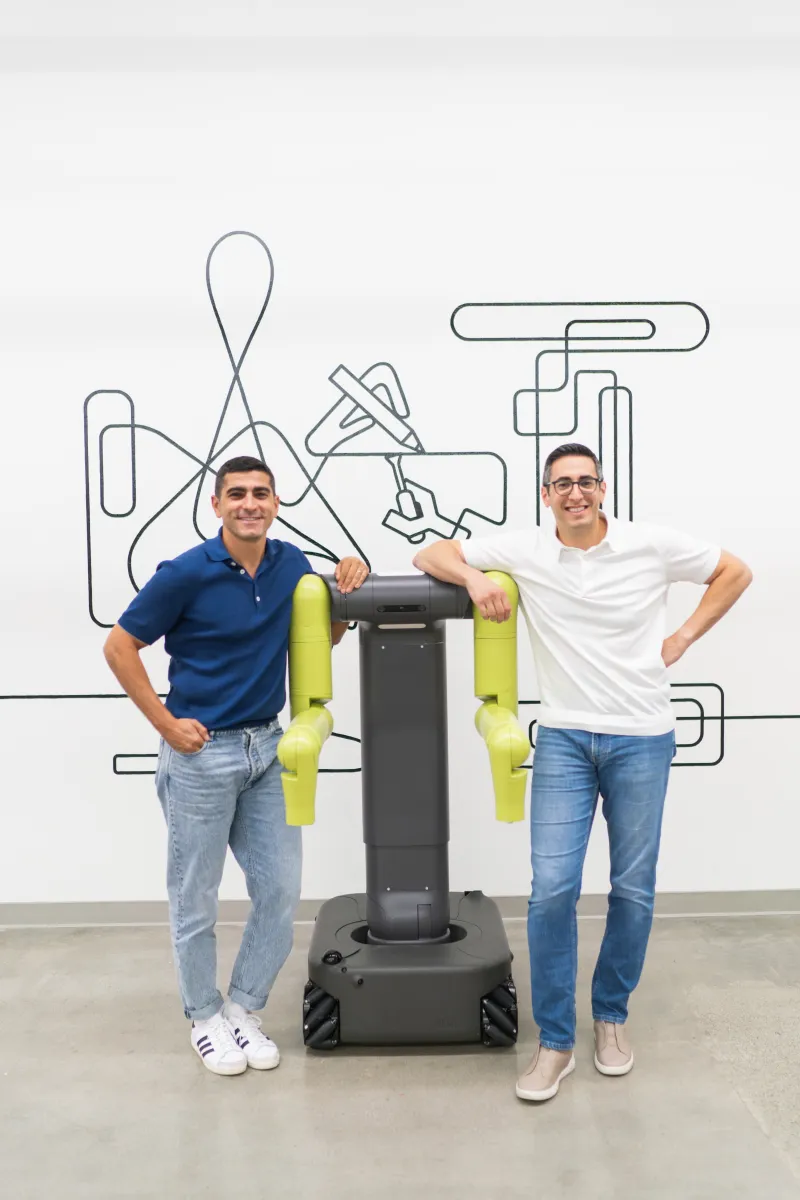
Fast forward two years, and the “cartoon of a robot” has materialized into a fleet of sophisticated machines. Maven now has as many as eight robots operating for 16 hours a day with an impressive 99% or higher uptime, a testament to their robust engineering and practical deployment. The $100 million funding round, backed by RoboStrategy, LocalGlobe, Vine Ventures, and XTX Markets Ventures, validates this success and fuels ambitious expansion plans, including building 250 third-generation robots and initiating design for a fourth-generation platform.
Maven’s robots are built for the demanding realities of industrial environments. They sit on sturdy wheeled bases, capable of navigating warehouses at speeds up to 10 miles an hour. Each unit is equipped with two arms designed to lift up to 30 kilograms, making them highly versatile for heavy-duty tasks. Their primary mission is “mixed palletizing”—a crucial and labor-intensive process in distribution centers. This involves taking wooden pallets of boxed goods, often arriving from various factories, and efficiently reorganizing them onto new pallets containing a specific mix of products for individual stores. “Within 48 hours of them putting the stuff on the shelves, they want to change the mix based on real-time demand. Here’s an order with different mixed [products] going to that retail store; please build it out. It’s all done with human labor today, running around the warehouse picking one of this, one of that,” Derbas elaborated, highlighting the immense efficiency gains their robots provide.
A visit to Maven’s Santa Clara facility offers a glimpse into this precision. In a training area, a robot executes its tasks with remarkable fluidity, using vacuum suckers to pick and arrange boxes at a steady, purposeful pace. A live video feed simultaneously displays other Maven robots diligently working in a customer facility, seamlessly coexisting with human employees, underscoring their commitment to safety and practical integration.
The Brains Behind the Bots: A Fusion of Experience
The leadership behind Maven Robotics brings a unique blend of expertise. Hamza Derbas, the CEO, spent his early career in automotive engineering, specializing in Electric Vehicles, before spending nine formative years at Apple. While he remains tight-lipped about his work there, it’s widely believed he was part of the company’s “special project group” dedicated to developing a self-driving car before its reported disbandment in 2024. It was then that he co-founded Maven with his brother, Khalid, who serves as CFO, bringing a background in private equity to the financial helm.
This connection to the self-driving car industry is not incidental. Like many leading physical AI companies, Maven heavily relies on veterans from autonomous vehicle efforts. These experts have pioneered the most sophisticated approaches to training autonomous hardware using real-world data. This involves establishing intricate data pipelines that can ingest information from operating robots within minutes or hours. This rapid feedback loop—”then retrain, evaluate, run ablation studies, figure out what’s the right set of weights, redeploy, and then turn that loop again”—is crucial for continuous improvement and operational excellence in complex, real-world environments.
In a crowded field of robotics startups, Maven sets itself apart through its unwavering focus on the practical realities of industrial operations. Jack Pearson, an investor at RoboStrategy, pointed to the company’s deep background in industrial systems as a key differentiator. Unlike many firms that might emerge from a pure research culture optimized for theoretical learning or a specific architectural design, Maven’s roots are firmly planted in the exigencies of manufacturing and logistics, ensuring their solutions are robust, reliable, and relevant from day one.
Navigating the Robot Landscape: Strategy and Future Vision
Maven’s strategic choices also define its competitive stance. While acknowledging respect for companies like Agility Robotics, which is going public via a $2.4 billion SPAC deal and also focuses on industrial workflows, Derbas offers a candid critique of their bipedal approach for specific tasks. He argues that two-legged robots “make zero sense for anything they’re doing…they are very complex, unreliable, and add unnecessary cost. ROI is the name of the game here.” This illustrates Maven’s pragmatic, cost-benefit driven philosophy: choose the simplest, most effective form factor for the task, prioritizing reliability and return on investment above all else.
While palletization represents a substantial $80 billion market, Maven’s ambition extends beyond this initial frontier. The next set of tasks the company is targeting—material handling, automation, and fabrication—will necessitate robotic manipulation capabilities that don’t yet widely exist. To achieve this, Maven acknowledges the need to evolve some aspects of its approach, potentially integrating a research culture to drive innovation beyond its current proven workflows.
Maven’s expansion strategy is meticulously planned. It involves leveraging its own proprietary systems, collaborating with third-party providers, and even developing innovative tools like pincer-like gloves that allow humans to emulate desired gripper form factors, facilitating rapid prototyping and development. While the company envisions itself as a maker of general-purpose robots, its path to that goal is deliberately task-by-task. “We’re grounded in solving one customer problem at a time,” Derbas affirmed. “If you focus on solving problems and you pick sizeable problems, each problem is a multi-billion-dollar market. If you do that, there’s plenty of data to master these skills.” This incremental yet strategic approach allows Maven to build expertise, gather critical data, and validate solutions in real-world scenarios before scaling to broader applications.
The Philosophy of Practical AI
Maven’s unique position in the robotics landscape is defined by its unwavering commitment to practical, problem-driven AI. This process, focusing on tangible industrial applications and iterative improvement, might represent the most viable path to widespread robot adoption in the workplace. It’s a calculated gamble that balances the immediate needs of industry with the accelerating pace of AI advancement. However, it also presents a potential vulnerability: the risk of being “one-shotted by the next powerful physical AI model to roll out of the frontier labs” that could render task-specific approaches obsolete.
Derbas, however, remains resolute. “We’re not in the race for models—we’re in the race to solve industrial labor and make this work possible at the scale the world needs,” he told TechCrunch. This statement encapsulates Maven’s core philosophy: a deep-seated belief that true innovation in robotics lies not in abstract AI breakthroughs alone, but in their effective deployment to solve real-world, human-centric challenges at scale.
Bottom Line
Maven Robotics’ journey from a nascent idea to a $100 million-funded industrial automation powerhouse offers a compelling blueprint for success in the competitive physical AI landscape. By prioritizing customer needs, delivering robust end-to-end solutions, and leveraging seasoned talent from the autonomous vehicle sector, Maven demonstrates that practical application and proven ROI can outmaneuver even the most advanced theoretical designs. Their focus on solving specific, multi-billion dollar industrial labor problems, rather than chasing generalized AI models, positions them uniquely to drive tangible change in warehouses and factories worldwide. As they expand beyond palletizing, Maven’s challenge will be to maintain this pragmatic edge while cultivating the innovation necessary to tackle increasingly complex tasks, proving that the future of industrial robotics is as much about grounded execution as it is about groundbreaking algorithms.
When you purchase through links in our articles, we may earn a small commission. This doesn’t affect our editorial independence.
{content}
Source:{feed_title}