
Britain Reaffirms Robust Military Presence and Commitment to Falkland Islands Defense
Armed Forces Minister Louise Sandher-Jones has affirmed Britain’s unwavering commitment to maintaining a robust air, land, and maritime military presence in the South Atlantic, deeming current force levels sufficient for the defense of the Falkland Islands. The assurance was provided in response to a written parliamentary question, underscoring the UK Government’s steadfast position on the sovereignty and security of the overseas territory.
The minister’s statement came following an inquiry from Liberal Democrat MP Clive Jones, who sought clarification on the government’s measures to ensure the security of the Falkland Islands. Sandher-Jones began by reiterating a core tenet of UK policy: the right of self-determination for the islanders.
“The UK Government is steadfast in its support for the Falkland Islanders’ right of self-determination,” Sandher-Jones stated, reinforcing London’s long-held stance. She further elaborated that the Ministry of Defence (MOD) is committed to sustaining a defensive military presence in the South Atlantic specifically for the protection of the Islands.
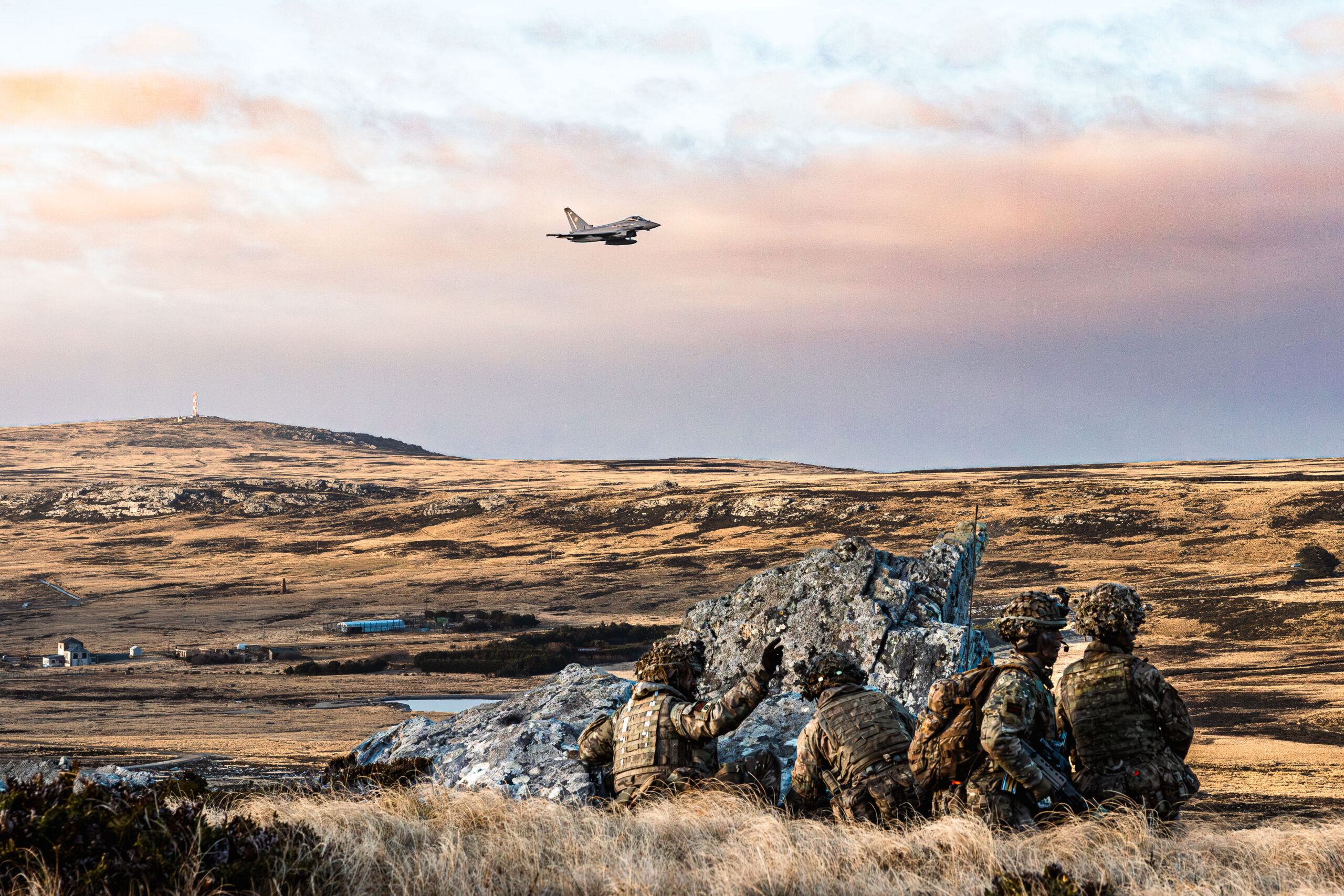
This defensive posture, according to the minister, encompasses all three traditional operating domains – air, land, and sea. It involves military personnel and capabilities permanently stationed on the Islands, supplemented by other assets that contribute to a broader defensive stance across the South Atlantic region. Sandher-Jones conveyed confidence in the current military arrangement, asserting that it is “at the appropriate level for the defence of the Islands” and subject to “constant review.” This ongoing assessment allows for potential adjustments should the strategic landscape or threat perception evolve.
The Falkland Islands remain one of Britain’s most prominently and permanently defended overseas territories. The UK’s strategy in the South Atlantic is predicated on maintaining a standing defensive presence, serving both as a deterrent against potential aggression and as a ready means of responding to any threat. This approach prioritizes proactive defense over relying solely on the ability to reinforce the territory after a crisis has already commenced.
The UK’s firm commitment to the Falkland Islands is deeply rooted in history, particularly the 1982 conflict with Argentina. That war, which resulted in significant loss of life on both sides, cemented Britain’s resolve to protect the islanders’ right to choose their own future. Argentina, however, continues to maintain its historical claim over the archipelago, which it refers to as the Malvinas, asserting that the islands were illegally occupied by Britain in 1833. This enduring dispute forms the backdrop for the UK’s sustained military vigilance.
The islanders themselves have repeatedly expressed their desire to remain a British Overseas Territory. A referendum held in 2013 saw an overwhelming 99.8% of voters choose to retain their status, with a high turnout, sending a clear message regarding their self-determination. The UK government consistently cites this expression of will as the paramount factor guiding its policy.
Beyond historical and political considerations, the Falkland Islands hold strategic importance due to their location in the South Atlantic, potentially offering access to Antarctica and vital shipping lanes. The surrounding waters are also rich in natural resources, particularly valuable fishing grounds and potential offshore oil and gas reserves, contributing significantly to the islands’ economy and further underscoring the importance of their security and stability.
The UK’s military presence, which includes elements such as Typhoon fighter jets, a naval patrol vessel, and ground troops, is designed to deter potential aggression and ensure a rapid response capability. While the specific details of force levels are not publicly disclosed, the minister’s statement assures that these capabilities are regularly assessed to meet evolving security requirements, demonstrating a blend of operational readiness and strategic foresight in a region with complex geopolitical dynamics.
Why This Matters
The British government’s reaffirmation of its robust military presence in the Falkland Islands carries significant implications on several fronts, affecting geopolitical stability, international law, and regional dynamics.
Firstly, it underscores the enduring nature of the Falklands dispute, a flashpoint that continues to shape relations between the United Kingdom and Argentina. Despite more than four decades passing since the 1982 conflict, Argentina consistently presses its sovereignty claim, including through diplomatic channels and international forums. The UK’s reiteration of its defensive posture signals that London remains prepared to defend its territorial integrity and the wishes of the islanders, indicating that a resolution to the dispute remains distant without a significant shift from either party.
Secondly, this declaration is a potent demonstration of the principle of self-determination in international law. The UK’s policy is explicitly anchored in the Falkland Islanders’ right to choose their own political status, as unequivocally expressed in the 2013 referendum. This stance serves as a precedent for other situations globally where the sovereignty of a territory is contested, emphasizing the importance of the inhabitants’ will over historical or geographical claims by a neighboring state. Conversely, it highlights the tension with the principle of territorial integrity often invoked by claimant nations.
Thirdly, the commitment reflects the UK’s broader foreign and defense policy, particularly its role as a global actor with responsibilities for its overseas territories. Maintaining a significant military presence thousands of miles from the mainland demonstrates the UK’s capacity and willingness to project power and defend its interests globally. This has implications for its alliances and its standing on the international stage, signaling reliability to its partners and a resolve to protect its sovereign territories.
Finally, for the Falkland Islanders, this assurance provides continued security and stability, allowing for the further development of their economy, which relies heavily on fishing, tourism, and potential future resource extraction. The ongoing military protection ensures the environment for their self-governance and economic prosperity, albeit under the shadow of a persistent sovereignty dispute. For Argentina, the statement reaffirms the barrier to its aspirations for the islands, likely reinforcing its diplomatic efforts to challenge British sovereignty, potentially impacting bilateral relations with the UK and its engagement with other South American nations.