
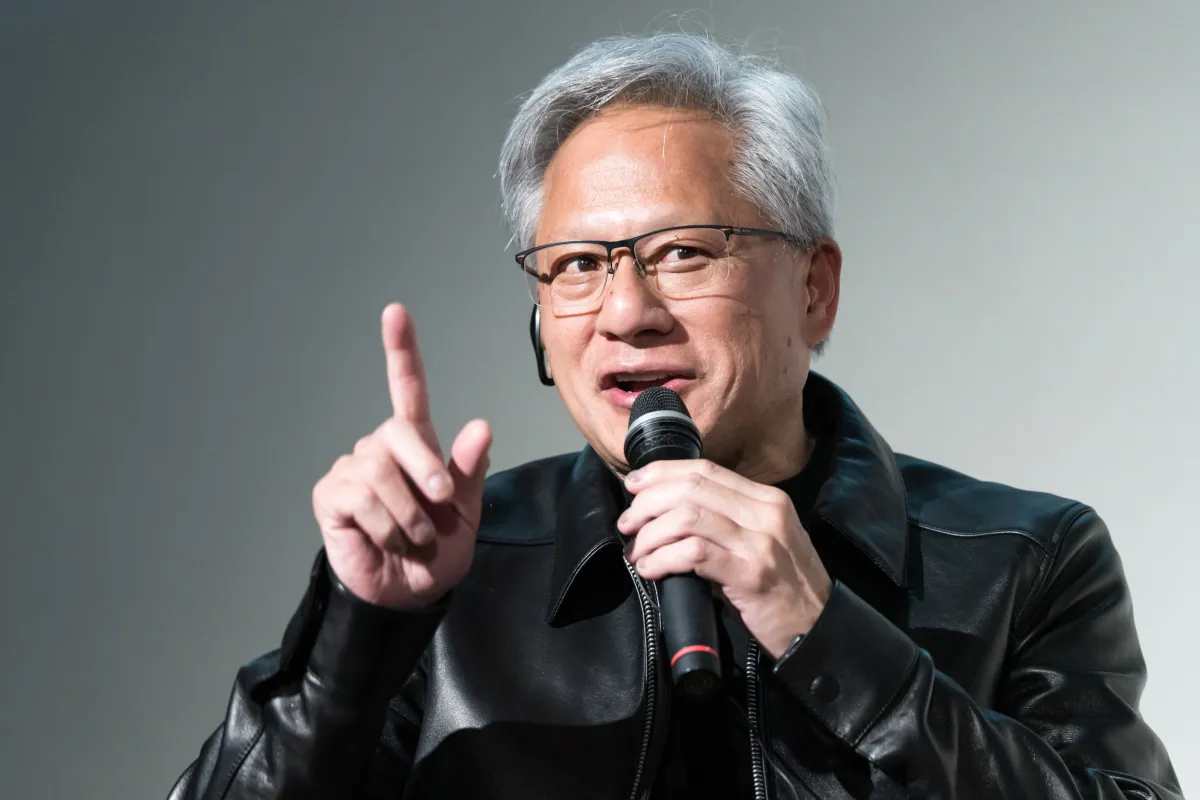
Jensen Huang made headlines Monday at the All-In conference in L.A. when President Trump called him, live, on stage. But there’s something else worth noting about his appearance. Huang, dressed in his now-signature alligator leather jacket, was handed Apple’s new foldable phone to answer it — a device that isn’t due to hit stores for another five weeks.
Flashing your unreleased hardware while chatting with the president? Not a bad flex.
Once he got Trump on speaker, the conversation turned to AI safety, and the two seemed to agree that mounting fears about AI equate to what Trump called a “hoax.” Trump argued that the real winners of the AI panic are China and “political people,” and that the technology is too big — “bigger than the internet,” he said — to slow down over. (“Did you hear that? Thousands of people are clapping,” said Huang to Trump during this same exchange.)
Whether Huang truly shares that same view or isn’t in a position to say otherwise, we’ll never know. Nvidia’s business model depends largely on AI labs buying more chips, so downplaying existential risk is the obvious move if he cares about his company’s share price. (It’s still up 33% for the past year but fell a few percentage points today.)
Either way, while everyone focused on Trump’s surprise call, a few of us noticed the $1,999 phone in Huang’s hand. And maybe that was Huang’s own message? A decade after Apple stopped putting Nvidia hardware in its own devices, it now needs Nvidia enough to run part of Apple Intelligence on it.
{content}
Key Takeaways:
- The Apple-Nvidia Reunion:Jensen Huang subtly unveiled an unreleased Apple foldable phone, signaling a significant, decade-later reconciliation and critical partnership between the tech giants for Apple Intelligence.
- Dismissing AI Safety:Huang and President Trump publicly downplayed AI safety concerns as a “hoax,” a stance that directly aligns with Nvidia’s vested interest in accelerating AI development and chip sales.
- Strategic Messaging Masterclass:Beyond the headline-grabbing phone call, Huang’s appearance was a carefully orchestrated display of power and influence, reinforcing Nvidia’s indispensable role in the burgeoning AI era.
The stage was set at the All-In conference in Los Angeles, an event typically buzzing with tech luminaries and provocative discussions. Yet, even in such an environment, Nvidia CEO Jensen Huang, ever the showman in his signature alligator leather jacket, managed to orchestrate a moment that transcended the usual industry chatter. It began with an unexpected, live phone call from former President Donald Trump, turning the spotlight onto a high-stakes conversation about artificial intelligence. But for the discerning eye, Huang delivered a dual message, subtly flashing an unreleased piece of hardware that spoke volumes about shifting power dynamics in Silicon Valley, even as he engaged in a politically charged debate about AI’s future.
The Apple Flex: A Symbolic Reunion a Decade in the Making
As President Trump’s call came through, Huang was handed what appeared to be Apple’s new foldable phone – a device purportedly not due to hit consumer markets for another five weeks. This wasn’t merely a casual choice of device; it was a potent, carefully calculated “flex.” For those in the know, this moment carried immense historical weight. A decade ago, Apple strategically moved away from using Nvidia’s graphics processing units (GPUs) in its Mac lineup, opting instead for AMD hardware and eventually developing its own powerful M-series silicon. The relationship between the two giants had largely cooled, with Apple preferring internal solutions and Nvidia dominating the PC gaming and data center markets.
The appearance of an unreleased Apple device in Huang’s hand, particularly one likely running on the very AI hardware that Nvidia specializes in, signals a critical turning point. Apple’s recent unveiling of “Apple Intelligence” – its suite of AI features – requires immense computational power, much of which will be handled both on-device and in the cloud. For Apple to potentially integrate Nvidia’s AI acceleration technology, even partially, in its new initiatives, is a tacit acknowledgment of Nvidia’s unparalleled leadership in the AI chip space. It’s a symbolic re-engagement, indicating that even the most self-sufficient tech behemoths sometimes need to tap into external expertise to stay competitive in the rapidly evolving AI landscape. For Huang, showcasing this device wasn’t just about answering a call; it was a powerful, visual statement about Nvidia’s indispensable position at the core of the AI revolution, even for its former rivals.
AI Safety: A Hoax or an Inconvenient Truth?
Once the conversation with President Trump was underway, the focus quickly shifted to the escalating debate surrounding AI safety. Trump, true to form, vehemently dismissed mounting fears about AI’s potential existential risks, labeling them a “hoax.” He argued that such concerns primarily benefit China and “political people,” suggesting they are a distraction designed to slow down a technology too transformative – “bigger than the internet,” he claimed – to be hindered. Huang, during the exchange, echoed the sentiment, noting the “thousands of people clapping” in response to Trump’s accelerationist stance.
While Huang’s genuine personal views on AI safety remain speculative, his public alignment with Trump’s narrative is strategically sound for Nvidia. Nvidia’s business model is inextricably linked to the rapid advancement and adoption of AI; the more AI labs and enterprises scale their operations, the more demand there is for Nvidia’s high-performance GPUs and AI platforms. Any sentiment that suggests slowing down AI development, whether due to ethical concerns, regulatory hurdles, or existential risk assessments, poses a direct threat to Nvidia’s growth trajectory and, consequently, its towering share price. Downplaying these risks is not just a preference; it’s a business imperative, ensuring the continued momentum that has catapulted Nvidia to unprecedented market valuations. This position places Nvidia firmly in the camp of AI accelerationists, a powerful industry voice often at odds with ethicists and researchers advocating for caution and robust regulatory frameworks.
Nvidia’s AI Imperium and Market Dynamics
Nvidia’s current market standing is nothing short of extraordinary. The company’s stock has surged, reflecting its undisputed dominance in the specialized hardware essential for training and deploying AI models. Although its share price experienced a minor dip on the day of Huang’s appearance, it remains up an astounding 33% over the past year, underscoring the insatiable demand for its chips. This demand is fueled by a global race among tech giants, startups, and even national governments to develop and deploy cutting-edge AI capabilities. Nvidia’s CUDA platform and GPU architecture have become the de facto standard, creating a powerful moat around its business.
Huang’s willingness to dismiss AI safety concerns, therefore, can be viewed through the lens of protecting and propelling this AI imperium. In a climate where regulatory debates are intensifying and calls for AI governance are growing louder, a narrative that paints caution as a politically motivated impediment serves to clear the path for continued, unchecked expansion. This strategic positioning not only reassures investors about Nvidia’s future prospects but also shapes the broader industry discourse, pushing for an unencumbered march toward advanced AI, with Nvidia’s hardware as its foundational engine.
Beyond the Headlines: Huang’s Calculated Moves
Jensen Huang’s appearance at the All-In conference was far more than a casual chat with a former president or a fleeting product placement. It was a masterclass in strategic communication, delivering a powerful, two-pronged message. On one hand, the unreleased Apple foldable phone served as an undeniable testament to Nvidia’s renewed and critical relevance, even to companies that once sought to minimize their reliance on external hardware. It underscored the reality that in the age of AI, specialized silicon is king, and Nvidia wears the crown.
On the other hand, Huang’s tacit endorsement of Trump’s “AI hoax” narrative was a clear signal of Nvidia’s unwavering commitment to an accelerated, unhindered AI future. It reinforced the company’s stance as a primary beneficiary and proponent of rapid AI development, positioning itself against any forces that might seek to slow its progress. These seemingly disparate moments converged to paint a clear picture: Jensen Huang is not just leading a chip company; he is actively shaping the narrative and the trajectory of the entire AI industry, asserting Nvidia’s power and influence with every calculated move.
Bottom Line:
Jensen Huang’s appearance at the All-In conference was a carefully orchestrated display of strategic power. By subtly revealing an unreleased Apple foldable phone and publicly aligning with President Trump’s dismissal of AI safety concerns, Huang delivered a dual message: Nvidia is not just a chip provider, but an indispensable partner even to former rivals, and it is firmly committed to accelerating an unhindered AI future. This calculated performance reaffirmed Nvidia’s dominance, shaped the industry narrative, and underscored its pivotal role at the heart of the ongoing AI revolution.
Source:{feed_title}