
Unlock the White House Watch newsletter for free
Your guide to what Trump’s second term means for Washington, business and the world
Key Takeaways:
- **Heightened Geopolitical Risk:** Financial ties between U.S. political figures and individuals linked to adversarial states like Russia introduce significant geopolitical uncertainty, potentially impacting U.S.-Russia relations and investor risk premiums.
- **Increased Regulatory Scrutiny:** The lavish nature and source of the gift are likely to intensify scrutiny from Congressional oversight bodies and financial regulators, particularly concerning foreign influence, anti-money laundering (AML) protocols, and politically exposed persons (PEPs).
- **Political Volatility Ahead of 2024:** Such revelations contribute to market volatility by fueling concerns over political stability, governance integrity, and potential foreign policy shifts, especially as the U.S. approaches a critical election cycle.
Russian Funding for Trump Jr. Wedding Party Sparks Market Concerns Over Geopolitical Entanglement
In a development poised to ripple through financial markets, a Russian businessman with reported ties to Vladimir Putin bankrolled the lavish after-party for Donald Trump Jr.’s recent wedding in the Bahamas. This disclosure quickly elevated questions about potential foreign influence within a prominent American political family, injecting a fresh layer of geopolitical risk into an already volatile U.S. political landscape and raising red flags for investors tracking Washington’s intricate power dynamics.
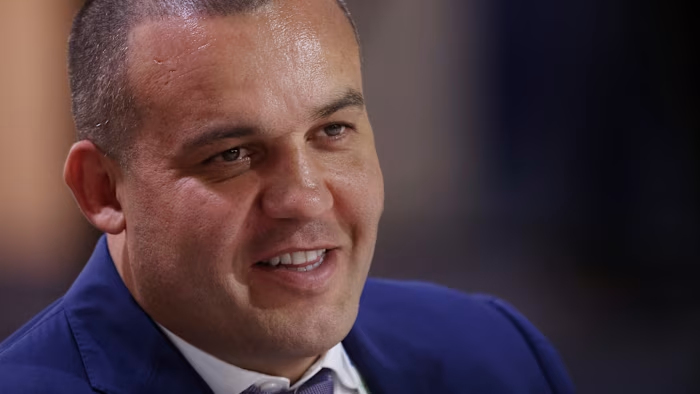
Donald Trump Jr. and his wife Bettina Anderson publicly acknowledged the generosity of “our dear friend Umar [Kremlev]” via Instagram on Monday, thanking him for hosting “two incredible nights of celebrations.” Their post, which seemed to confirm earlier U.S. media reports, described the gesture as an “extraordinarily generous wedding gift from a friend, and something for which we were and remain incredibly grateful.” While presented as a personal matter, the source and scale of such a gift, particularly given the recipient’s political lineage and the donor’s background, immediately transcend the realm of private celebration to become a subject of considerable market and regulatory interest.
Umar Kremlev, the head of the International Boxing Association (IBA), is widely reported to be close to Russian President Vladimir Putin. His association includes awarding Putin a diamond boxing glove and subsequently receiving the Order of Merit to the Fatherland from the Russian leader, according to reports by the Washington Post. Furthermore, Kremlev’s reported past membership in the nationalist biker gang, the Night Wolves—a group known for its staunch support of Putin and its involvement in conflicts linked to Russian foreign policy objectives—adds another dimension of complexity and potential geopolitical sensitivity to the relationship. This background suggests a network of influence far beyond typical business dealings, raising questions for market participants about the nature and extent of any potential future leverage or access.
The lack of a longstanding public relationship between Kremlev and Donald Trump Jr. has fueled further speculation. A spokesperson for Eric Trump, Donald Trump Jr.’s brother, reportedly claimed he did not know Kremlev, according to ProPublica, which first broke the story. This absence of a clear, established connection between the two men intensifies the “what for?” question from both political watchdogs and financial analysts. For investors, such opaque financial dealings involving politically exposed persons (PEPs) are inherently risky, demanding enhanced due diligence and raising concerns about potential compliance breaches, including anti-money laundering (AML) regulations and foreign agent registration requirements.
Congressional Democrats were quick to seize on the revelations. Robert Garcia, the top Democrat on the U.S. House oversight committee, publicly questioned the transaction on X, stating, “Umar Kremlev spent hundreds of thousands of dollars on the president’s son. What did he get in return? We need answers.” This line of inquiry is not merely political; it signals potential future investigations that could expose sensitive information, impose legal costs, and create significant reputational damage, all factors that can weigh on investor sentiment and corporate valuations linked to the individuals or entities involved.
In their Instagram defense, Bettina and Donald Trump Jr. expressed regret that “something so personal and happy can be recast as something political or sinister simply because of who someone is or where they come from.” They insisted, “Friendship doesn’t require a political motive. Generosity doesn’t automatically come with an agenda,” concluding with a firm assertion: “NO CONSPIRACY, NO MYSTERY.” While these statements aim to de-politicize the gift, in an environment of heightened U.S.-Russia tensions and ongoing concerns about foreign interference in American politics, such explanations may do little to assuage the skepticism of national security experts, congressional oversight committees, or indeed, the broader market that values transparency and accountability above all else.
For financial institutions, the incident underscores the persistent challenge of managing risk associated with PEPs and their associates. Any banks or wealth management firms involved in facilitating transactions for individuals linked to such politically charged situations face increased regulatory scrutiny and potential reputational damage. The choice of the Bahamas, an offshore financial center, as the location for the festivities further complicates the optics, even if the jurisdiction played no direct role in the financial transaction itself. The entire episode serves as a stark reminder for investors of the non-market risks – political, regulatory, and reputational – that can emerge unexpectedly and impact financial stability.
Market Impact:
The disclosure of a significant financial tie between a prominent U.S. political figure and an individual linked to a geopolitical adversary is set to amplify market uncertainty. Investors are likely to price in an increased geopolitical risk premium, particularly for sectors sensitive to U.S.-Russia relations or those heavily reliant on stable international trade and political environments. The prospect of intensified congressional and regulatory investigations could weigh on sentiment, potentially leading to increased volatility in U.S. equities, especially those perceived to be susceptible to shifts in U.S. foreign policy or domestic political scandal. Furthermore, the episode highlights governance risks and the potential for a weakening of institutional trust, which can dampen foreign direct investment and overall market confidence ahead of the critical 2024 election cycle. Financial institutions, particularly those with global reach and exposure to PEPs, will face renewed pressure to bolster their compliance frameworks and risk assessment protocols, potentially leading to higher operational costs and a more cautious approach to client onboarding.