
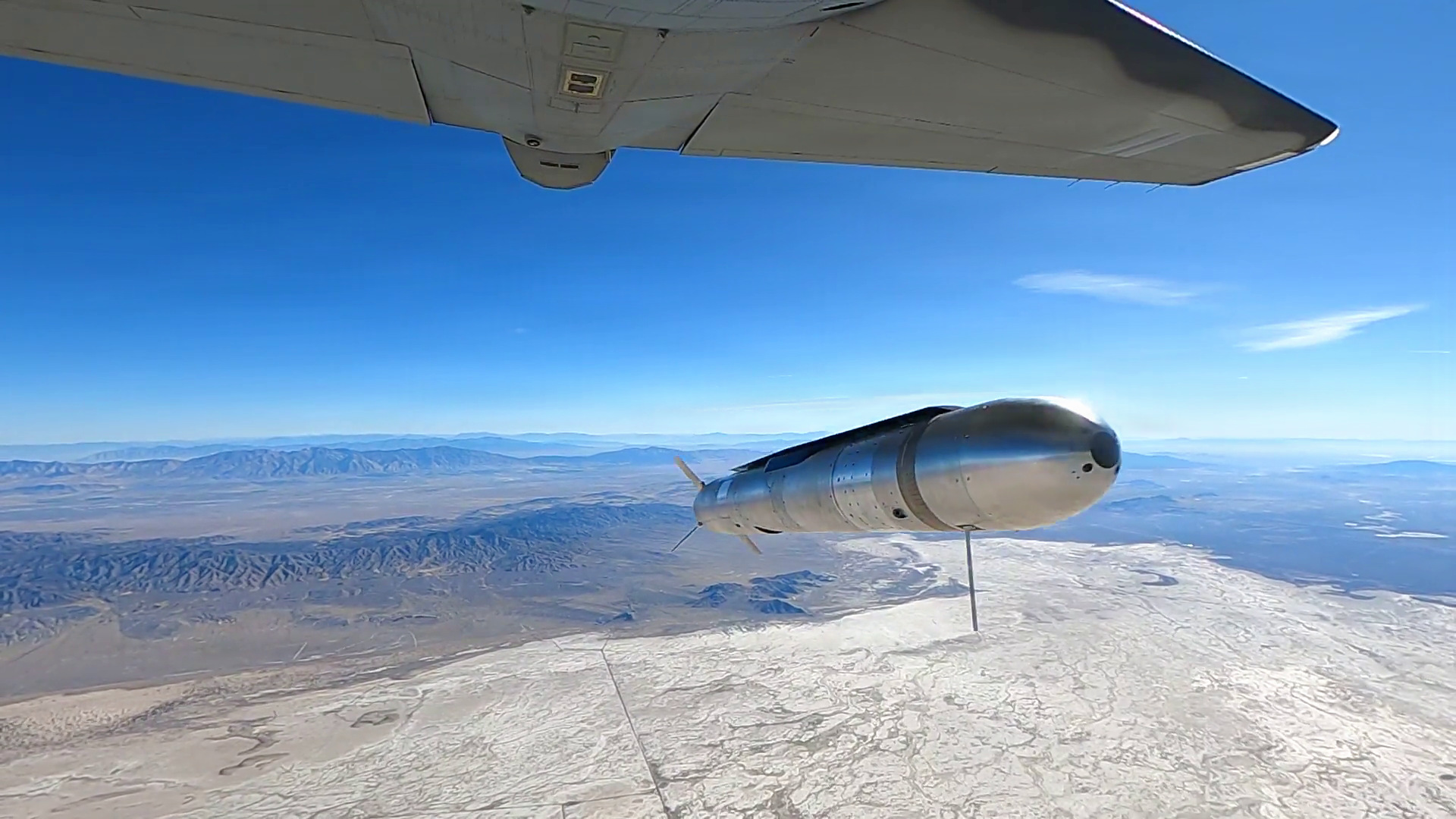
NATIONAL HARBOR, Md.—The U.S. Air Force Special Operations Command (AFSOC) has announced the successful combat validation of a new, low-cost cruise missile, the AGM-190A Havoc Spear. The missile was fired from an AC-130J gunship during combat operations in the U.S. Africa Command (AFRICOM) area of responsibility, confirming its safety, accuracy, and operational readiness for broader military use.
In an announcement on September 14, AFSOC confirmed that the combat test validates the Havoc Spear’s readiness for “broader real-world use.” This milestone represents a significant step in the Pentagon’s drive to increase its inventory of affordable, high-volume weapons, known as “combat mass.”
Developed by defense contractor Leidos, the AGM-190A Havoc Spear, initially nicknamed “Black Arrow,” is a lightweight weapon, falling into the 200-pound class. Despite its compact size, it boasts an impressive range of over 400 nautical miles (approximately 460 miles or 740 kilometers), offering a substantial standoff capability for engaging distant targets.
During a roundtable discussion with reporters prior to the public announcement, AFSOC officials disclosed that two AGM-190A missiles were launched this past spring. These firings targeted two “validated ground targets” within the AFRICOM area of responsibility. While specific details about the nature or exact location of these targets were not provided, AFSOC unequivocally stated that the evaluations proved the missile to be “accurate, reliable, and operationally ready.”
Colonel Robert Johnston, director of strategic plans, programs, and requirements at AFSOC, highlighted the strategic importance of the new weapon. “Havoc Spear gives commanders the essential standoff capability to neutralize threats without putting our personnel and platforms in immediate danger, and it’s also proving its tactical value on the battlefield,” Johnston explained. This capability allows forces to engage targets from a safe distance, significantly reducing the risk to aircrews and expensive aircraft.
The Havoc Spear is part of a growing family of low-cost cruise missiles that defense industries have been developing in recent years. This trend is a direct response to the Pentagon’s strategic requirement for greater “combat mass”—the ability to field a larger quantity of weapons, even if individually less advanced or costly, to overwhelm enemy defenses or provide more operational flexibility than a smaller number of highly expensive, “exquisite” systems.
The missile’s development history dates back to 2021, leveraging Leidos’s prior experience with precision munitions, including the GBU-69 Small Glide Munition. To advance the Havoc Spear, Leidos entered into a Cooperative Research and Development Agreement (CRADA) in 2022 with U.S. Special Operations Command (SOCOM) and AFSOC. This collaborative effort culminated in the recent combat evaluation, approximately four years after the program’s inception.
Following the successful development and testing, SOCOM moved to expand its acquisition. In July, the command awarded Leidos a $27.2 million contract for the production of 45 Havoc Spear missiles. This initial low-rate initial production (LRIP) contract places the average cost of each missile at approximately $600,000 per unit. AFSOC officials, however, anticipate a substantial reduction in this unit cost as production scales up, potentially dropping by as much as two-thirds once full-rate production is achieved. The ultimate cost efficiency will largely depend on the volume of future orders.
AFSOC harbors ambitious long-term plans for the Havoc Spear, aiming for its integration not only across various special operations platforms but also potentially across the entire U.S. Air Force. “Our ultimate goal is to try to get this on every type of SOF platform, as well as conventional platform possible, in multiple launch modes,” Colonel Johnson stated, emphasizing the desire for widespread adoption.
The missile’s design incorporates versatility in launch methods. While successfully demonstrated via launch tubes from the ramp of an AC-130J gunship, it is also designed to be mounted on pylons or configured as a palletized system for deployment from larger cargo aircraft. Furthermore, its payload capacity is modular, opening up possibilities for various mission-specific warheads or sensors.
The initial batch of 45 missiles from the July contract, expected to be delivered by next fall, will primarily be utilized for further developmental testing rather than immediate operational deployment. “We’re still doing further development on other platforms and other launch mechanisms, and so we’ll use that initial tranche to try to get after more development than employment,” Johnson clarified.
Identifying which special operations aircraft will next integrate the Havoc Spear remains uncertain, largely due to ongoing operational demands. “To be quite honest, with current operations, we have to piecemeal what assets we can actually employ and get test dates on,” Johnson explained, highlighting the challenges of scheduling developmental tests amidst active global operations.
In the long term, AFSOC envisions the Havoc Spear as a potential component of the Air Force’s larger “Family of Affordable Mass Missiles” (FAMM) program. FAMM is a significant, Air Force-wide initiative focused on rapidly developing and mass-producing more economical air-to-ground missiles. This strategic pivot aims to build a larger inventory of weapons that can be deployed in greater numbers, enhancing overall combat capability.
In July, the Pentagon announced framework agreements under the FAMM program for multiyear production of several other similar missiles, including Anduril’s Barracuda, CoAspire’s Rapidly Adaptable Affordable Cruise Missile (RAACM), and Zone 5 Technologies’ AGM-188 Rusty Dagger. Through these combined efforts, the Air Force projects acquiring up to 8,000 such missiles annually once production fully ramps up, with budget projections indicating plans to acquire as many as 28,000 over the next five years. This collective strategy underscores a fundamental shift in military procurement, prioritizing quantity and cost-effectiveness alongside advanced technological capability to meet future defense needs.
Why This Matters
The successful combat validation of the AGM-190A Havoc Spear marks a pivotal moment for U.S. military strategy, defense procurement, and global security. Its significance can be understood through several key lenses:
1. Shifting Military Strategy and Doctrine:The introduction of the Havoc Spear aligns with a profound evolution in U.S. military thought, particularly emphasizing “standoff capability” and “combat mass.” Standoff capability means forces can engage targets from greater distances, significantly reducing risk exposure for personnel and high-value aircraft. The pursuit of “combat mass” signifies a strategic pivot towards acquiring a large volume of affordable weapons, enabling the military to overwhelm adversaries or maintain sustained pressure, rather than relying solely on a smaller number of extremely expensive, high-end systems. This shift could fundamentally alter how the U.S. military plans and executes operations in complex geopolitical environments.
2. Cost-Efficiency and Defense Procurement:At an initial projected cost of $600,000 per missile (with expectations for significant reduction), the Havoc Spear represents a more budget-friendly alternative to many traditional cruise missiles, which can cost millions of dollars each. This focus on affordability, exemplified by the broader Family of Affordable Mass Missiles (FAMM) program, signals a strategic commitment to sustainable defense spending. It has the potential to influence future defense budgets and acquisition processes, encouraging innovative, cost-effective weapon system development from the defense industrial base and ensuring greater numbers of precision munitions can be acquired within fiscal constraints.
3. Enhanced Capabilities for Special Operations:For Air Force Special Operations Command (AFSOC), the Havoc Spear substantially augments its operational toolkit. Integrating a long-range cruise missile into platforms like the AC-130J gunship, and potentially other special operations aircraft, provides critical new options for precision strike, intelligence, surveillance, and reconnaissance (ISR), and close air support missions. The missile’s versatile launch methods (ramp-fired, pylon-mounted, palletized) and modular payload capability offer unparalleled tactical flexibility, allowing special operators to adapt rapidly to diverse and evolving threat landscapes globally.
4. Implications for Global Security and Adversaries:The development and prospective widespread deployment of such missiles send a clear message to potential adversaries. A U.S. military capable of fielding a high volume of relatively inexpensive, long-range precision weapons from a variety of platforms presents a complex and formidable challenge. This capability could significantly complicate adversary air defense strategies, forcing them to invest more heavily in countermeasures. Ultimately, the Havoc Spear bolsters U.S. deterrence and influence in regions where special operations forces are active, such as the U.S. Africa Command area of responsibility, and contributes to maintaining a qualitative and quantitative edge.
5. Innovation and Industry Trends:The Havoc Spear’s journey from Leidos’s development under a Cooperative Research and Development Agreement (CRADA) to its successful combat validation highlights the increasing importance of public-private partnerships and rapid prototyping in military innovation. This model demonstrates a trend where defense contractors are incentivized to produce highly effective yet less “exquisite” (complex and expensive) weapons. Such an approach fosters a more competitive and dynamic defense industrial base, which can accelerate the fielding of new technologies and ensure U.S. forces retain a continuous advantage against evolving threats.