
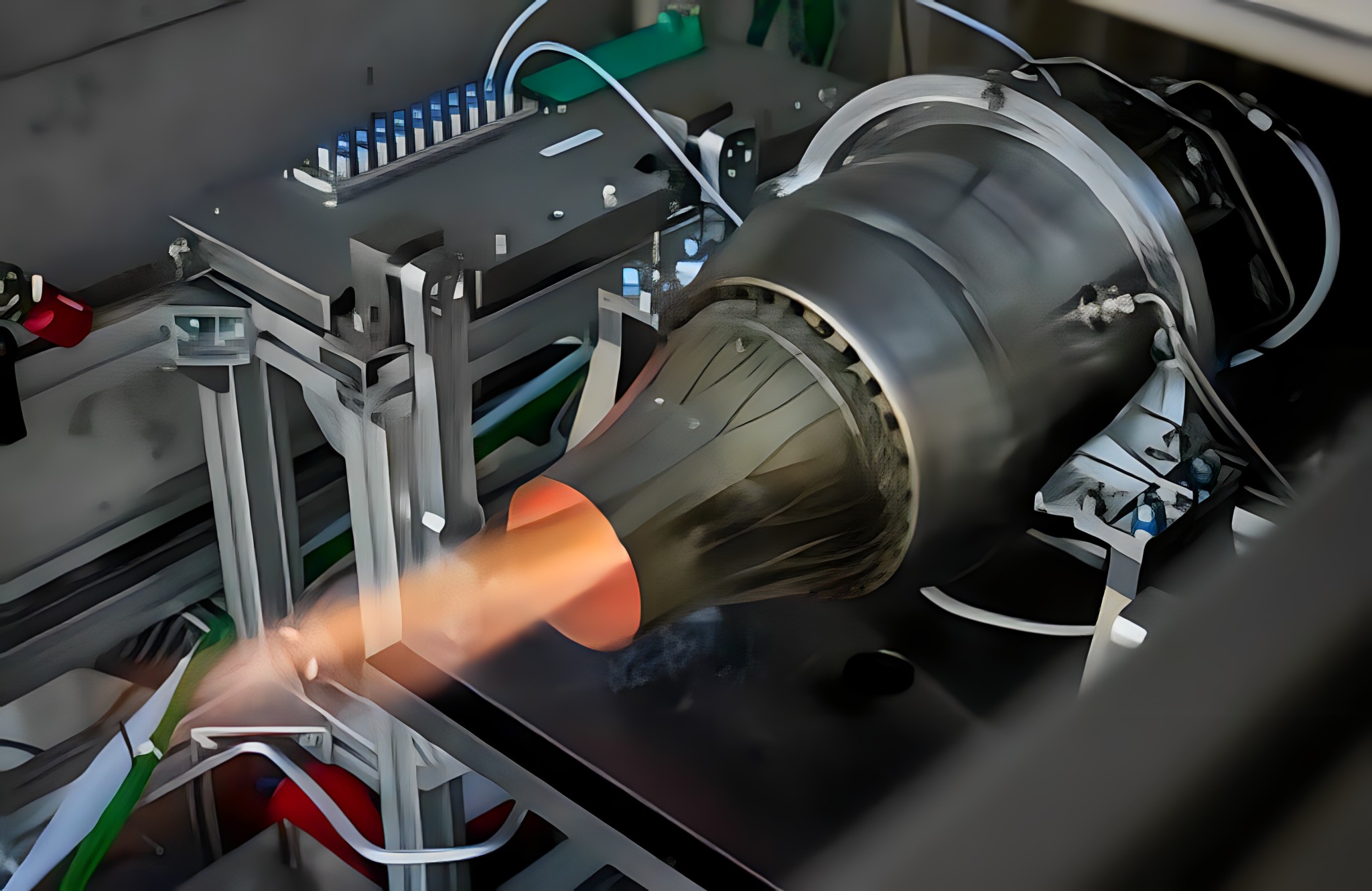
UK Unveils New Family of Domestically Produced Turbojet Engines, Enhancing Defense Capabilities
The United Kingdom has announced the successful development of a new family of domestically produced turbojet engines, marking a significant step towards establishing sovereign propulsion capabilities for its future defense systems. One notable achievement includes taking a larger engine design from initial concept to flight-ready status in less than seven months, while a smaller engine is already entering serial production.
This ambitious program is a collaborative effort between the Ministry of Defence’s Strategic Capabilities Office and UK-based start-up Alloyed. The initiative combines direct government investment with matched funding from the company, strategically aimed at cultivating a fully sovereign British capability in propulsion technology for a range of future weapons platforms and aircraft.
The newly developed engine family is designed to produce thrust levels ranging from 30 Newtons (N) to 2,000 Newtons. This broad spectrum of power output positions the technology for diverse applications, from relatively small uncrewed aerial vehicles (UAVs) to larger, more complex defense systems.
Key milestones have already been achieved, demonstrating the program’s rapid progress and effectiveness. A 300N-class engine has successfully completed its flight testing phase and has now transitioned into serial production within the UK. Concurrently, a larger 1,100N-class design showcased an accelerated development timeline, moving from its initial conceptualization to a flight-ready state in under seven months—a testament to the program’s innovative approach and efficiency.
According to the Government, this initiative has successfully cultivated the comprehensive capability to design, manufacture, test, and provide ongoing support for this class of engine entirely within the United Kingdom. This domestic capacity is crucial for mitigating reliance on potentially vulnerable overseas propulsion supply chains, thereby enhancing national security and strategic autonomy.
Defence Readiness and Industry Minister Luke Pollard emphasized the speed and effectiveness of the partnership, stating,“Taking a jet engine from concept to flight-ready in just a matter of months shows how defence and industry can work together to deliver capabilities at the speed required by today’s world.”
Minister Pollard further highlighted the strategic imperative behind the program:“The threats we face demand the ability to produce cutting-edge technology on demand and at scale – this programme delivers that, combining sovereign manufacturing, digital engineering and industrial innovation to ensure our Armed Forces retain an operational advantage, while delivering good jobs for working people here in the UK.”
Digital Design and Agile Production
A core element of this development has been the adoption of a digitally led engineering and manufacturing process. This innovative methodology is specifically designed to significantly reduce the elapsed time between initial design conceptualization, rigorous testing, and eventual production, streamlining the entire development lifecycle.
Beyond the physical engines themselves, the program has established a robust, UK-based digital design and modeling capability. The Government anticipates that this advanced infrastructure will enable the development of entirely new propulsion systems and variants in a matter of months, rather than the years typically associated with such complex engineering projects.
The approach integrates sophisticated digital engineering tools with a modular design philosophy. This allows individual components or subsystems of an engine to be modified, upgraded, or replaced independently, without necessitating a complete redesign of the entire propulsion system. This flexibility is vital for rapid adaptation to evolving operational requirements.
Michael Holmes, chief executive of Alloyed, underscored the impact of the collaboration:“Working alongside the Ministry of Defence has enabled Alloyed to bring to bear its world-leading metals technologies to mature and demonstrate advanced propulsion systems at remarkable pace while building a lasting capability in the UK.”
He added,“This programme shows the power of combining defence expertise, digital engineering and industrial innovation.”
The wide thrust range of 30N to 2,000N ensures that the underlying technology can be scaled and applied across systems of vastly different sizes and operational profiles. Furthermore, the inherent modular architecture is a critical feature, designed to facilitate easier future adaptations and upgrades as defense requirements continue to evolve.
Expanding Production and Economic Impact in Britain
The program has already generated significant economic benefits, creating more than 60 new engineering and advanced manufacturing jobs within the UK. The Government projects that an additional 45 positions will be created over the next 12 months as production volumes increase to meet demand. This growth extends beyond direct employment, involving a network of over 40 suppliers across the UK, a majority of which are small and medium-sized businesses (SMEs), bolstering the wider industrial ecosystem.
This co-development model represents a departure from conventional defense procurement processes, where the Ministry of Defence typically specifies and purchases a finished system from an industrial partner. Instead, the Strategic Capabilities Office and Alloyed have jointly funded and developed the technology from its nascent stages, a strategy intended to shorten development cycles, foster innovation, and critically, retain the resulting industrial capability and intellectual property within Britain.
The Government explicitly stated that this program aligns with key commitments outlined in the Strategic Defence Review. These commitments include strengthening the domestic defense industrial base, promoting technological sovereignty, and significantly increasing the speed at which new defense technologies can be developed, tested, and deployed to frontline forces.
Looking ahead, there is also a clear export ambition for this advanced propulsion technology. Ministers have indicated that the engines could eventually be offered to allied nations seeking domestically supportable or resilient engine solutions for their own defense platforms. However, specific export customers or overseas programs have not yet been publicly announced.
For the immediate future, the most tangible outcomes are the successful transition of the 300N-class engine into serial production and the remarkably swift development of the larger 1,100N design. These achievements collectively establish a vital new domestically based turbojet development and manufacturing capability for Britain, capable of supporting a much wider family of future defense systems and strengthening the nation’s strategic industrial resilience.
Why This Matters
The United Kingdom’s successful development and rapid progression of a new family of domestically produced turbojet engines represents a significant advancement with profound implications for national security, economic resilience, and strategic autonomy. This initiative addresses several critical challenges facing modern defense and industrial policy.
Strategic Sovereignty and Security:At its core, this program is about reducing the UK’s reliance on overseas propulsion supply chains. In an increasingly volatile geopolitical landscape, the ability to design, manufacture, test, and support critical defense components like jet engines domestically is paramount. It mitigates vulnerabilities to supply chain disruptions, geopolitical pressures, or export restrictions from other nations, thereby enhancing the UK’s strategic independence and national security posture. This ensures that the UK can equip its armed forces with cutting-edge technology without external dependencies.
Accelerated Innovation and Defense Readiness:The speed at which these engines have been developed – particularly the 1,100N-class engine moving from concept to flight-ready in under seven months – is a testament to the efficacy of the digitally led engineering and modular design approach. This rapid innovation cycle is crucial for maintaining an operational advantage against evolving threats. It allows the UK’s armed forces to field new capabilities more quickly, adapting to changes in the strategic environment with greater agility than traditional procurement models.
Economic Growth and Industrial Base Strengthening:Beyond direct defense applications, the program injects significant vitality into the UK’s advanced manufacturing and engineering sectors. The creation of over 60 direct jobs, with another 45 anticipated, along with the involvement of more than 40 UK-based small and medium-sized enterprises, highlights a tangible economic boost. This fosters high-skill job creation, strengthens the domestic industrial base, and promotes investment in critical technological capabilities, contributing to the UK’s broader economic resilience and innovation ecosystem.
New Model for Defense Procurement:The co-development model, jointly funded by the Ministry of Defence and Alloyed, could set a precedent for future defense projects. This collaborative approach prioritizes speed, shared risk, and the retention of intellectual property and manufacturing capabilities within the UK, offering a potentially more efficient and strategically advantageous alternative to traditional procurement methods. It signifies a shift towards more agile and adaptive defense industrial strategies.
Export Potential and Global Influence:The long-term ambition to export these propulsion technologies to allied nations carries significant geopolitical weight. It positions the UK not just as a consumer, but as a producer and potential supplier of advanced defense technology, enhancing its influence within international defense markets and strengthening alliances by offering resilient and domestically supportable solutions to partners.
In essence, this development is more than just about new engines; it represents a strategic investment in the UK’s future security, technological leadership, and economic prosperity, allowing it to navigate a complex global landscape with greater confidence and capability.