
Stay informed with free updates
Simply sign up to the Russian politics myFT Digest — delivered directly to your inbox.
Key Takeaways:
- Entrenchment of War Economy:The significant influx of Ukraine war veterans into Russia’s parliament signals a deeper institutionalization of the conflict, suggesting a prolonged commitment to military objectives that will continue to dictate fiscal policy, resource allocation, and overall economic strategy, prioritizing defense over consumer-driven growth.
- Heightened Geopolitical Risk & Isolation:The Kremlin’s successful consolidation of power, marked by the pro-war parliament and suppression of dissent, reinforces an intransigent stance against Western pressures. This implies sustained or even intensified sanctions regimes, continued market decoupling, and a higher geopolitical risk premium for any entities operating in or exposed to the Russian economy.
- Structural Economic Shifts:The promotion of a “new elite” from military ranks, coupled with the ongoing “struggling economy” and suppression of independent political voices, points towards a further shift away from market liberalization. Expect greater state control, potential nationalization risks, and a diminished environment for private sector innovation and foreign direct investment, with resources channeled predominantly into state-backed strategic industries.
Beyond the immediate headlines of Russia’s internal political machinations, the recent parliamentary elections — the first since Vladimir Putin’s full-scale invasion of Ukraine began in 2022 — offer critical insights for financial markets. The Kremlin’s leading party, United Russia, has not only secured its best-ever result but will also seat nearly 50 veterans of the Ukraine conflict in the Duma, the lower house of parliament. This development, far from being a mere domestic political footnote, serves as a stark market signal regarding Russia’s future economic trajectory, its geopolitical posture, and the sustained risk premium associated with its assets.
United Russia, unequivocally backed by President Putin, is projected to command roughly 58 percent of the vote, with its general secretary Vladimir Yakushev confirming that 49 Ukraine war veterans will now occupy seats in the Duma. This heavy presence of individuals whose previous service has, in some cases, been linked to units accused of war crimes, is a deliberate strategic move by the Kremlin. It aims to solidify public support for the protracted invasion, now in its third year, by embedding a pro-war narrative directly into the legislative body. For investors, this move underscores a hardening stance, signaling the Kremlin’s unwavering commitment to its military objectives and, by extension, a sustained allocation of national resources towards the defense sector at the expense of other economic areas. This prioritization will likely manifest in continued elevated government spending, potentially fueling inflation and diverting skilled labor and capital from consumer-facing industries, further distorting the market landscape.
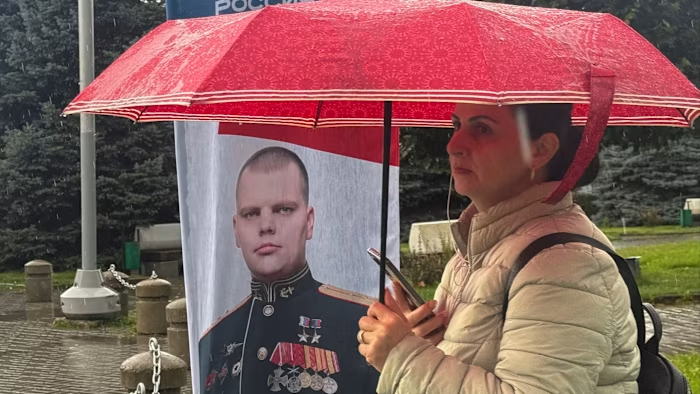
The integration of these veterans is not an ad-hoc occurrence but a meticulously managed process. Over 100 veterans have emerged from “Time of Heroes,” a Kremlin-sponsored program designed to fast-track former soldiers into mid-ranking government and state-company positions. This initiative, while superficially resembling Western public policy academies, functions as a mechanism to cultivate a “new elite” loyal to the regime and its wartime agenda. Analysts interpret this as an attempt to bolster the war’s legitimacy while maintaining tight control over the political process. From a market perspective, the rise of such an elite signals a further consolidation of state power and a potential erosion of any remaining vestiges of independent economic policy-making. Decisions are likely to be increasingly driven by geopolitical expediency rather than pure market efficiency, impacting sectors from energy and technology to finance and consumer goods. Companies still operating within Russia or with significant exposure must contend with this enhanced political risk and the implied shift towards a command-and-control economic model, where state directives often supersede market forces. This environment increases the risk of arbitrary policy changes and asset seizures.
The urgency behind these maneuvers stems from declining public support for the war, a trend exacerbated by Ukraine’s intensifying drone strikes, a struggling national economy, and widespread internet blackouts. These factors have brought the tangible consequences of the conflict closer to home for many Russians, particularly in major urban centers. In response, the Kremlin has deliberately tied President Putin more directly to United Russia, a departure from previous strategies aimed at shielding him from the party’s often-poor approval ratings. This direct linkage reinforces the perception of an authoritarian leader doubling down, a posture that financial markets typically view with apprehension due to its implications for transparency, rule of law, and macroeconomic stability. The “struggling economy” noted in the original report manifests in various market indicators, including persistent inflationary pressures, stagnant real wages, and a declining long-term growth outlook, further compounded by capital flight and diminished foreign direct investment. This scenario creates a challenging operating environment for both domestic businesses and any remaining foreign entities.
Further cementing this trajectory, Russia’s Supreme Court removed Yabloko, the sole party expressing even mild opposition to the war, from the ballot. This effectively eliminated any semblance of genuine political competition, leaving voters with a choice between ideologically aligned “puppet parties,” all of whom endorse the war and feature military candidates. As political scientist Andrei Kolesnikov bluntly stated, “We know where decisions are made and whose job it is to rubber-stamp them. Who cares who rubber-stamps them.” For markets, the absence of political pluralism equates to a lack of checks and balances, potentially leading to more unpredictable or arbitrary policy decisions. This environment deters both domestic and international investors, who seek predictability and institutional strength. The consolidation of power and suppression of dissent underscore Russia’s growing political isolation, mirroring its economic decoupling from Western markets and reinforcing the perception of Russia as a high-risk investment destination with limited future integration prospects.
While Yakushev initially suggested 86 war veterans would be seated, the corrected figure of 49 still ensures a substantial pro-war bloc, potentially even surpassing the representation of the Communist Party, which came second with approximately 40 seats. The precise final number remains fluid as parties finalize their lists, with senior figures like Foreign Minister Sergei Lavrov and Moscow Mayor Sergei Sobyanin – whose name recognition bolstered United Russia’s vote – likely to yield their seats. This could further increase the veteran contingent. However, political scientists like Mikhail Komin note that voter enthusiasm for veteran candidates is not inherently strong, suggesting their inclusion is more about fulfilling Putin’s directive to elevate them rather than a genuine electoral boost. This observation highlights the top-down nature of this political engineering, rather than a grassroots movement, which means economic policy will continue to be centrally dictated with little public input, increasing the likelihood of economically inefficient decisions driven by political loyalty.
This push to elevate veterans is not without its internal tensions. Russia’s existing elite has demonstrated reluctance to cede control, as evidenced by some veteran lawmakers being high-ranking officers or “Heroes of Russia,” while others are long-time politicians who have opportunistically rebranded themselves as combatants. The case of Vitaly Milonov, a United Russia lawmaker accused of treating army service as a public relations stunt while simultaneously participating in parliamentary debates, exemplifies this friction. Furthermore, the broader “Time of Heroes” program has seen its momentum stall, with nearly 90 percent of participating regions failing to take on new participants for a year or more. Political scientist Kolesnikov warns that “These contradictions could start to show themselves more fully after the war, when those who return from the front start jockeying for position with civilian officials.” Such internal power struggles, while not immediately visible to external markets, pose a long-term risk to Russia’s political and economic stability, potentially leading to policy inconsistencies or even periods of internal unrest that could impact capital flows, investor confidence, and the ruble’s stability. Any significant internal power shift could introduce another layer of uncertainty for an already beleaguered economy.
Market Impact:
The outcome of Russia’s recent parliamentary elections, culminating in a significant influx of Ukraine war veterans into the Duma, sends an unambiguous signal to global financial markets: Russia is fully committed to prosecuting its war in Ukraine and entrenching a wartime economy for the foreseeable future. This political shift reinforces the nation’s geopolitical isolation and the high-risk premium associated with any Russian assets. Investors should anticipate continued fiscal prioritization of military spending, potentially leading to further inflationary pressures and a diversion of resources away from productive civilian sectors. The ruble is likely to remain highly sensitive to geopolitical developments, energy price fluctuations, and the efficacy of sanctions. Bond yields, where applicable, will reflect elevated sovereign risk. Furthermore, the consolidation of state control and the suppression of dissent suggest a diminishing environment for private enterprise and foreign direct investment, with state-backed corporations likely to dominate the economic landscape. The long-term outlook for Russia’s economy under this “new elite” points towards structural changes that favor self-sufficiency and military industrialization over market liberalization and global integration, deepening the schism between Russia and the majority of international financial systems and cementing its status as a largely isolated economy with limited appeal for diversified international portfolios.