
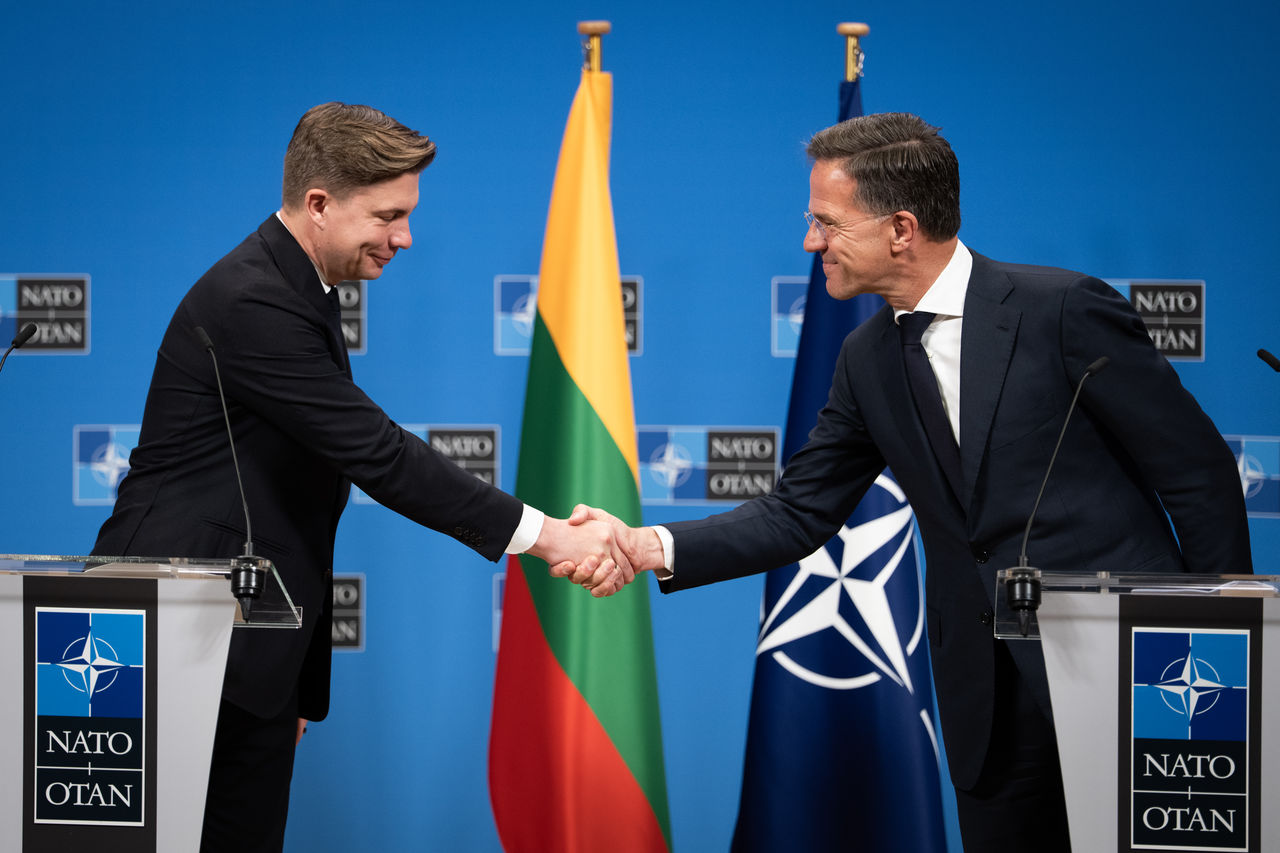
NATO Secretary General Highlights Collective Defense After Drone Incident in Lithuanian Airspace
NATO Secretary General Mark Rutte affirmed the destruction of an unidentified drone that violated Lithuanian airspace by Italian jets operating from Šiauliai Air Base as a clear demonstration of collective defense in action. His remarks followed a meeting with Lithuanian Prime Minister Mindaugas Sinkevičius in Brussels, marking the Prime Minister’s inaugural visit to alliance headquarters in his new role.
During their discussions on Tuesday, Mr. Rutte emphasized the alliance’s unwavering commitment to maintaining NATO’s strength and ensuring Lithuania’s security. “NATO defends every inch of Allied territory, against any threat, from any direction,” he stated, referring to the alliance’s robust presence in the Baltic state. He specifically cited the drone shootdown on September 15 as tangible evidence of this commitment: “This is collective defence in action.”
The incident involved Italian Air Force jets, part of NATO’s Baltic Air Policing mission stationed at Šiauliai, engaging and neutralizing a drone that had entered Lithuanian airspace without authorization. While neither NATO nor the Lithuanian government has publicly attributed the drone to any specific state or revealed its type, the event underscored the heightened security environment in the region and the operational readiness of allied forces. This mission, which has been hosted at Šiauliai since 2004, has historically involved intercepting and escorting Russian aircraft transiting to Kaliningrad; however, the recent drone engagement signifies an evolution in the nature of threats and the operational responses required.
In response to evolving security challenges, particularly the proliferation of unmanned aerial systems, NATO is actively strengthening its integrated air and missile defense capabilities. The alliance is adapting its posture against drone threats through a series of strategic initiatives, including a program known as “Drone Edge.” While specific details regarding the scope and implementation of Drone Edge were not publicly disclosed, it highlights NATO’s focus on countering asymmetric threats and maintaining a technological advantage in modern warfare.
Mr. Rutte also commended Lithuania’s substantial contributions to collective security, referencing the alliance’s significant presence in the Baltic Sea and the Forward Land Forces stationed within the country. He specifically welcomed Lithuania’s considerable investment in developing the Rūdninkai training area, located south of Vilnius, which is being expanded to accommodate these troops, including a full brigade led by Germany.
Highlighting Lithuania’s financial commitment to defense, the Secretary General was unequivocal in his praise. “Lithuania leads by example on defence investment,” he declared. “This year, you are expected to reach 5.38% of GDP for core defence spending. Lithuania doesn’t just meet its commitments; it sets the standards.” This figure is noteworthy, significantly surpassing the alliance’s newly agreed headline target of 3.5 per cent of GDP on core defense by 2035. For context, the Labour Party in the United Kingdom, through Shadow Defence Secretary Wes Streeting, recently reiterated a commitment to meet this 3.5% target, underscoring the ambition of Lithuania’s current spending levels.
Discussions also covered the ongoing conflict in Ukraine, where Mr. Rutte acknowledged Lithuania’s robust and consistent support. He enumerated Lithuania’s commitment of at least 0.25 percent of its GDP annually in military assistance, a contribution of 38 million dollars to the Ukrainian defense industry, and crucial support for Ukraine’s energy infrastructure and railway locomotives. The Secretary General conveyed a strong message regarding the conflict’s trajectory: “Russia is failing. It is failing on the battlefield in Ukraine, and it is failing to undermine our unity and support for Ukraine. Our message to Moscow is clear: we will do even more for Ukraine, not less.”
The Forward Land Forces in Lithuania are a critical component of NATO’s enhanced deterrence and defense posture on its eastern flank. Germany leads this deployment, committing to station a full brigade in the country, a significant strategic move. Similarly, the United Kingdom contributes to this framework further north, leading the multinational battlegroup deployed in Estonia, reinforcing the collective defense strategy across the Baltic states. These deployments are designed to bolster the alliance’s ability to defend its territory and deter potential aggression, reflecting a fundamental shift in NATO’s defense planning since Russia’s full-scale invasion of Ukraine.
Why This Matters
This report underscores several critical developments impacting European security and the operational posture of NATO. Firstly, the drone incident and Secretary General Rutte’s immediate characterization of it as “collective defense in action” is highly significant. It serves as a tangible demonstration of NATO’s Article 5 commitment – an attack on one ally is an attack on all – being put into practice. While the drone’s origin remains unconfirmed, the response illustrates the alliance’s readiness to defend its airspace and territory, signaling a strong deterrent message to any potential aggressor.
Secondly, Lithuania’s exemplary defense spending, projected to reach 5.38% of its GDP, sets an unprecedented benchmark within NATO. This figure not only far exceeds the alliance’s new 3.5% target but also highlights the profound security concerns of frontline states bordering Russia. Lithuania’s commitment reflects a deep understanding of geopolitical realities and serves as a powerful call to action for other allies to increase their own defense investments, ensuring the collective strength and credibility of the alliance in an increasingly volatile security environment.
Thirdly, the ongoing adaptation of NATO’s air and missile defense systems, particularly the focus on countering drone threats through initiatives like “Drone Edge,” reflects the evolving nature of modern warfare. The proliferation of drones, both state-sponsored and otherwise, presents complex challenges for traditional air defense. NATO’s investment in these capabilities signifies a proactive approach to maintaining a technological edge and ensuring the security of allied airspace against contemporary threats.
Finally, the unwavering support for Ukraine, as highlighted by Lithuania’s substantial contributions and Secretary General Rutte’s firm stance against Russia, reinforces the unity and resolve of the international community. The alliance’s commitment to “do even more for Ukraine” sends a clear message to Moscow that aggression will not succeed in undermining democratic principles or the sovereignty of nations. This sustained support is crucial not only for Ukraine’s defense but also for upholding the international rules-based order against revisionist powers.