
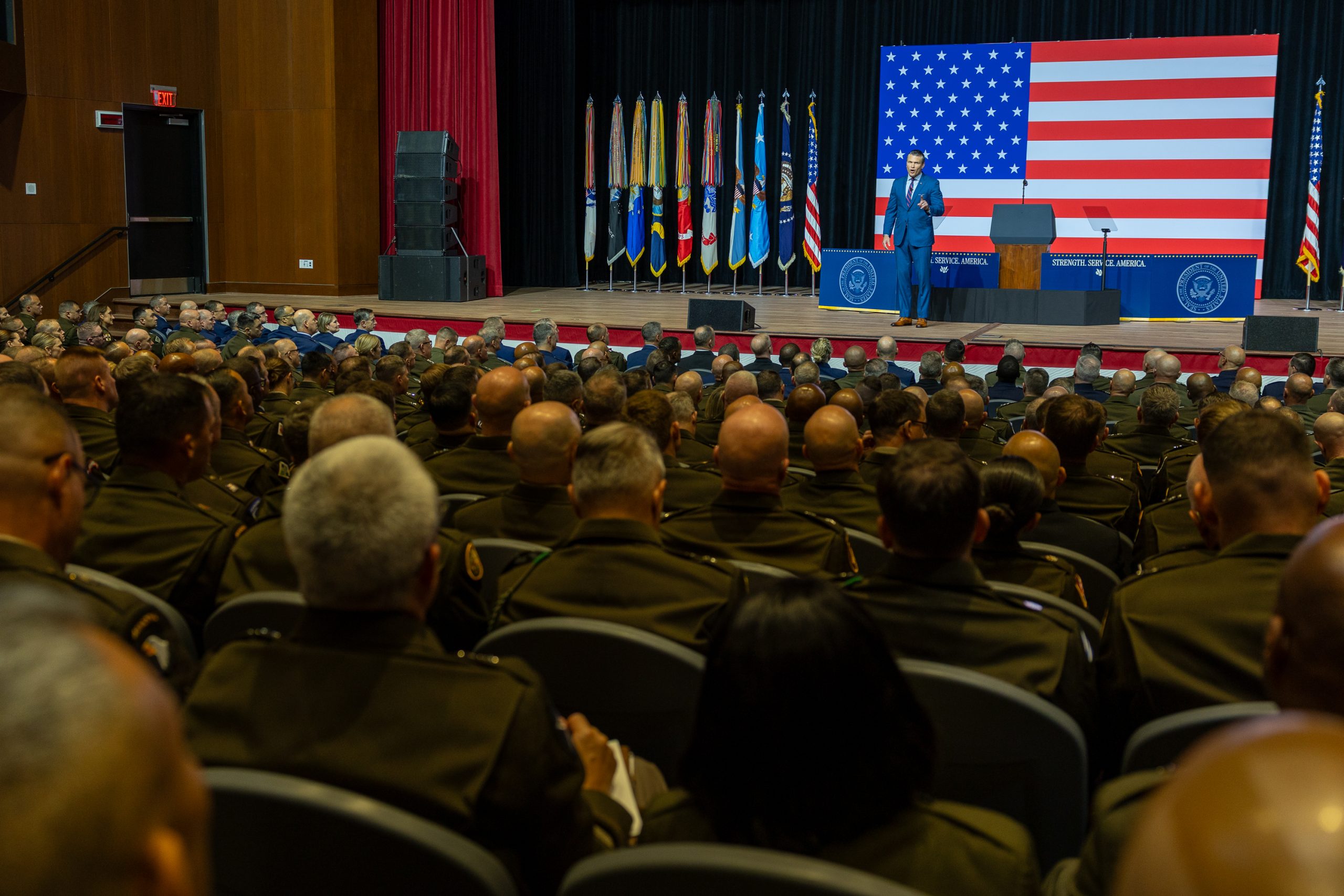
Secretary of Defense Pete Hegseth is scheduled to announce a new directive on September 30, mandating a 20 percent reduction in the number of general and flag officers across the United States military. This information was confirmed by Pentagon officials to Air & Space Forces Magazine.
This upcoming directive represents an expansion of a previous order issued by Secretary Hegseth last year, which called for a 10 percent cut in senior military leadership positions. That initial policy was publicly referred to by the Secretary as “less generals, more GIs,” signaling an emphasis on streamlining the upper echelons of the military and potentially reallocating resources towards enlisted personnel and junior officers.
The announcement is slated to occur during a “State for the Force” address, a significant speech outlining the Secretary’s vision and priorities for the armed forces. The planned reductions will target general and flag officer “billets,” which are authorized positions, rather than necessarily resulting in the immediate removal of 20 percent of currently serving generals and admirals. This approach suggests that the implementation of these cuts may unfold over an extended period as officers rotate out of positions or retire, rather than through abrupt dismissals.
Initial reports regarding these new cuts and the details of the planned announcement were first published by Fox News, with Pentagon officials subsequently confirming the accuracy of these accounts.
The forthcoming “State of the Force” address takes place approximately one year after Secretary Hegseth convened an extraordinary gathering of senior U.S. military leaders from various commands globally. During that unprecedented meeting, the Secretary outlined his overarching philosophy for the management and strategic direction of the Department of Defense.
The military services are expected to implement the mandated reductions by January 1, 2027. Specific details regarding how these cuts will be distributed among the individual branches of the armed forces—the Army, Navy, Air Force, Marine Corps, and Space Force—have not yet been publicly clarified.
General and flag officers constitute a very small fraction of the total military personnel, typically less than 1 percent. According to data compiled by the Congressional Research Service, there were approximately 850 general officer positions authorized in 2023. It is common for some of these authorized positions to be unfilled at any given time, a situation that also applies today.
The maximum permissible number of general officers for each military service is established by federal law. However, these statutory caps do not apply to positions designated as “joint,” meaning those that involve personnel from multiple military branches. Federal law also specifies a minimum number of general officers required to serve in such joint assignments.
By way of example, the Air Force currently maintains a corps of roughly 250 generals. The Space Force, a newer branch, has approximately 30 generals and has previously articulated plans for continued growth in its senior officer ranks to support its evolving mission requirements.
During his address at Quantico a year ago, Secretary Hegseth delivered a pointed message to the assembled ranking military officers and senior enlisted advisors. He stated that “more leadership changes will be made” and critically asserted that “fat generals and admirals” were occupying positions within the Pentagon, suggesting a perception of inefficiency or excess at the highest levels of military command.
These directives have drawn criticism from prominent lawmakers. Senator Jack Reed (D-R.I.), the ranking member of the Senate Armed Services Committee, voiced concerns that the proposed cuts appeared arbitrary and were being pursued without adequate consultation with Congress. Senator Reed also highlighted previous instances where Secretary Hegseth had reportedly removed senior officers from their roles without providing public explanations.
Senator Reed stated, “Efficiency and streamlining in the military are worthy goals, but the size and structure of our military’s senior officer corps are matters in which Congress has a fundamental role.” He further emphasized, “Article I of the Constitution assigns Congress the power to raise and support the armed forces and to make rules for their government. Reshaping the senior leadership of the world’s most powerful military is precisely the kind of decision that requires consultation with and justification to Congress.”
The proposed reductions in the senior officer corps are not the only significant institutional changes being pursued by Secretary Hegseth this week. In a separate memo released by the Pentagon on September 29, the Secretary directed military service academies to eliminate tenured positions for civilian professors. Hegseth justified this move by asserting that “civilian academic norms … dilute our focus on lethality,” suggesting a desire to align academic institutions more closely with the operational priorities of the military.
Critics of this policy change have expressed concerns that efforts to reform the institutions in this manner could potentially compromise the academic independence and the overall quality of education provided at the service academies. These institutions include the U.S. Air Force Academy, the U.S. Naval Academy, and the U.S. Military Academy at West Point. It is notable that the U.S. Air Force Academy (USAFA) had only recently begun offering tenure to its civilian faculty members.
Secretary Hegseth’s own military background includes service as a major in the Army National Guard. He has frequently presented himself as a Pentagon chief who possesses a direct understanding of and strong affinity for the experiences and perspectives of rank-and-file troops.
His previous directive to reduce general officers included specific targets: a 20 percent reduction in active four-star generals, a 20 percent cut in National Guard generals, and a 10 percent overall reduction in general and flag officers. Secretary Hegseth has consistently articulated that these cuts are necessary measures aimed at reducing perceived bureaucratic inefficiencies within the Department of Defense.
Why This Matters:
The directives issued by Secretary of Defense Pete Hegseth concerning the reduction of general and flag officers and the elimination of tenure for civilian professors at military academies carry significant implications for the structure, effectiveness, and educational foundations of the U.S. military. These policies highlight an ongoing debate about military efficiency, leadership development, and the appropriate balance of power between the executive and legislative branches in matters of national defense.
**Impact on Military Leadership and Readiness:** A 20 percent reduction in general and flag officers, following a previous 10 percent cut, represents a substantial reshaping of the military’s senior leadership corps. Proponents argue this could lead to a leaner, more agile command structure, potentially cutting bureaucracy and freeing up resources. Conversely, critics may express concern that such deep cuts could diminish strategic depth, reduce expertise in specialized fields, or strain the remaining senior leadership, potentially affecting the military’s ability to manage complex global operations, innovate, and maintain readiness. The method of implementation—targeting billets over time—suggests a managed transition, but the ultimate effect on leadership pipelines and morale remains to be seen.
**Congressional Oversight and Civil-Military Relations:** Senator Jack Reed’s strong objections underscore a critical constitutional tension. Congress is vested with the authority to raise and support the armed forces and make rules for their governance. Unilateral executive actions that significantly alter the military’s structure, particularly its senior leadership, can be perceived as encroaching on this constitutional prerogative. This friction could lead to legislative pushback, potential funding disputes, or a broader reevaluation of the roles of each branch in military policy, impacting the delicate balance of civil-military relations.
**Academic Freedom and Military Education:** The decision to eliminate tenure for civilian professors at service academies is a departure from established academic norms designed to protect intellectual independence and foster critical inquiry. Hegseth’s rationale, focusing on “lethality,” suggests a desire to align academic institutions more directly with military operational goals. However, critics fear this could compromise the quality of education by deterring top academic talent, stifling diverse perspectives, and limiting critical analysis, all of which are vital for developing well-rounded officers capable of complex strategic thought and ethical decision-making. The long-term consequences for the intellectual rigor and reputation of these esteemed institutions are a key concern.
**Military Culture and Morale:** Secretary Hegseth’s rhetoric, including references to “fat generals and admirals” and the “less generals, more GIs” policy, signals a cultural shift. While intended to resonate with rank-and-file troops, such statements and deep cuts to the senior ranks can also create uncertainty within the officer corps regarding career progression, professional value, and the future of military service. The perception of arbitrary cuts or political influence in military structure could impact recruitment, retention, and the overall professional ethos of the armed forces.
In essence, these directives represent a significant effort to reform the U.S. military’s leadership and educational institutions. Their success will depend on their ability to genuinely enhance efficiency and readiness without inadvertently undermining strategic capacity, academic integrity, or the fundamental principles of civil-military governance.