
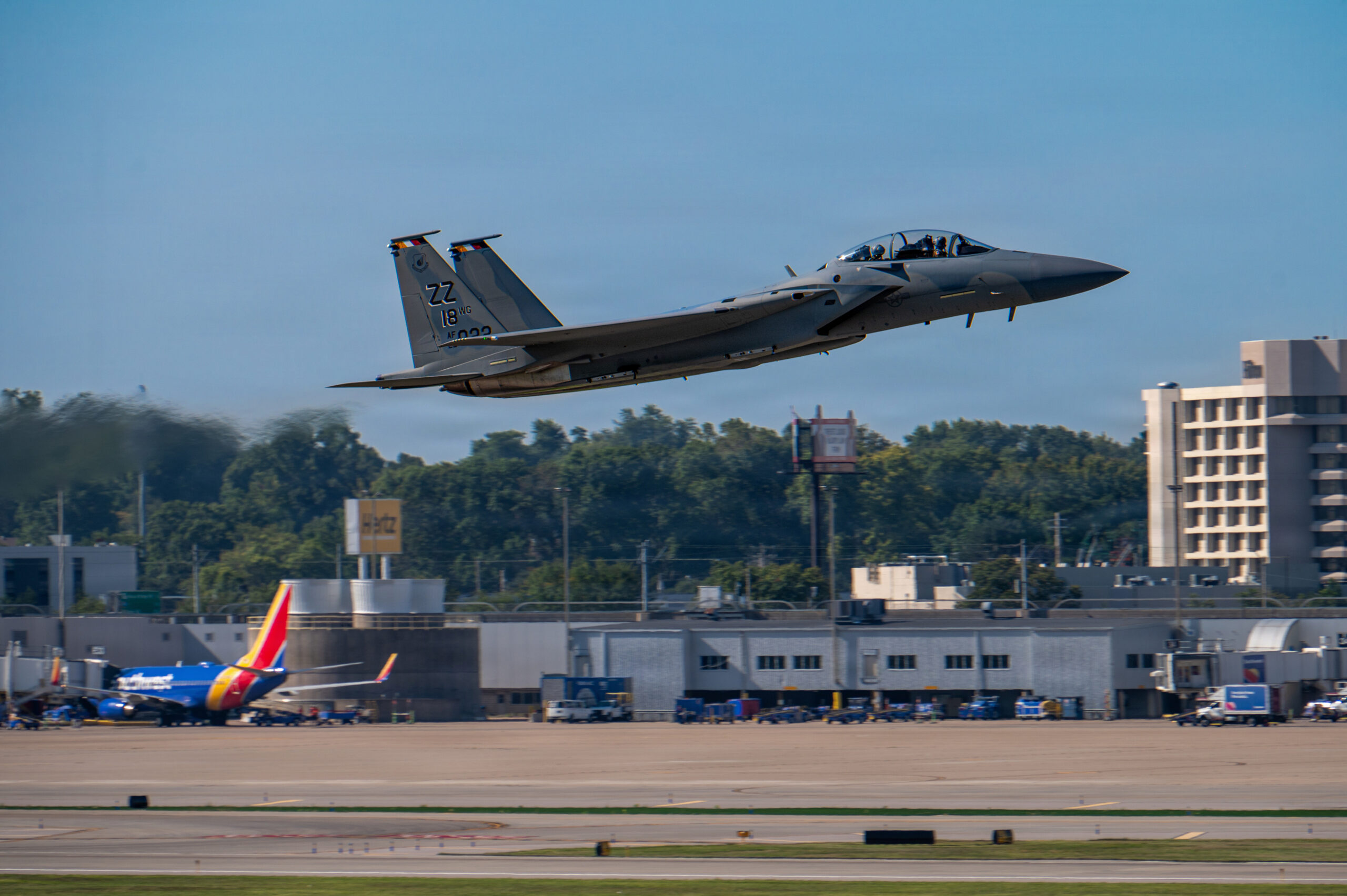
The United States Air Force has officially awarded Boeing a substantial contract valued at $2.38 billion for the procurement of 22 F-15EX Eagle II fighter aircraft. The contract, finalized on September 29, was critical for the Air Force as it enabled the timely utilization of specific funds allocated in a previous legislative reconciliation package, thereby averting a mandated reduction in those funds.
This latest acquisition, designated as Lot 7 within the F-15EX program, increases the total number of F-15EXs currently under contract to 120 aircraft. This development follows a significant adjustment made in April, when the Air Force dramatically expanded its projected total program requirement for the F-15EX, raising it from an initial plan of 129 jets to a more ambitious 269 aircraft.
The F-15EX is presented as a highly modernized iteration of the venerable fourth-generation F-15 fighter, incorporating numerous technological advancements that have led some defense analysts to characterize it as a “4.5 generation” combat aircraft. Its design integrates state-of-the-art systems aimed at enhancing its operational capabilities and extending its service life well into the future.
Key upgrades featured in the F-15EX Eagle II include a sophisticated digital fly-by-wire flight control system, a contemporary all-glass touchscreen cockpit for improved pilot interface, and the advanced APG-82 active electronically scanned array (AESA) radar. Furthermore, the aircraft is equipped with the Eagle Passive Active Warning Survivability System (EPAWSS), a comprehensive and integrated electronic warfare suite designed to enhance the jet’s survivability in contested airspace by detecting, identifying, and countering threats.
The funding mechanism for Lot 7 involved a combination of appropriations: $115 million sourced from the fiscal year 2026 budget and a significant $2.8 billion from the “One Big Beautiful Bill Act,” a reconciliation package passed in the preceding year. A crucial stipulation attached to the funds from the reconciliation bill dictated that any unspent amounts by October 1, 2026, would be subject to an 8.3 percent reduction. This provision created an imperative for the Air Force to finalize the contract before the conclusion of the fiscal year on September 30, thereby avoiding the loss of allocated funds.
In a public statement regarding the contract award, the Air Force underscored its successful navigation of these financial and temporal constraints. The statement highlighted the “extensive collaboration among program management, contracting, pricing, engineering, financial management, logistics and other acquisition professionals.” It further elaborated that “the team assessed the impacts of changing production conditions and inflation, aligned the aircraft procurement with available funding, and completed the action before the fiscal-year deadline,” emphasizing the complex coordination required for such a large-scale defense acquisition.
Based on the $2.38 billion contract value for 22 aircraft, the average unit cost for each F-15EX works out to approximately $108 million. It is important to note that this figure exclusively covers the airframe and associated systems, as the engines for these aircraft are procured separately by the Air Force from GE Aerospace.
Boeing, in its own statement, confirmed that it is actively delivering aircraft from Lot 3 of the program and anticipates continuing these deliveries through the remainder of the current year. The company also indicated that it is engaged in discussions with the Pentagon regarding an increase in its production rate for the F-15EX, with an aim to achieve a monthly output of two aircraft, signaling a commitment to meet the Air Force’s expanded program requirements.
Coincidentally, the announcement of this F-15EX contract occurred on the same day that the U.S. Navy revealed its selection of Boeing to develop its next-generation air dominance fighter, known as F/A-XX. This dual success positions Boeing as a dominant force in the defense aerospace sector, securing its role in both the Air Force’s and Navy’s future fighter aircraft initiatives, encompassing both advanced fourth-generation and nascent sixth-generation platforms.
Why This Matters
The award of this F-15EX contract carries significant implications across various dimensions, from national defense strategy to the dynamics of the defense industrial base and the complexities of federal budgeting.
**National Defense Strategy and Air Superiority:** The F-15EX plays a crucial role in the U.S. Air Force’s strategy to maintain a robust and adaptable air superiority fleet. While the Air Force continues to invest heavily in fifth-generation stealth fighters like the F-35 and is actively pursuing sixth-generation capabilities, the F-15EX offers complementary strengths. Its impressive payload capacity, high speed, and advanced electronic warfare systems make it particularly valuable for missions where stealth is not the primary requirement, or as a “munitions truck” capable of carrying a large array of weapons and sensors. This layered approach ensures the Air Force possesses a versatile set of tools to address a broad spectrum of global threats and maintain a decisive advantage in the air.
**Defense Industrial Base and Economic Impact:** This multi-billion dollar contract represents a substantial commitment to the American defense industrial base. It directly supports Boeing and its extensive network of suppliers and subcontractors across the country, securing numerous high-tech manufacturing jobs and fostering innovation within the aerospace sector. Such large-scale defense procurements have significant ripple effects on the economy, stimulating research and development, strengthening supply chains, and contributing to workforce development in critical engineering and manufacturing fields. It underscores the government’s role in sustaining strategic industries vital for national security.
**Budgetary Pressures and Fiscal Accountability:** The urgency surrounding the contract’s finalization, driven by the “use-it-or-lose-it” clause tied to the reconciliation bill funds, highlights the intricate and often challenging nature of federal defense budgeting. This scenario exemplifies the complex interplay between legislative intent, fiscal year deadlines, and the operational requirements of the military. It draws attention to the intense scrutiny placed on defense spending and the emphasis on efficient procurement processes to ensure taxpayer money is obligated within mandated timelines and without reduction, reinforcing principles of fiscal accountability.
**Modernization and Technological Advancement:** The F-15EX program is a prime example of modernizing a legacy platform with cutting-edge technology. By integrating advanced digital flight controls, AESA radar, and sophisticated electronic warfare suites into a proven fourth-generation airframe, the Air Force can rapidly field enhanced capabilities. This strategy allows for significant upgrades at a potentially lower cost and faster pace compared to developing an entirely new aircraft from scratch. The continuous advancement of electronic warfare systems like EPAWSS is particularly vital in an era characterized by increasingly sophisticated anti-access/area denial (A2/AD) capabilities deployed by potential adversaries, aiming to ensure U.S. aircraft can operate effectively in highly contested environments.
**Strategic Competition in a Global Context:** In an era of renewed great power competition, particularly with nations like China and Russia, maintaining a technological and numerical edge in air combat is paramount. The F-15EX contributes to this strategic imperative by providing a highly capable and adaptable platform that can operate both independently and in conjunction with stealth assets. Its ability to carry a large weapons load and potentially act as a command-and-control node for unmanned systems in future collaborative combat scenarios makes it a critical asset in high-intensity conflicts. The strategic decision to increase the total program from 129 to 269 aircraft signals a long-term commitment to the F-15EX as a cornerstone of future U.S. airpower projection.
**Boeing’s Strategic Market Position:** The fact that Boeing secured both the F-15EX contract and the selection for the Navy’s F/A-XX next-generation fighter program on the same day significantly solidifies the company’s strategic position in the defense aerospace market. This dual victory establishes Boeing as a dominant player across both advanced fourth-generation and the nascent sixth-generation fighter programs. This could have profound long-term implications for competition within the defense sector, influencing future innovation, design philosophies, and market share for decades to come, while also raising questions about competition and diversification within the industrial base.