
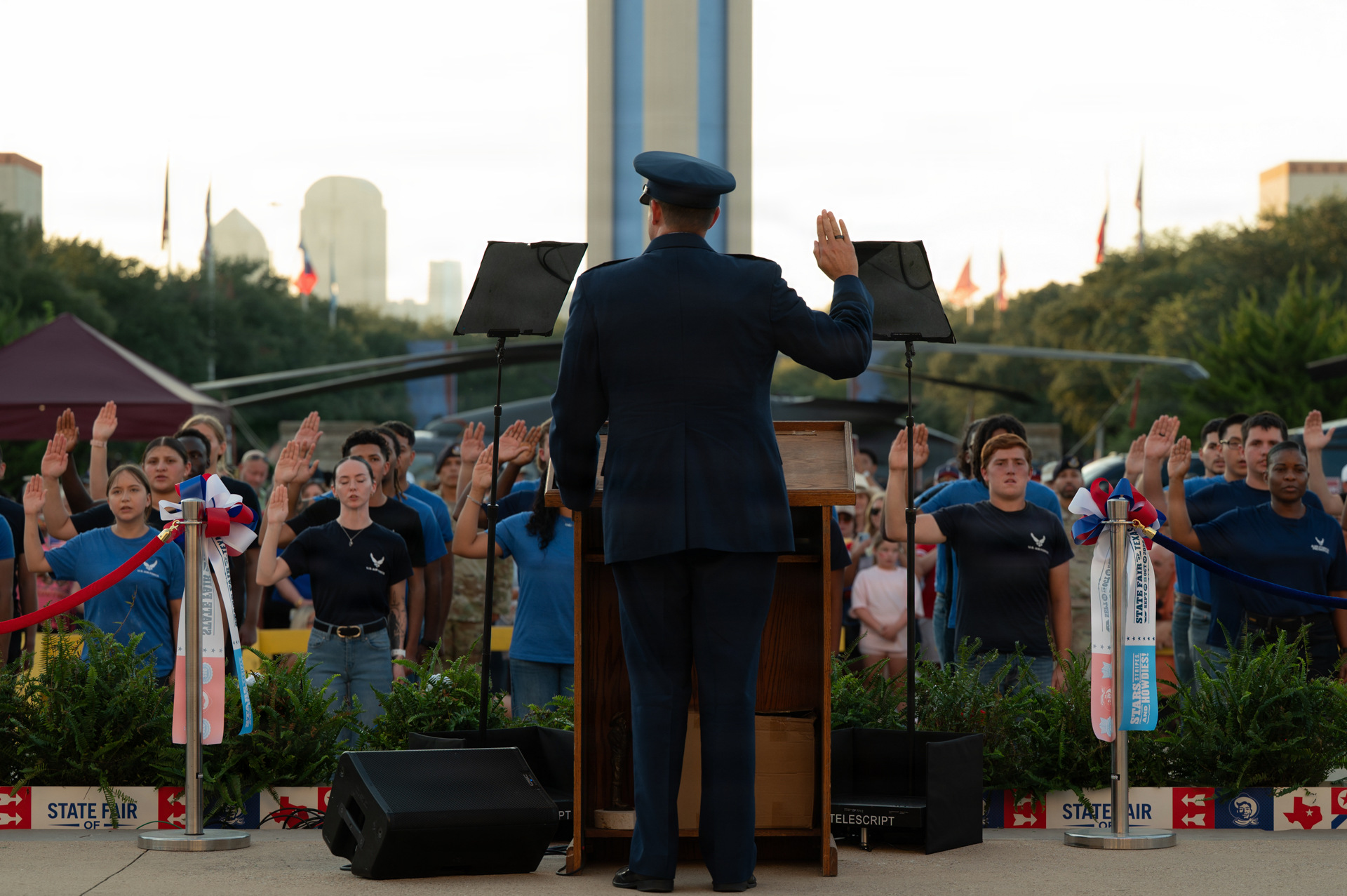
The U.S. Air Force has adjusted its recruiting target for Fiscal Year 2026 downward by several hundred enlisted personnel, a move primarily driven by higher-than-anticipated retention rates among current service members and limitations in available training slots. Despite this revision for the current fiscal year, the Air Force is setting an ambitious recruitment goal for Fiscal Year 2027, aiming for its largest intake of active-duty Airmen in nearly 25 years. Concurrently, the U.S. Space Force has announced its most substantial recruitment target to date, signaling a significant expansion for both branches.
In an official statement released on October 1, the Air Force Recruiting Service (AFRS) announced it had successfully met its recruiting objectives for Fiscal Year 2026. The service reported enlisting 31,950 Airmen into the Air Force and 730 Guardians into the Space Force. This figure for the Air Force represents a reduction of 800 recruits from the 32,750 target initially cited in April, when the service had celebrated achieving its goal five months ahead of schedule.
A spokesperson for Headquarters Air Force clarified that the adjustment to the Fiscal Year 2026 goal occurred over the summer. This revision was a response to the “realities” of increased retention and constraints on the capacity of Basic Military Training (BMT) facilities. Each year, Congress authorizes a specific “end strength” for every military service, which represents the total number of personnel permitted. If the rate at which existing service members choose to remain in uniform exceeds projections, the need for new recruits to maintain the authorized end strength decreases. Additionally, the number of individuals who can be processed through BMT at any given time can be limited by available resources, instructors, and training schedules.
The Air Force spokesperson emphasized that recruits were not dismissed but rather transitioned into the Delayed Entry Program (DEP). The DEP serves as a pool for individuals who have committed to joining the military but are awaiting their scheduled start date for Basic Military Training. As of the current period, there are 15,799 recruits in the DEP, providing the Air Force Recruiting Service with a substantial backlog. This reservoir of future Airmen is expected to be a critical asset as the service prepares for its ambitious Fiscal Year 2027 recruitment drive.
For Fiscal Year 2027, an Air Force spokesperson confirmed significantly higher targets. The goal for non-prior service enlisted Airmen for the active-duty force is set at 36,300. This marks the first time since 2003 that the Air Force’s recruiting goal has exceeded 35,000, according to historical data. Similarly, the Space Force has established an unprecedented target of 1,402 enlisted Guardians, a substantial increase from its previous highest goal of 900 new Guardians since its establishment.
These heightened recruitment targets align with broader pronouncements from military officials regarding a surge in interest among potential recruits. The Pentagon has also outlined plans for a substantial increase in overall end strength and resources across the armed forces. In April, Pentagon Comptroller Jules “Jay” W. Hurst III articulated this strategy, stating, “In [Fiscal Year 2027], we will grow the force again by an additional 44,000 service members. This growth will provide the manpower needed to employ new capabilities, and it will improve readiness and quality of life by ensuring units are properly staffed for the missions we task them with.”
Specifically, the Air Force aims to increase its active-duty end strength by nearly 9,000 personnel, growing from 321,500 Airmen to 330,400. The Space Force projects an even more significant percentage increase, planning to add 2,800 Guardians, thereby expanding its force from 10,400 to 13,200.
To achieve these ambitious goals for Fiscal Year 2027, the Air Force Recruiting Service has indicated it will adapt its strategies. These adjustments will be informed by analyses of prevailing labor market trends, data on the propensity of individuals to serve in the military, and specific demand signals for various career fields within the services. During a panel discussion at AFA’s Air, Space & Cyber conference last month, Lt. Gen. Jefferson O’Donnell, the Air Force Deputy Chief of Staff for manpower, personnel, and services, provided further insight. He clarified that much of the anticipated growth would be more “restorative” than “additive.” This means the focus will be on reversing previous declines in manning for crucial career fields that have faced shortages. “We are focused on making sure that we are prioritizing those things like maintenance and logistics and security forces to fill in those spots where we have been taking significant risk across our service,” O’Donnell explained, highlighting the intent to bolster critical support and operational functions.
Why This Matters
The recruitment goals and adjustments for the U.S. Air Force and Space Force carry significant implications for national security, military readiness, and the broader socio-economic landscape. The decision to scale back Fiscal Year 2026 enlistments due to higher retention and training limitations underscores the dynamic nature of military force management. High retention, while reducing immediate recruitment needs, indicates that current service members are choosing to continue their careers, potentially reflecting job satisfaction, competitive benefits, or a stable career path in an uncertain economic climate. However, it also highlights the physical and logistical constraints of the military’s training infrastructure, which must adapt to fluctuating personnel flows.
The ambitious targets set for Fiscal Year 2027 are a clear signal of the Pentagon’s strategic intent to expand the U.S. military’s overall end strength. For the Air Force, the largest recruiting goal in nearly a quarter-century reflects a need to modernize and expand its capabilities in an increasingly complex global environment. This includes integrating new technologies, maintaining an aging fleet, and preparing for future conflicts. For the Space Force, its unprecedented recruitment target signifies a rapid build-up of its personnel as it solidifies its role as a critical domain for national defense and economic activity. A larger, well-trained force is deemed essential for enhancing military readiness, ensuring units are adequately staffed, and providing the human capital necessary to operate and maintain advanced weapon systems and technologies.
Furthermore, Lt. Gen. O’Donnell’s emphasis on “restorative” growth highlights a critical focus on addressing long-standing manning shortfalls in essential career fields such as maintenance, logistics, and security forces. These roles are foundational to the effective operation and deployment of military assets. Adequately staffing these areas is crucial for reducing operational risks, improving quality of life for service members through better workload distribution, and ensuring the overall efficacy of military operations. Failure to fill these critical gaps can lead to equipment readiness issues, prolonged deployment cycles, and increased stress on personnel.
From an economic perspective, military recruitment campaigns represent a significant investment in human capital. These efforts provide career opportunities, advanced technical training, and educational benefits to thousands of young Americans each year. A robust recruiting effort also contributes to the national economy through direct employment, training programs that develop marketable skills, and the subsequent reintegration of veterans into the civilian workforce. The planned expansion of 44,000 service members across the Pentagon will require substantial budgetary allocations for salaries, benefits, training, and infrastructure, impacting federal spending and tax policy.
Ultimately, these recruitment trends are vital indicators of the U.S. military’s strategic direction and its capacity to meet future national security challenges. They reflect an ongoing assessment of geopolitical realities, technological advancements, and the need to maintain a competitive edge against potential adversaries. The success or failure in meeting these recruitment goals will directly influence the nation’s ability to project power, deter aggression, and respond to crises effectively, making these figures far more than mere statistics—they are a barometer of America’s defense posture.